Corporate Failure Knowledge Base
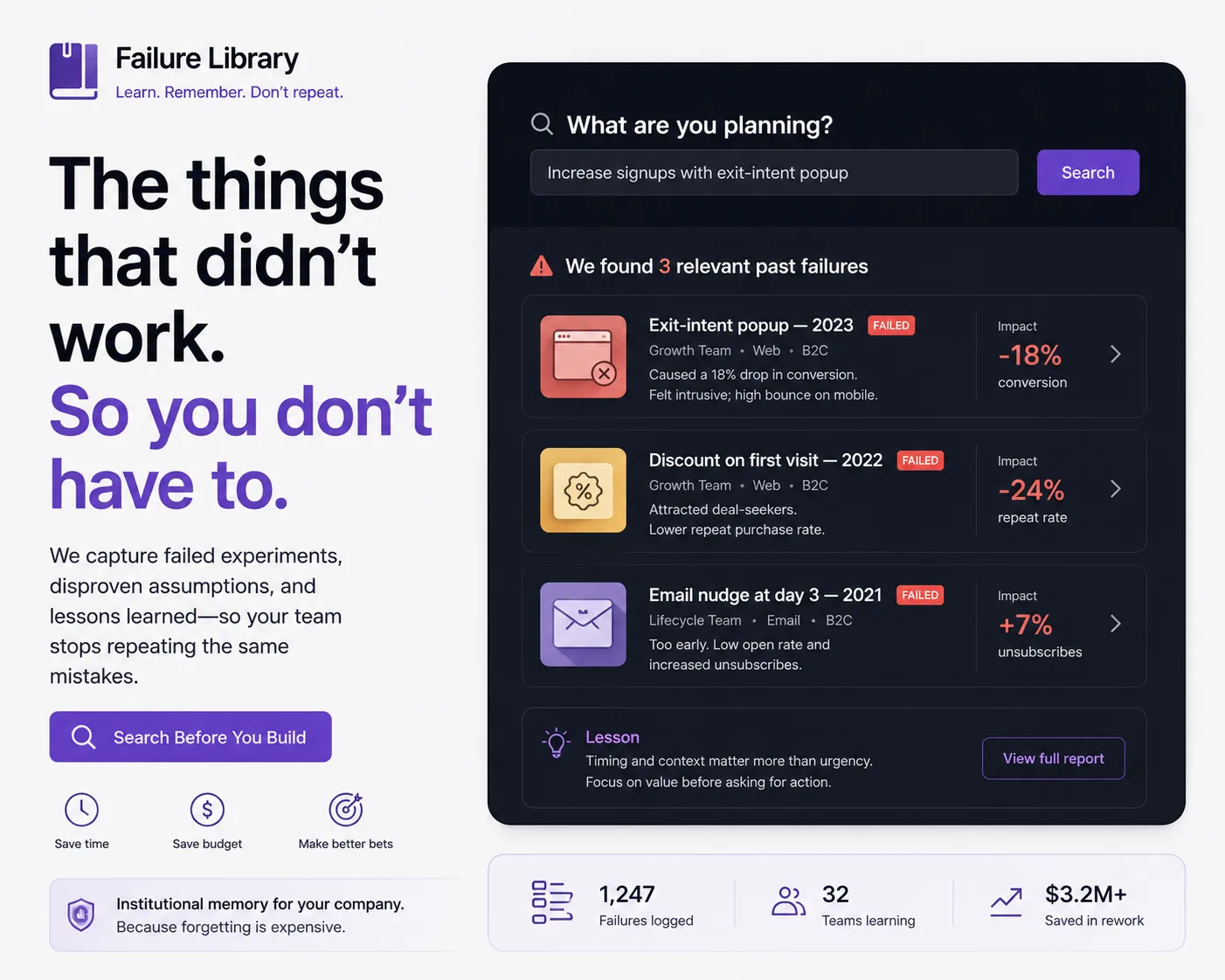
Companies document what worked far better than what didn't. Employees leave, experiments disappear into old decks, and five years later another team unknowingly tests the same failed assumption. Failure Library would build an institutional memory specifically around disproven ideas. Before a company launches a product, campaign, pricing change or experiment, it searches the underlying hypothesis against everything the organization has previously tried and surfaces relevant failures, conditions and evidence. The valuable corporate knowledge isn't always knowing what to do. Sometimes it's remembering what you've already learned not to do.
Description
No additional description provided.
The Pitch
A company’s most expensive knowledge is often stored in the least reliable format: the memory of people who were in the room. Successes get turned into case studies because they are politically useful; failures are softened, reframed, or allowed to vanish because they are socially awkward. That creates a strange asymmetry inside large organizations: the lessons most likely to prevent waste are the least likely to survive.
The business is compelling because repeated failure is not usually caused by stupidity, but by institutional amnesia. A new team inherits the same market, the same customer constraints, the same channel dynamics, and the same internal incentives, but not the scar tissue. In a company with thousands of employees, even a modest reduction in duplicated experiments could be worth more than a large productivity tool, because it prevents entire teams from spending quarters proving something the organization once knew.
The deeper insight is that failures become more valuable as companies grow. A startup can rely on shared context because everyone remembers the painful mistakes. A large company cannot. Its scale turns forgotten negative evidence into a recurring tax. The bigger and more distributed the organization, the more likely that one group’s hard-won lesson is invisible to another group that needs it. This makes the library more useful precisely where the cost of coordination is highest.
There is also a cultural wedge hidden inside the product. Most companies say they want learning cultures, but they reward clean narratives. A system that captures failed hypotheses without turning them into blame changes the status of failure from embarrassment to asset. The important unit is not “who was wrong,” but “under what conditions was this assumption disproven?” That framing makes candor easier because it converts failure from a personal event into reusable evidence.
The strongest version of this business would not be a graveyard of bad ideas. It would become a map of the company’s accumulated judgment. Over time, it could show which beliefs have been tested repeatedly, which assumptions were only false under past conditions, and which “new” ideas are actually old ideas wearing new language. In knowledge work, originality is often overrated; remembering accurately may be the rarer advantage.