Corporate Budget Fit Analysis Tool
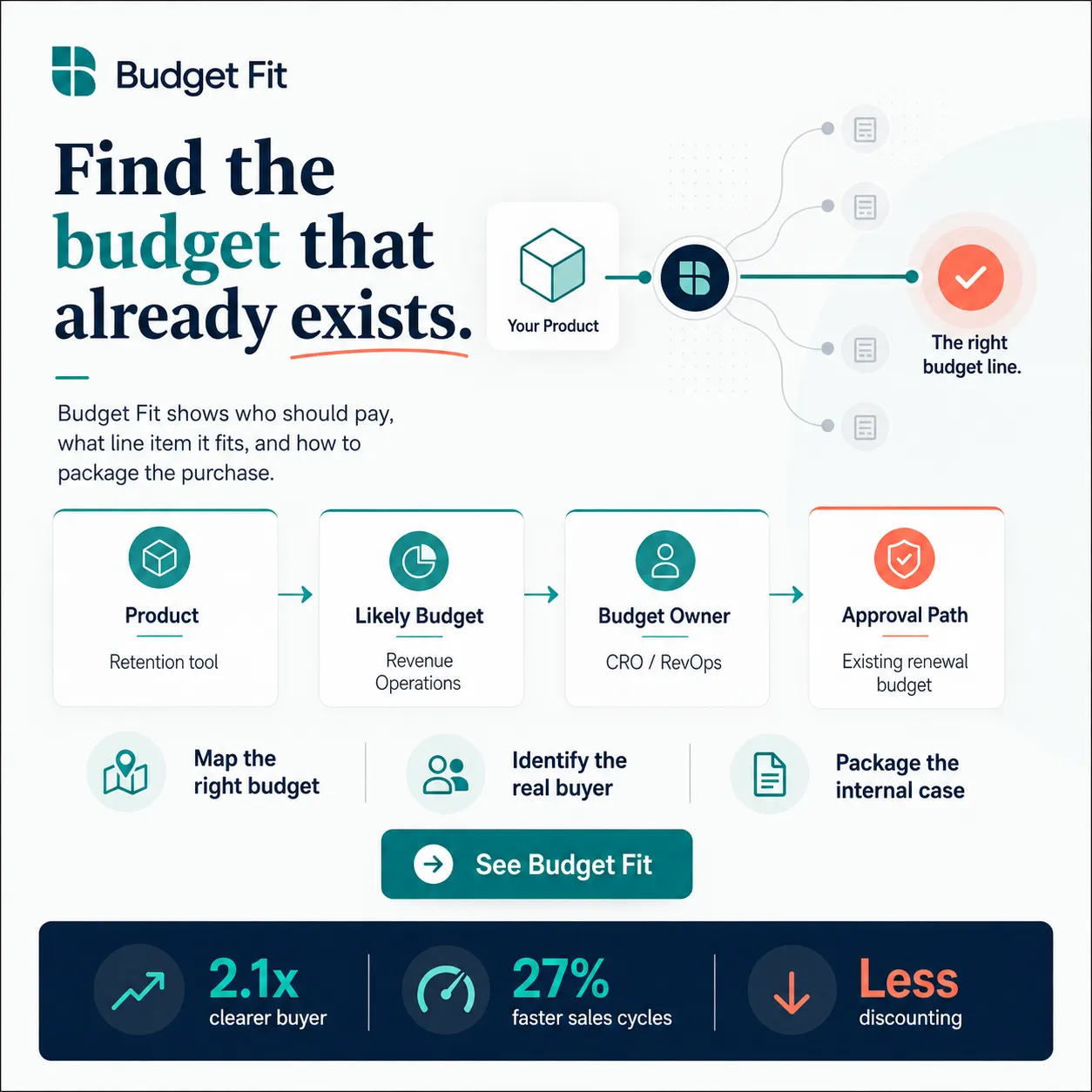
A company enters its product, price, buyer, user and claimed outcome. Budget Fit tells it which existing corporate budget line is most likely to own the purchase, what comparable spend already sits there, who typically controls it and how the product should be packaged to fit. Why now: companies waste months selling into functions with interest but no authority, while public job, software and organizational data make budget ownership more inferable than it used to be. Example: a $25K product aimed at customer success gets reclassified as a revenue-retention tool funded from sales operations, with the right economic buyer, approval threshold and internal ROI framing.
Description
No additional description provided.
The Pitch
Budget ownership is one of the most important facts in B2B selling, yet it is usually discovered socially, late, and expensively. Companies spend weeks proving that someone has a problem, only to learn that the person has no natural place to pay for the solution. A system that maps a product to an existing budget line would turn a hidden organizational constraint into something legible before the first sales motion is designed.
The non-obvious insight is that companies rarely buy in the language vendors use to describe themselves. They buy through inherited accounting categories, departmental habits, approval thresholds, and comparisons to things they already pay for. A product may be “AI workflow automation” to its maker, but inside the buyer it becomes training, headcount avoidance, compliance tooling, sales productivity, or outsourced services replacement. The same software can feel either impossible to fund or obvious to approve depending on which budget story it enters.
This would be especially valuable because budget fit changes positioning more than copywriting does. Most messaging tools help a company sound clearer; this would help it become purchasable. If the right comparison is not another startup but an agency retainer, an internal analyst, a software seat expansion, or a required audit process, the entire sales conversation changes. The buyer is no longer being asked to create a new category of spend; they are being asked to reallocate from a familiar one.
There is also a data advantage hiding in plain sight. Job postings reveal which teams are expanding, software review data shows what tools sit together, org charts imply authority, procurement language exposes categories, and public case studies show which outcomes companies attach to which functions. None of these sources perfectly names a budget owner, but together they can make an informed guess that is better than a founder’s intuition or a sales team’s anecdotes.
The business works because being wrong about budget is not a small error; it distorts the product, the buyer, the price, and the proof required. A tool that prevents that mistake would sit upstream of marketing and sales, but its value would be felt in fewer dead conversations, shorter cycles, and products that are framed in the economic language companies already understand. Its power is not in predicting demand, but in identifying where demand can actually become a purchase.