Contract Compliance Runtime for Enterprise AI Agents
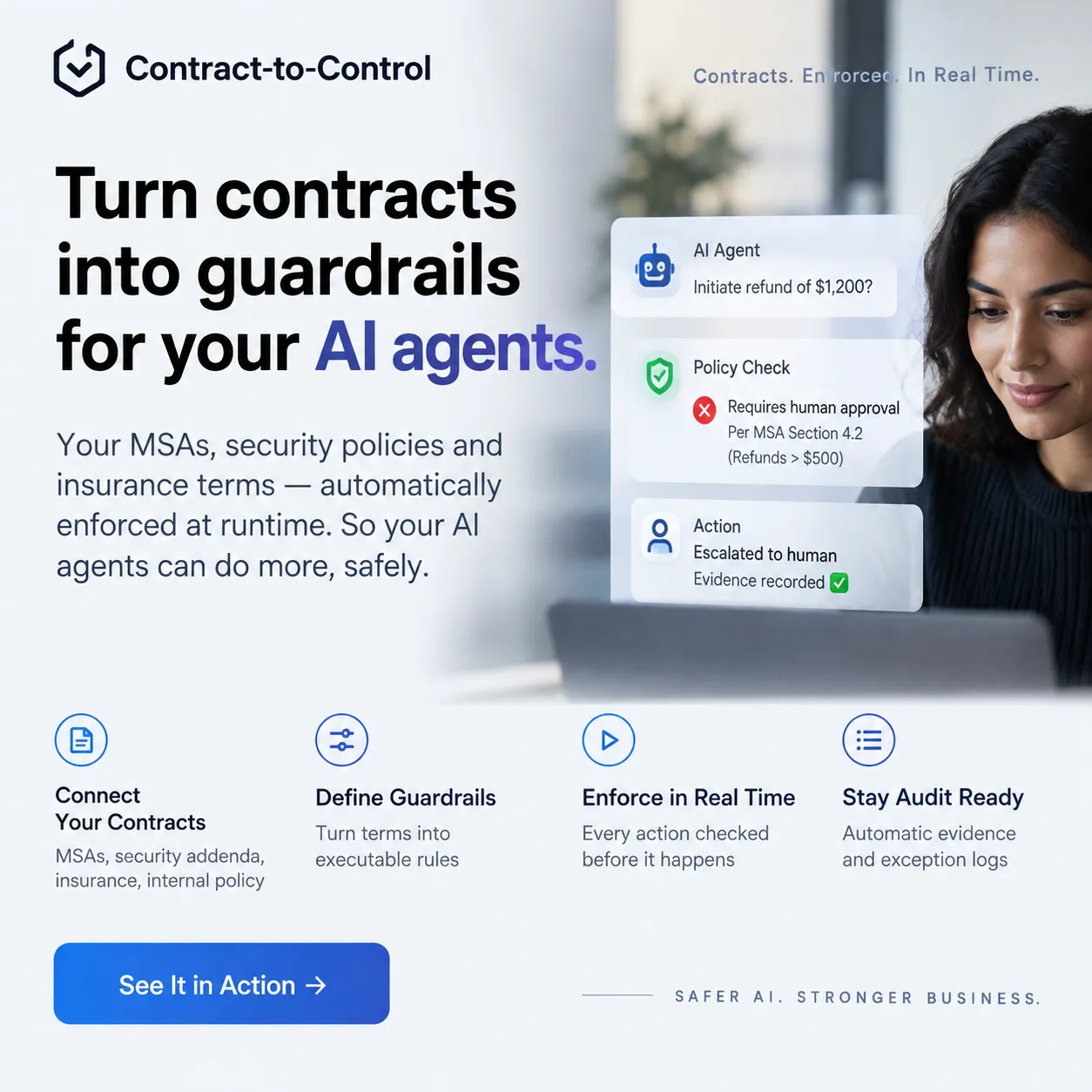
An enterprise can spend weeks negotiating what an AI agent is allowed to do, then enforce those rules somewhere completely different. The contract might say refunds above $500 need human approval, certain records cannot leave the system, or specific actions are excluded from insurance. Engineering then recreates those restrictions through permissions, tool scopes and custom code, and the two versions can drift. Build a contract-to-control layer that turns the MSA, security addendum, insurance conditions and internal AI policy into executable rules for the agent itself. Every consequential action is checked against the policy in force at that moment, with exceptions routed for approval and evidence recorded automatically. As agents get authority to actually do work, contracts increasingly need to become part of the runtime.
Description
No additional description provided.
The Pitch
This treats contracts not as paperwork around software, but as part of the software’s operating environment. That becomes much more important when the “user” is no longer a human employee making judgment calls, but an agent executing thousands of small decisions at machine speed. In that world, the contract is not merely a legal fallback after something goes wrong; it is the clearest artifact the enterprise has for describing what the agent is and is not allowed to do.
The non-obvious advantage is that legal language is often the most durable source of enterprise intent. Product requirements change, permission systems are scattered, and internal policy pages go stale, but signed agreements tend to capture the real constraints that matter because money, liability, and customer trust depend on them. If those constraints can be made executable, the business becomes a kind of translation layer between institutional memory and machine action. That is valuable precisely because enterprises already have the rules; the hard part is preventing those rules from being reinterpreted inconsistently across legal, security, procurement, and engineering.
This also sits at a painful boundary no single existing system owns. Contract lifecycle tools know what was agreed, but not what the agent is doing. Identity systems know who or what has access, but not whether a particular action violates an indemnity clause or customer-specific restriction. Observability tools know what happened, but usually after the fact. A runtime control layer that can answer “is this permitted under the current agreement?” occupies a more consequential position than another dashboard: it becomes the checkpoint where commercial promises are converted into operational behavior.
The business becomes stronger as AI adoption matures because the cost of ambiguity rises with autonomy. A chatbot giving a bad answer is a support problem; an agent issuing credits, changing records, contacting customers, or triggering transactions can create contractual breach, regulatory exposure, and insurance disputes. Companies will not want every edge case escalated to lawyers, but they also cannot rely on engineers to manually encode every obligation buried in negotiated documents. The valuable product is not just automation; it is confidence that delegated authority has boundaries.
If this existed, it could become the system of record for what an enterprise’s agents are allowed to do in the real world. That is a rare position: close enough to the contract to understand liability, close enough to the runtime to prevent mistakes, and close enough to the audit trail to prove what happened. As AI agents move from answering questions to exercising discretion, enforceable permission will matter as much as capability.