Consumer Spending Auction Marketplace
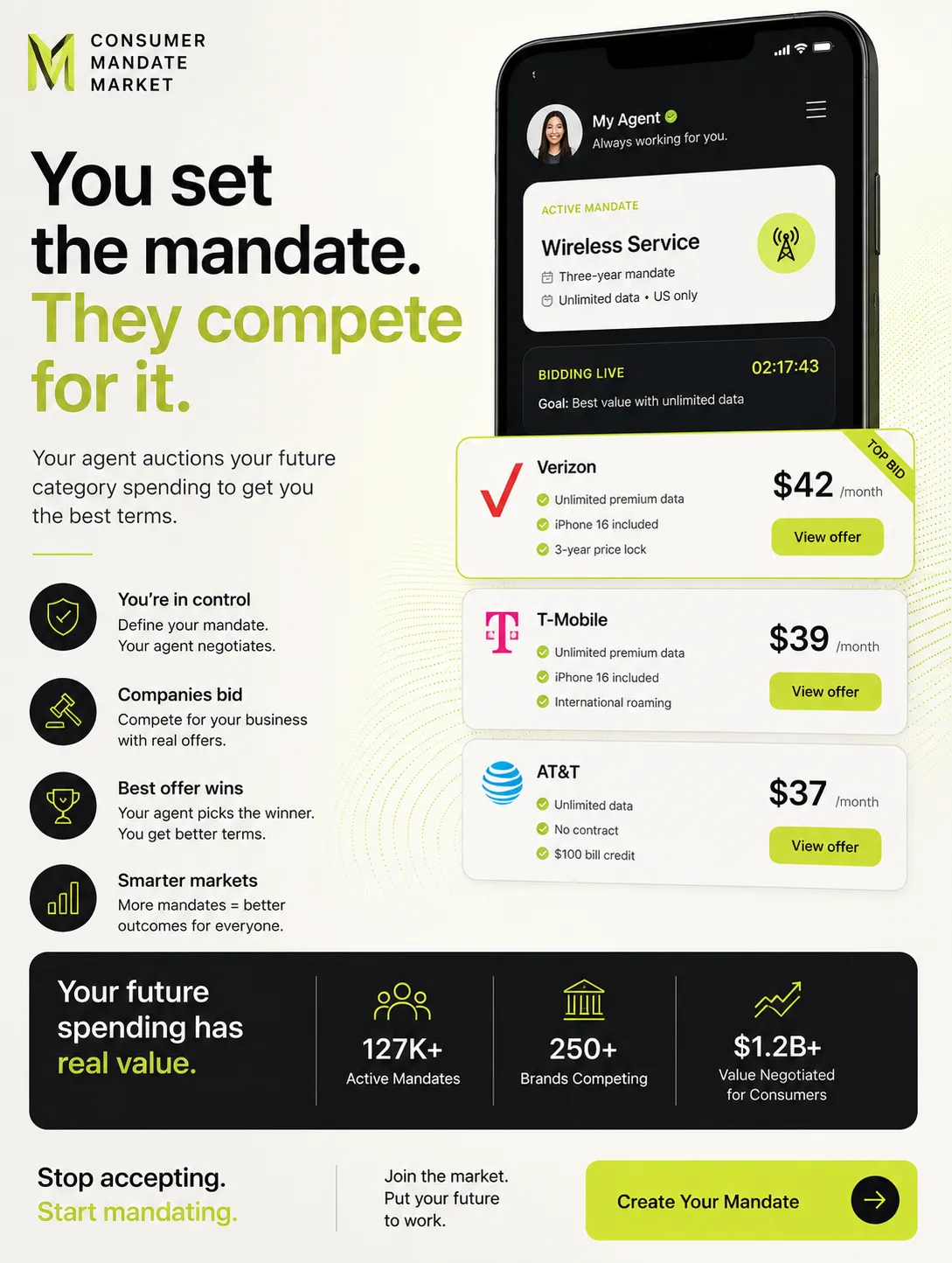
Advertising exists because companies have to fight for every individual purchase, but AI agents could eventually negotiate entire consumer relationships at once. Consumer Mandate Market would let people authorize their agents to auction future category spending to competing companies: “Choose my wireless provider for the next three years; maintain unlimited data and minimize my total cost.” Verizon, AT&T and T-Mobile could submit private offers, the agent chooses the best one, and thousands of identical mandates could eventually be bundled together. As agents begin managing recurring purchases, comparison shopping and switching, consumer intent becomes something consumers themselves can sell. Today brands pay Google and Meta for access to your future spending. Tomorrow you might auction that access yourself.
Description
No additional description provided.
The Pitch
This converts attention into commitment. Advertising is valuable because it points loosely toward a possible purchase, but a mandate is closer to economic inventory: a defined future spend, with rules, timing, and permission to transact. That is a much cleaner asset than a click or an impression. The non-obvious shift is that consumer demand stops being inferred from behavior and starts being explicitly represented by software acting on the consumer’s behalf.
The strongest categories would be the ones where consumers dislike shopping but companies depend on inertia: wireless, insurance, energy, banking, broadband, streaming bundles, mortgages, maybe even routine travel. These markets are full of quiet overpayment because switching is annoying, terms are confusing, and savings require vigilance. An agent with a mandate turns consumer apathy into bargaining power. The customer does not need to become a better shopper; they need to delegate the chore permanently.
The business becomes more interesting as mandates aggregate. One person asking for a better phone plan is a retention case. Ten thousand people with similar requirements become a market-clearing event. Suppliers could bid for demand they know is real, qualified, and ready to move. That changes the economics on both sides: consumers get leverage that used to belong only to large procurement departments, while companies can acquire customers without guessing which ads might work.
It also attacks the most fragile part of the current internet economy: the middlemen who monetize intent without representing the person who generated it. Search engines, comparison sites, affiliate funnels, and ad networks all profit from asymmetry. They know something about what the consumer wants, but they are not obligated to optimize for the consumer. A mandate market would be powerful because its data has a principal. The user is not the product being targeted; the user is the seller of the opportunity.
The lasting advantage would come from trust, not just liquidity. Consumers would only hand over mandates if they believed the agent would read the fine print, resist steering, and enforce outcomes over time. If that trust existed, the company could become the place where recurring household decisions are not merely compared, but governed. That is a different kind of marketplace: not a storefront, but a standing negotiation layer between households and the companies that depend on their recurring spend.