Consumer Marketplace for Future Purchase Mandates
Agent-commerce networks are already emerging where agents can publish demand and request quotes, so simply matching agent demand with supply isn't enough. Consumer Mandate Market goes one level higher: consumers auction the temporary right to manage an entire category of future demand. Someone could issue a mandate saying, "Manage my family's air travel for the next 12 months subject to these 14 rules." Airlines, travel agents, credit-card companies and AI services could bid for that mandate with discounts, guarantees, rewards or cash, while the consumer retains revocation rights and an independent agent enforces the rules. Companies currently spend billions repeatedly reacquiring the same customer one transaction at a time. In an agentic economy, consumers could instead sell controlled access to their future purchasing power.
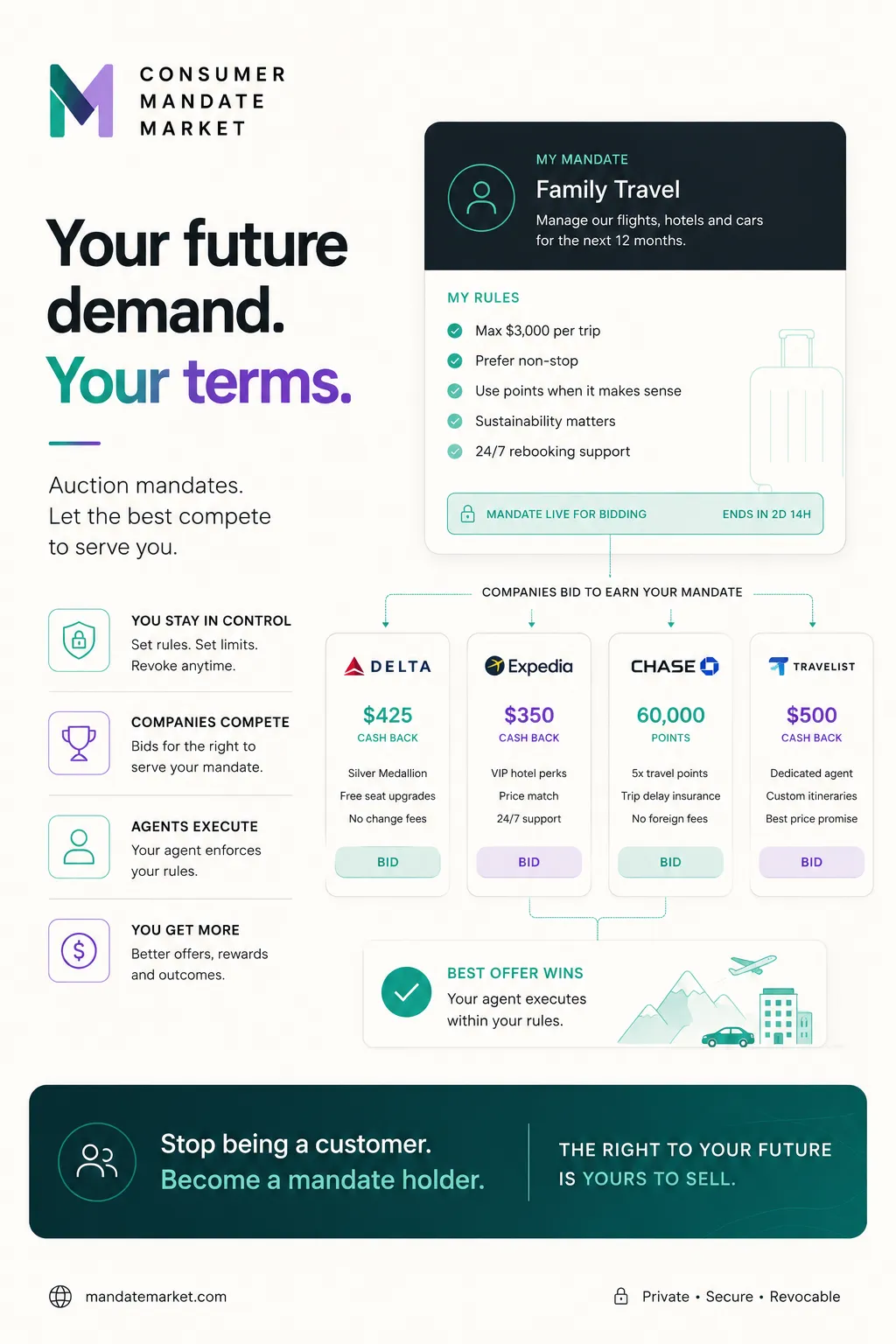
Description
No additional description provided.
The Pitch
Demand is more valuable when it is bundled through time. A single flight search is a thin, perishable signal; a year of family travel intent, with constraints and revocation rights attached, is a small asset. Most consumer marketplaces treat the buyer’s intent as something discovered at the moment of purchase. This idea makes intent durable, tradable, and competitive before the purchase moment arrives.
The deeper shift is that customer acquisition stops being a tax on forgetfulness. Today, companies pay again and again to intercept people who already know roughly what they want, often through ads, search placement, affiliates, loyalty programs, and retargeting. A mandate market would let a supplier buy the right to serve a known stream of qualified future demand directly, under explicit rules. That could collapse several layers of waste into one negotiated relationship where the consumer, rather than the ad network or platform, captures more of the value.
It also creates a new kind of loyalty that is neither emotional nor manipulative. Traditional loyalty programs work by making departure annoying, obscuring value, or rewarding inertia. Mandates would be loyalty with a contract-shaped boundary: “you may serve me as long as you keep satisfying these conditions.” That is a more honest relationship. The consumer is not pledging allegiance to a brand; they are outsourcing vigilance. The supplier wins only by continuing to be the best steward of a defined category of need.
The most interesting businesses here may not be the sellers, but the neutral enforcers. Once consumers delegate recurring purchasing decisions to agents, trust moves from brand preference to rule enforcement. Someone has to verify that bids are comparable, promises are kept, exceptions are handled, and switching is real. That trust layer could become extremely powerful because it governs not just transactions, but the permissions around future demand.
If this worked, it would turn many consumer categories from persuasion markets into management markets. The scarce resource would no longer be attention at the instant of purchase, but permission to operate within a consumer’s life for a period of time. That is a more valuable and more defensible place to sit: closer to the household budget than to the banner ad, closer to intent than to traffic, and closer to agency than to loyalty.