Consumer Dividends for AI Purchase Recommendations
AI assistants will increasingly influence what people buy, creating an enormous new source of commercial value. Today that value would accrue to the assistant, platform, or advertiser. Attention Dividends would instead track when an AI recommendation leads to a transaction and return a portion of the resulting referral or acquisition revenue to the consumer. Ask your assistant for a hotel, insurance policy, or laptop, buy one of its recommendations, and you receive part of what your decision was worth. Credit cards turned spending into rewards. AI could turn influence into dividends.
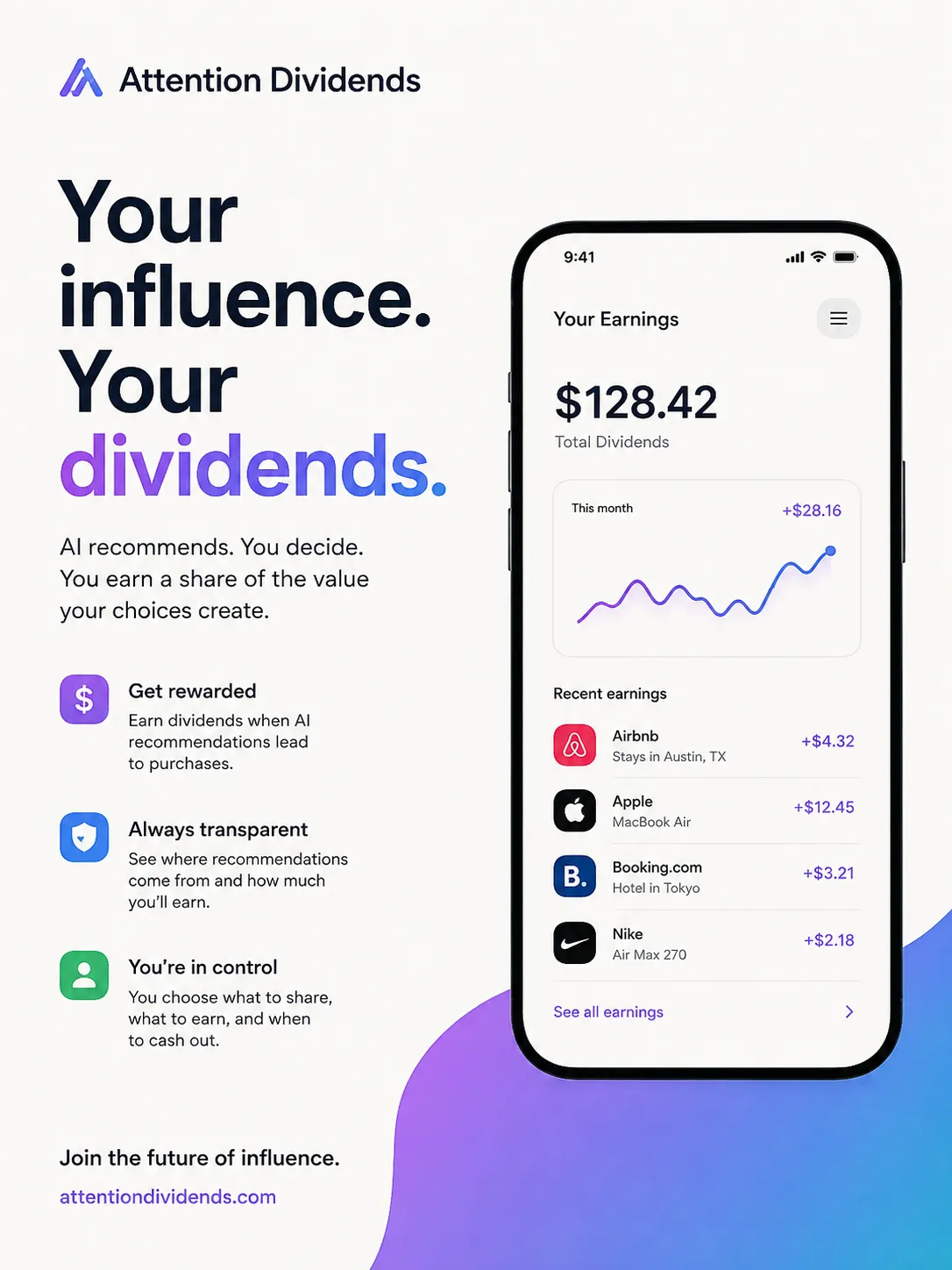
Description
No additional description provided.
The Pitch
AI will make commercial persuasion feel less like advertising and more like advice. When a person asks an assistant what to buy, the recommendation sits at the exact moment where intent, trust, and transaction converge. That moment is far more valuable than a display ad or search result, but unlike traditional advertising, the consumer is not merely being shown a message; they are delegating judgment. A business that lets people share in the value of that delegated judgment reframes influence as an asset the consumer owns.
The non-obvious prize is that consumers may eventually need a reason to trust recommendations made by systems that are financially entangled with merchants. If assistants are paid by brands, platforms, or affiliate networks, every answer becomes suspect. Returning part of the commercial value to the user does not eliminate bias by itself, but it changes the psychological contract. The user can see that their choice created economic value, and that value did not disappear entirely into an opaque marketplace. In a world where algorithmic advice will be abundant, visible alignment may become a product feature.
The business also sits on top of an existing behavior rather than trying to create a new one. People already compare products, follow recommendations, use affiliate links, collect card points, and optimize cash back. The difference is that AI collapses the comparison process into a conversation. If the assistant becomes the new front door to commerce, then the old reward systems tied to cards, portals, and coupon extensions start to look mispositioned. They reward the payment rail or the last-click detour; this would reward the actual decision path.
Its durability would come from making attribution legible across a messy purchasing journey. The hard part of commerce is not that merchants dislike paying for customers; they already do. The hard part is proving who caused the purchase. An intermediary that consumers trust enough to route high-intent buying decisions through it could become a cleaner source of commercial signal than ads, cookies, or coupon sites. The consumer’s query is the intent, the recommendation is the influence, and the purchase is the proof.
The deeper idea is that AI may create a new class of consumer property: not data exactly, and not attention in the old advertising sense, but monetizable intent. If that intent is going to be harvested, packaged, and sold, the most interesting company is the one that makes the person who generated it a participant rather than the raw material.