Conditional Purchase Commitment Platform
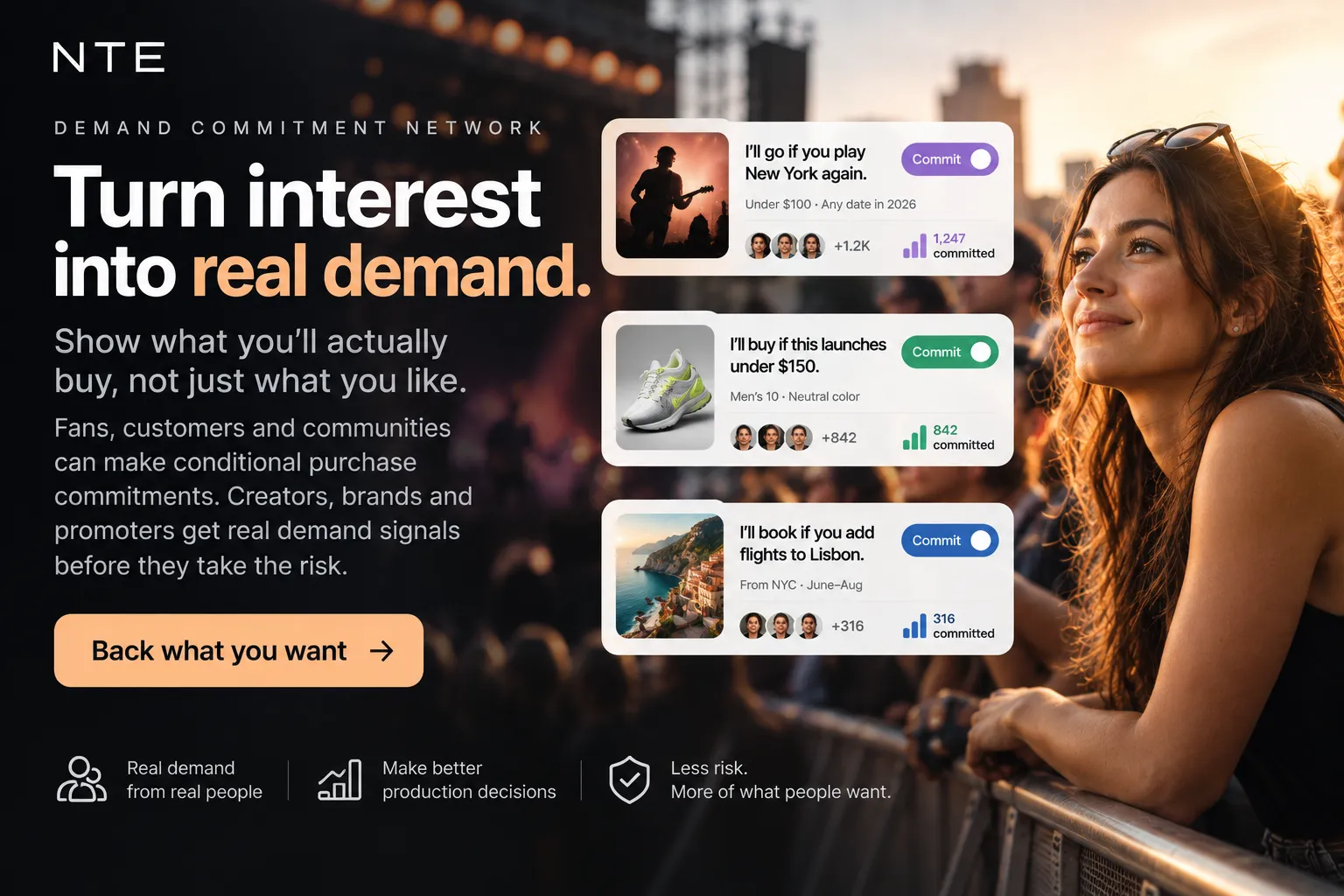
Likes, follows, waitlists, and “notify me” buttons tell companies that someone is interested, but they rarely tell them whether that person would actually spend money if the right thing existed. Someone should build a universal way for people to turn interest into conditional purchase commitments: “I’ll buy a ticket if this artist plays Philadelphia for under $80,” “I’ll buy this product if it launches below $50,” or “I’ll subscribe if this creator makes this show.” Those commitments could aggregate into visible, executable demand that creators, brands, promoters, and manufacturers can act on before taking production or inventory risk. Agents and programmable payments make this much more plausible now because a consumer can authorize a future transaction without repeatedly checking for it. Imagine 1,500 fans pre-authorizing a $75 ticket if an artist adds a second New York show, giving the promoter evidence of real demand rather than another petition or waitlist.
Description
No additional description provided.
The Pitch
Turn demand from a mood into an asset. Today, most intent signals are cheap to produce and therefore hard to trust. A like costs nothing, a petition is performative, and a waitlist is often just a polite maybe. But a conditional commitment sits in a different category: it is not quite a purchase, but it has enough friction, specificity, and consequence to reveal something much closer to the truth.
The strongest version of this business would not merely help sellers forecast demand; it would change what gets made. Many products, events, and creative projects fail not because nobody wanted them, but because the people who wanted them were too scattered, too quiet, or too late to be legible. Aggregated conditional demand gives the long tail a coordinating mechanism. It lets small pockets of willingness become large enough to justify action, and it does so before someone has rented the venue, printed the inventory, or committed the budget.
There is also a subtle power shift here from persuasion to discovery. Much of commerce is built around convincing people to buy what already exists. This model starts with people declaring what would have to be true for them to buy. That creates a market of unmet conditions: not just “I want this,” but “I want this at this price, in this place, in this format, by this date.” The valuable data is not preference in the abstract; it is the boundary between desire and transaction.
If it worked, the company could become a kind of demand registry for the internet: a neutral layer where consumers express executable intent and sellers compete or respond to satisfy it. That is more interesting than another marketplace because the inventory does not have to exist yet. The demand can precede the supply, which makes the platform valuable in categories where uncertainty is the expensive part.
The trust problem would be difficult, but it is also the moat. Consumers would need confidence that commitments are conditional and controlled; sellers would need confidence that the commitments are real. If one company became the place where both sides believed the signal, it would own a rare position: not the checkout button, and not the ad impression, but the moment before a market comes into existence.