Company Claims Compliance Monitoring Platform
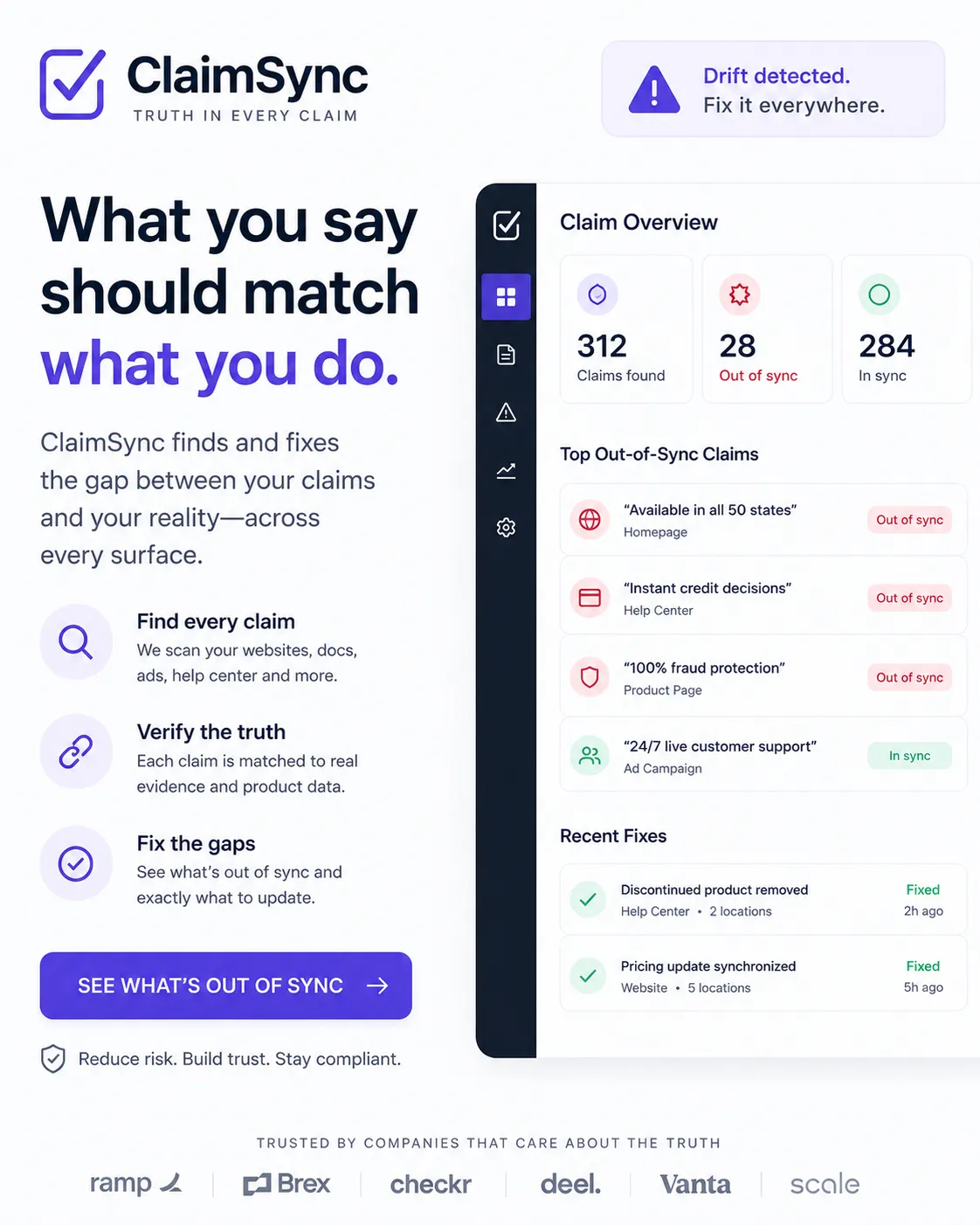
Companies change product capabilities, policies, pricing and operations constantly, but their public claims live across websites, help centers, sales decks, app stores, ads and support content with no system making sure they still match reality. ClaimSync would create a continuously updated map of every factual claim a company makes, connect those claims to the internal evidence or system that supports them, and flag when the two diverge. Why now: companies are producing more content with AI while regulators are paying closer attention to whether claims are substantiated, making manual review increasingly impossible. Example: a product is discontinued, but ClaimSync finds it still promised on the homepage, in three help articles, an old sales deck and an AI-generated support answer, then opens the exact changes that need to happen.
Description
No additional description provided.
The Pitch
A company’s public surface area has become too large for anyone inside it to actually understand. The interesting shift is not just that businesses publish more content, but that content has stopped being a finished artifact. Websites, support answers, sales materials, chatbot responses and marketplace listings now behave like a living organism, continually regenerated by teams and machines that are not always aware of each other. That creates a new kind of operational risk: the company no longer knows exactly what it has promised.
The most compelling part of this business is that “truth” inside a company is usually trapped in systems of record, while “claims” live in systems of persuasion. Product databases know what exists. Billing systems know what is charged. Legal policies know what is allowed. But marketing pages, sales decks and support macros translate those facts into language, and translation is where drift begins. A business that can connect the factual layer to the expressive layer becomes valuable because it treats language as infrastructure, not decoration.
This would also matter because false or stale claims are rarely dramatic when they are created. They accumulate quietly. A feature mention survives one redesign too many. A support article preserves an old entitlement. A sales slide keeps a number that was once true. Each individual error looks too small to justify a process, but together they form a hidden liability across compliance, customer trust and employee time. The business works if it can turn that fog into a concrete inventory: not “our content may be out of date,” but “these 17 sentences no longer match reality.”
AI makes the opportunity sharper because it increases the distance between authorship and accountability. When humans wrote most customer-facing language, review could at least follow the org chart. When AI drafts, summarizes and answers from mixed sources, a company needs a separate mechanism for knowing whether generated statements are still grounded. The more businesses use AI to communicate, the more they need a durable memory of what is actually safe to say.
The durable insight is that many companies already manage code, data and security with continuous monitoring, but they still manage factual language through episodic review. That mismatch cannot last. Public claims are becoming regulated, machine-generated and operationally consequential. A system of record for what the company says—and whether it is still true—feels less like a content tool than a missing control layer for modern business.