College Sports Compliance Management Platform
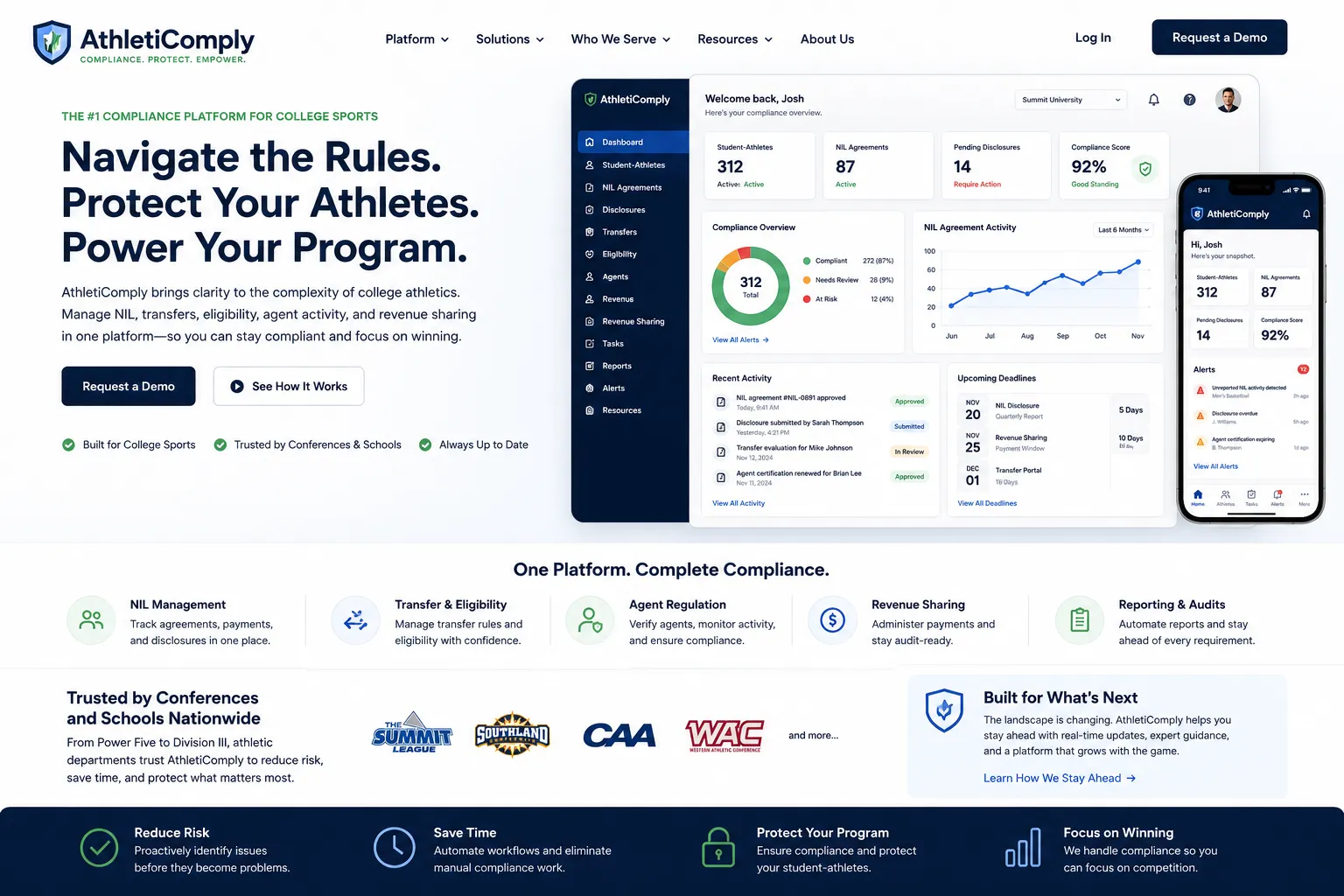
College athletic departments are being asked to manage an increasingly complicated mix of NIL deals, athlete transfers, eligibility rules, agent disclosures, revenue-sharing payments, and state-by-state regulations, but most smaller conferences and schools do not have the legal teams or compliance infrastructure of the SEC or Big Ten. A compliance operating system for college sports could centralize every athlete record, flag potential violations, automate required disclosures, and generate reports for schools, conferences, and regulators. The opportunity is becoming more urgent as Congress moves toward a national framework that could make compliance more standardized, enforceable, and expensive to get wrong. For example, the Summit League could purchase the platform once and provide it to every member school, giving each athletic department enterprise-grade compliance tools without requiring them to build a large internal team.
Description
No additional description provided.
The Pitch
College sports compliance is shifting from an episodic paperwork function into a continuous operating burden. The old model assumed that risk lived in a few predictable places: recruiting, scholarships, academic eligibility. The new model creates risk every time an athlete signs a brand deal, enters the transfer portal, receives a payment, hires an adviser, or crosses a state regulatory boundary. That is not just more work; it is a different category of work, closer to financial controls than athletic administration.
The most interesting feature of this market is that the schools with the least capacity may face the most asymmetric pain. A major athletic department can absorb ambiguity with lawyers, consultants, and dedicated staff. A mid-major school cannot, yet it is still expected to comply with the same broad system and will be judged harshly when something goes wrong. In that environment, software is not replacing sophistication; it is packaging sophistication for institutions that could never afford to build it themselves.
There is also a strong coordination problem hiding inside the category. One school’s compliance failure can become a conference problem, and one inconsistent process can create distrust among athletes, agents, brands, and regulators. That makes the natural buyer less likely to be only the individual school and more likely to be the conference, which has an incentive to standardize behavior across members. A shared system becomes valuable not merely because it stores records, but because it makes everyone legible to everyone else.
The business becomes more durable if regulation becomes clearer, not looser. Ambiguity creates anxiety, but enforceable standards create recurring operational requirements. Once disclosures, approvals, audit trails, and reports become mandatory in a more uniform way, compliance stops being a judgment call and starts becoming infrastructure. The company that translates rules into daily workflows can sit between policy and practice, updating the machinery whenever the rules change.
The deeper thesis is that college athletics is professionalizing faster than its administrative backbone. Athletes are becoming economic actors, schools are becoming payment processors and risk managers, and conferences are becoming quasi-regulatory bodies. A system of record for that transition would not just help departments avoid mistakes; it would define what competent administration looks like in the new era of college sports.