College Athlete Eligibility Verification API
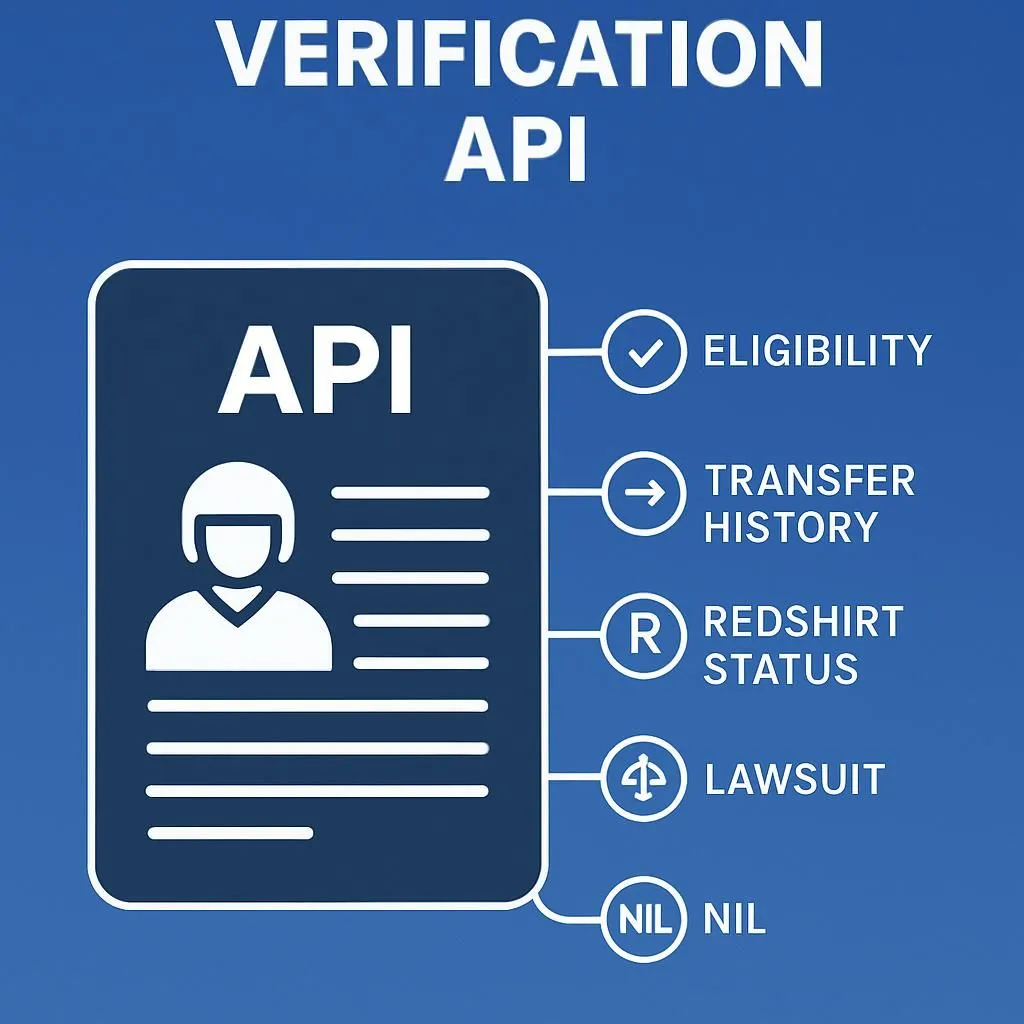
As NIL, sports betting, recruiting platforms, media companies, and schools all rely on accurate athlete information, there is surprisingly no universal source of truth for eligibility status. Determining how many seasons an athlete has remaining often requires manual research across multiple systems. An Eligibility Verification API would serve as the foundational infrastructure layer for college sports by providing verified eligibility, transfer history, redshirt status, lawsuit involvement, and NIL eligibility through a simple API. The opportunity exists because college athletics is rapidly professionalizing and infrastructure tends to become highly valuable as markets mature. For example, a sportsbook, recruiting platform, or media company could instantly verify whether a player is expected to be active next season rather than relying on incomplete public information.
Description
No additional description provided.
The Pitch
NIL eligibility data is that it is both boring and consequential. Nobody becomes a fan because a database correctly knows whether a linebacker has one year left, but a surprising amount of money now depends on that fact being right. In professional sports, contract status, roster status, and transaction history are treated as core market infrastructure. College sports has reached the same economic complexity without inheriting the same record-keeping layer.
The best businesses of this kind usually emerge where a piece of information is too fragmented to be trusted casually, but too important to be guessed. Eligibility sits in exactly that gap. It is affected by redshirts, medical waivers, transfers, NCAA rule changes, court rulings, conference rules, junior college time, international histories, and school-specific interpretations. The answer is not just “what class is this athlete?” but “what is the defensible version of the truth as of today?” That makes the product more like a clearinghouse than a content database.
Its value would compound because the same verified record becomes useful to many different markets that do not naturally share data with one another. A recruiting service, a collective, a broadcaster, a fantasy operator, and a sportsbook may all care about different outcomes, but they all need the same underlying identity and eligibility layer. When many downstream products depend on the same canonical fact, the company maintaining that fact can become quietly embedded in workflows far larger than itself.
There is also a timing asymmetry. College sports is becoming more commercial before it has become more standardized. That creates a period where confusion is not an edge case; it is the operating environment. Rule changes, litigation, transfers, and NIL enforcement turn athlete status into a moving target. A business that turns that ambiguity into verified, time-stamped records would not simply save labor. It would reduce the risk of building products, making offers, publishing claims, or setting markets on bad assumptions.
The deeper thesis is that college athletes are becoming economic actors before the industry has built the identity systems that economic actors require. Once an athlete’s status affects contracts, content, compliance, wagering, and recruiting decisions, eligibility stops being an administrative detail and becomes a primitive. The company that owns the trusted primitive does not need to be the most visible participant in college sports. It only needs to be the one everyone checks before acting.