College Athlete Eligibility Extension Agency
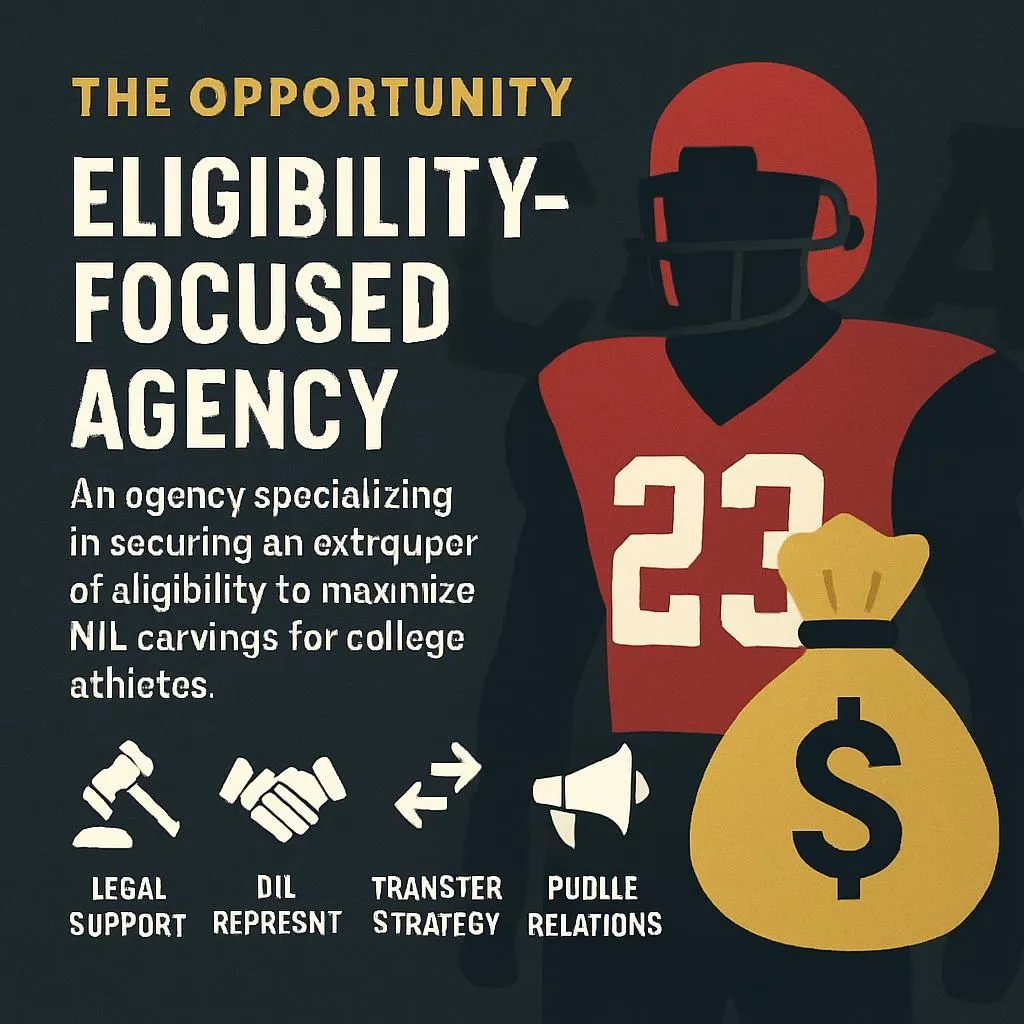
For many athletes, an additional year of eligibility can be worth hundreds of thousands or even millions of dollars in NIL earnings. Yet navigating appeals, lawsuits, transfer opportunities, and NIL negotiations requires expertise that most athletes do not possess. A specialized agency focused exclusively on securing additional seasons of eligibility would combine legal support, NIL representation, transfer strategy, and public relations into a single offering. The opportunity exists because the NCAA’s rule changes are creating a new category of athlete whose primary objective is maximizing eligibility rather than pursuing professional opportunities. For example, a star college football player facing the loss of a final season could hire the agency to manage appeals, negotiate NIL opportunities, and identify transfer options that preserve earning potential.
Description
No additional description provided.
The Pitch
NIL eligibility has quietly become an asset class. For the right athlete, one more season is not an administrative detail; it is a monetizable year of fame, leverage, development, and optionality. The unusual part is that the value is highly concentrated. Most athletes would not need this, but the ones who do may be protecting life-changing money, and their incentives to pay for specialized help are unusually clear.
The most interesting truth is that college sports now has a second career path between “stay in school” and “go pro.” Some athletes are no longer simply deciding whether they are good enough for the next level. They are deciding whether another year inside the college ecosystem is more valuable than leaving it. That creates a strange new labor market where procedural knowledge—waivers, hardship arguments, transfer timing, conference rules, litigation risk—can be worth as much as scouting or coaching.
This business would also benefit from the fact that eligibility disputes are not purely legal problems. They are narrative problems. The same case can look like a loophole grab, a fairness issue, a medical hardship, a pandemic-era correction, or a restraint-of-trade fight depending on how it is framed. In college sports, public sympathy can influence institutional behavior, media attention can change negotiating leverage, and schools often care as much about optics as precedent. A firm that understands both the rulebook and the story around the rulebook would have an edge over a traditional attorney or agent working in isolation.
There is also a timing advantage: the rules are unstable, which means expertise compounds quickly. In mature legal categories, knowledge is commoditized; here, every ruling, settlement, injunction, and NCAA adjustment becomes fresh terrain. The agency that sees enough cases would develop pattern recognition no individual athlete, family, school compliance office, or general sports agent could easily match. It could know not just what the rules say, but which arguments are gaining traction and which institutions are likely to bend.
The deeper business insight is that NIL made time itself the scarce commodity. A college athlete’s audience, marketability, and earnings window may peak before professional success is assured. If another season can preserve or expand that window, then extending eligibility becomes less like filing paperwork and more like recovering a lost commercial asset. That is a narrow but powerful category: a company built to turn one more year into a meaningful economic event.