Cognitive Wills for Personal AI Legacies
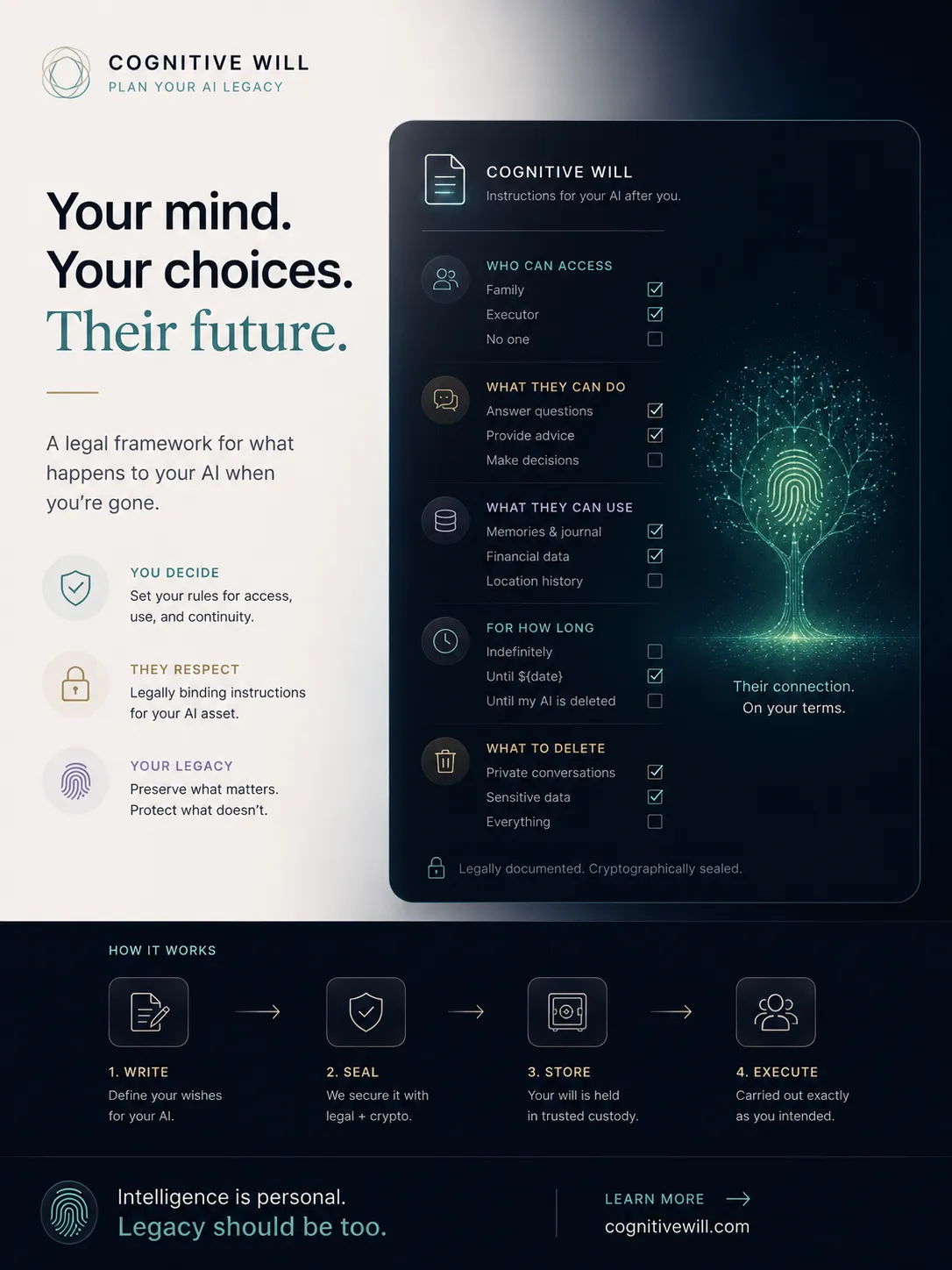
Digital estate plans decide what happens to someone's passwords, photos, crypto, and online accounts. They don't answer what happens when someone leaves behind an AI that has spent thirty years learning how they think. A Cognitive Will would specify which memories the system may retain, who can speak with it, what secrets it can reveal, whether descendants can retrain it, whether it can continue making decisions, and when parts of it must permanently disappear. As personal AI shifts from software we use to intelligence accumulated over a lifetime, dying will leave behind something fundamentally different from a hard drive.
Description
No additional description provided.
The Pitch
A lifetime AI will be the first asset that is simultaneously intimate, useful, dangerous, and unfinished. Photos and files are inert; an AI trained on a person’s habits, voice, relationships, judgments, and secrets can keep producing new consequences after the person is gone. That makes ordinary inheritance logic feel inadequate. The valuable thing is not simply access, but authority: who gets to ask, what they are allowed to learn, and where the dead person’s agency ends.
The business becomes compelling because the default setting for this future is chaos. Families will not discover the problem in a calm planning moment; they will discover it during grief, conflict, and ambiguity. One child may want the AI preserved as a parent. Another may see it as a surveillance archive. A spouse may need practical knowledge locked inside it. A company may still be relying on decisions or workflows shaped by it. The absence of instructions will not feel neutral. It will feel like someone else is deciding what the deceased meant to leave behind.
This is also one of the rare consumer trust problems where permanence matters more than convenience. People may tolerate clumsy software for daily tasks, but they will not casually entrust their private reasoning, confessions, and posthumous boundaries to a tool that feels disposable. The natural winner is less like a productivity app and more like a hybrid of estate attorney, fiduciary, and archive: boring in the right ways, durable enough to outlive platforms, and credible to courts, families, and AI providers.
The deepest insight is that identity itself will become governable. Today we ask whether data should be deleted or transferred. Tomorrow the harder question will be whether a model of a person is allowed to keep becoming them. A Cognitive Will turns that from an emotional improvisation into a declared preference. It gives people a way to say, in advance, which parts of themselves were meant to be remembered, which were meant to be useful, and which were meant to die with them.
If personal AI becomes a long-running companion, this category is not an add-on to estate planning. It is the estate plan for the part of a person that remains active. The company that defines the norms early could become the trusted interpreter between human mortality and machine continuity.