Climate Attribution Evidence Platform for Lawsuits
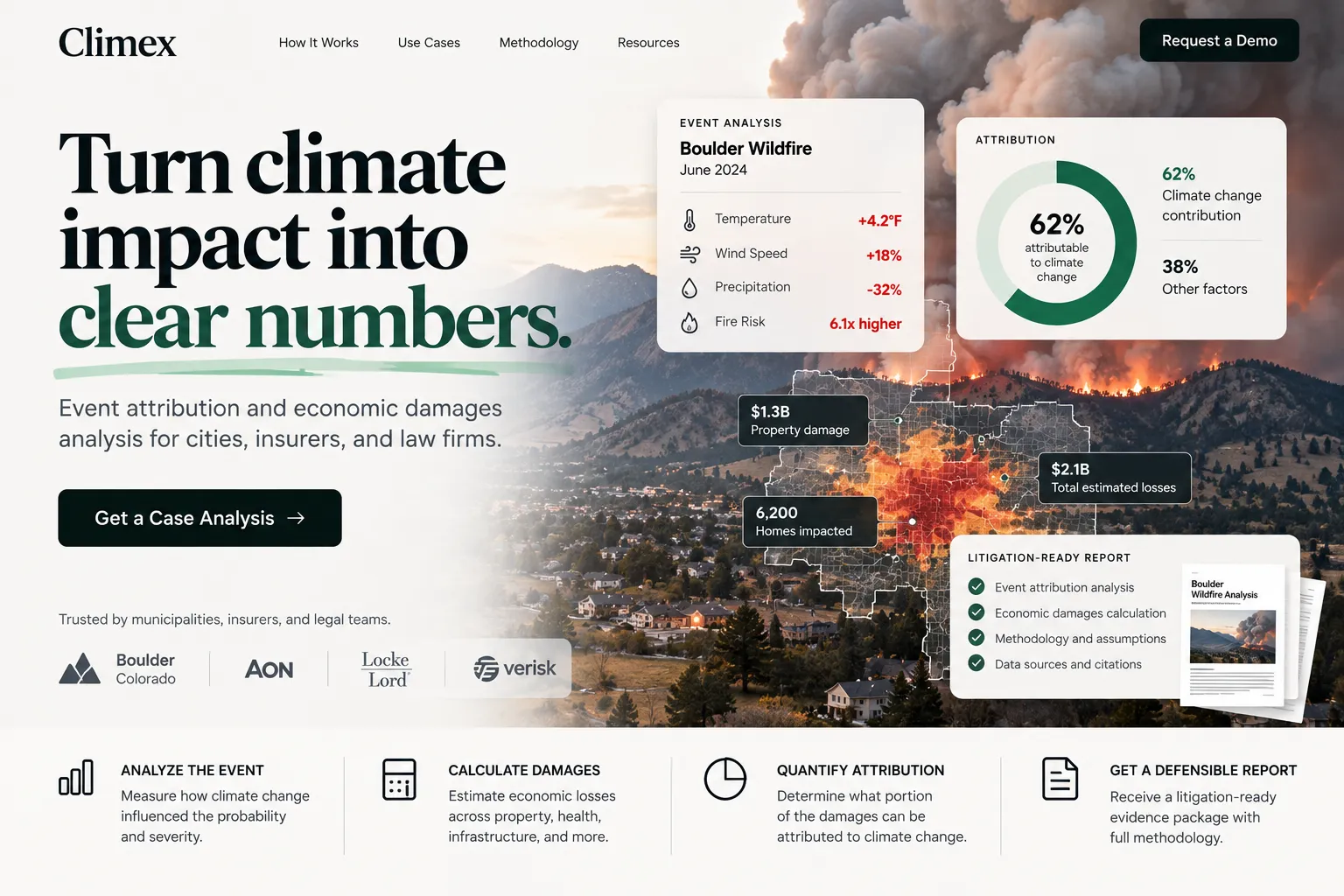
Cities, insurers, and law firms can increasingly point to climate change as a contributor to floods, heat waves, wildfires, and infrastructure damage, but proving exactly how much of a local event was caused by climate change—and what that damage is worth—still requires bespoke scientific, economic, and legal analysis. Build a platform that takes a specific event, estimates how much climate change altered its probability or severity, calculates the resulting economic losses, and turns the analysis into a litigation-ready evidence package. This becomes more important now as climate liability cases move through courts and more governments look for ways to recover the rising cost of extreme weather without rebuilding the same analysis from scratch. Imagine a city uploading data from a $2 billion wildfire and receiving a defensible estimate of how much warming increased the event’s severity, what portion of the losses can reasonably be attributed to that increase, and the evidence supporting the claim. That’s a product that needs to exist.
Description
No additional description provided.
The Pitch
This turns climate attribution from an academic capability into financial infrastructure. Today, the question “what share of this loss was caused by climate change?” is answered slowly, unevenly, and expensively, even though billions of dollars increasingly hinge on that answer. Whoever makes that question repeatable does not merely sell reports; they help define the accounting system for climate harm.
The non-obvious opportunity is that climate litigation is not limited by outrage or damages. It is limited by causation. Many plaintiffs can show that losses occurred, and many can show that emissions changed the climate, but the bridge between those facts is where cases become fragile. A company that standardizes that bridge could become valuable because it sits at the exact point where science becomes admissible money.
This also creates a rare kind of compounding advantage. Each analyzed event improves the next one: better hazard models, better loss mappings, better precedent-aware language, better understanding of what courts accept and reject. Over time, the product would not just be faster than bespoke experts; it would become more credible because it has been tested across events, jurisdictions, defendants, and legal theories. In a field where credibility is the product, repetition is not a cost-saving feature—it is the moat.
The business is interesting because the buyer’s alternative is not another SaaS tool; it is uncertainty. Cities and insurers already absorb climate losses, but without defensible attribution those losses remain politically frustrating rather than legally recoverable. Even a modest increase in the probability of recovery on a large claim can justify serious spending, because the underlying numbers are so large. The product’s value comes from changing a loss from “act of God” into something with an assignable share.
If this market develops, the winner may look less like a climate software company and more like a ratings agency for climate causation. Its authority would come from being trusted by adversarial parties, not merely adopted by friendly ones. That is what makes the idea powerful: it would create a shared evidentiary layer for a world where extreme weather is no longer treated as random background noise, but as damage with a balance sheet.