Channel Risk Analytics for Customer Acquisition
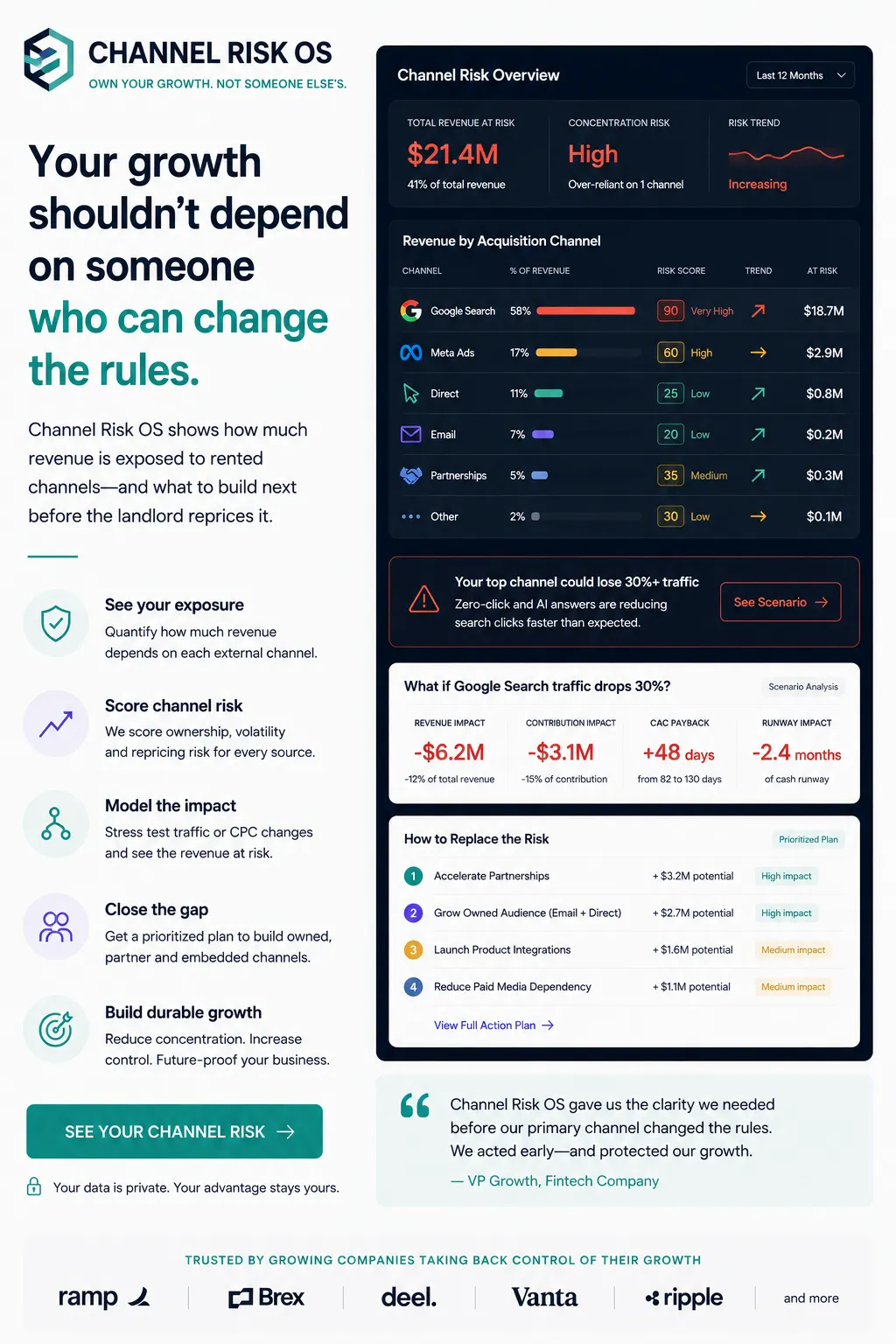
Companies know CAC by channel but rarely measure how much revenue is exposed to a platform they do not control. Channel Risk OS would map every acquisition source, score its ownership and repricing risk, model what happens if traffic or economics change, and show which replacement assets need to be built before the shock arrives. Why now: search, social and paid distribution are being intermediated faster than companies can rebuild acquisition elsewhere; even Google describes AI-powered search as a meaningful change in search behavior. Example: a company gets 58% of new customers from informational Google queries. The system shows that 41% of total revenue is exposed to one rented channel and that owned audience and embedded partnerships need another 18 months of growth to absorb the risk.
Description
No additional description provided.
The Pitch
A company’s acquisition mix is usually treated as a performance dashboard, when it is really a balance sheet of dependencies. The uncomfortable truth is that two channels with identical CAC can have radically different strategic value: one compounds into an asset the company owns, while the other is merely a temporarily underpriced toll road. The business opportunity is in making that distinction legible before it becomes obvious in revenue.
What makes this compelling is that distribution risk is often invisible precisely when the numbers look best. A brand getting cheap customers from search, a creator-driven marketplace riding TikTok, or a software company growing through app-store discovery may appear efficient while becoming structurally fragile. The danger is not that CAC rises next quarter; it is that management mistakes borrowed demand for durable demand. A system that translates channel dependence into revenue-at-risk would give leadership a language for a threat that currently lives in anecdotes and nervous board slides.
The second insight is that platform shifts do not need to destroy a channel to damage a company. A small change in ranking, attribution, targeting, answer formats, affiliate rules, or take rates can erase the margin in an otherwise healthy acquisition engine. Most companies plan for binary disasters, but the more common failure mode is slow repricing: the channel still exists, but the economics now belong to someone else. Measuring exposure to repricing, not just traffic loss, is what turns this from analytics into strategic infrastructure.
The third reason this should exist is that replacement distribution has long lead times. Owned audience, brand search, direct traffic, partnerships, community, integrations, and word-of-mouth cannot be switched on after the platform shock. They have to be grown while the rented channel is still working, which is exactly when companies are least motivated to invest in them. The product’s value is therefore not prediction; it is forcing a company to notice the maturity gap between the asset it depends on today and the asset it will wish it had tomorrow.
The deeper business is a new category of operating discipline: distribution resilience. Finance teams already understand customer concentration, supplier concentration, and currency exposure; acquisition concentration deserves the same treatment. The companies that manage it well will not necessarily grow fastest in calm periods, but they will be the ones that keep their revenue shape when the internet’s landlords change the rent.