Certified Immutable AI Hardware Agents
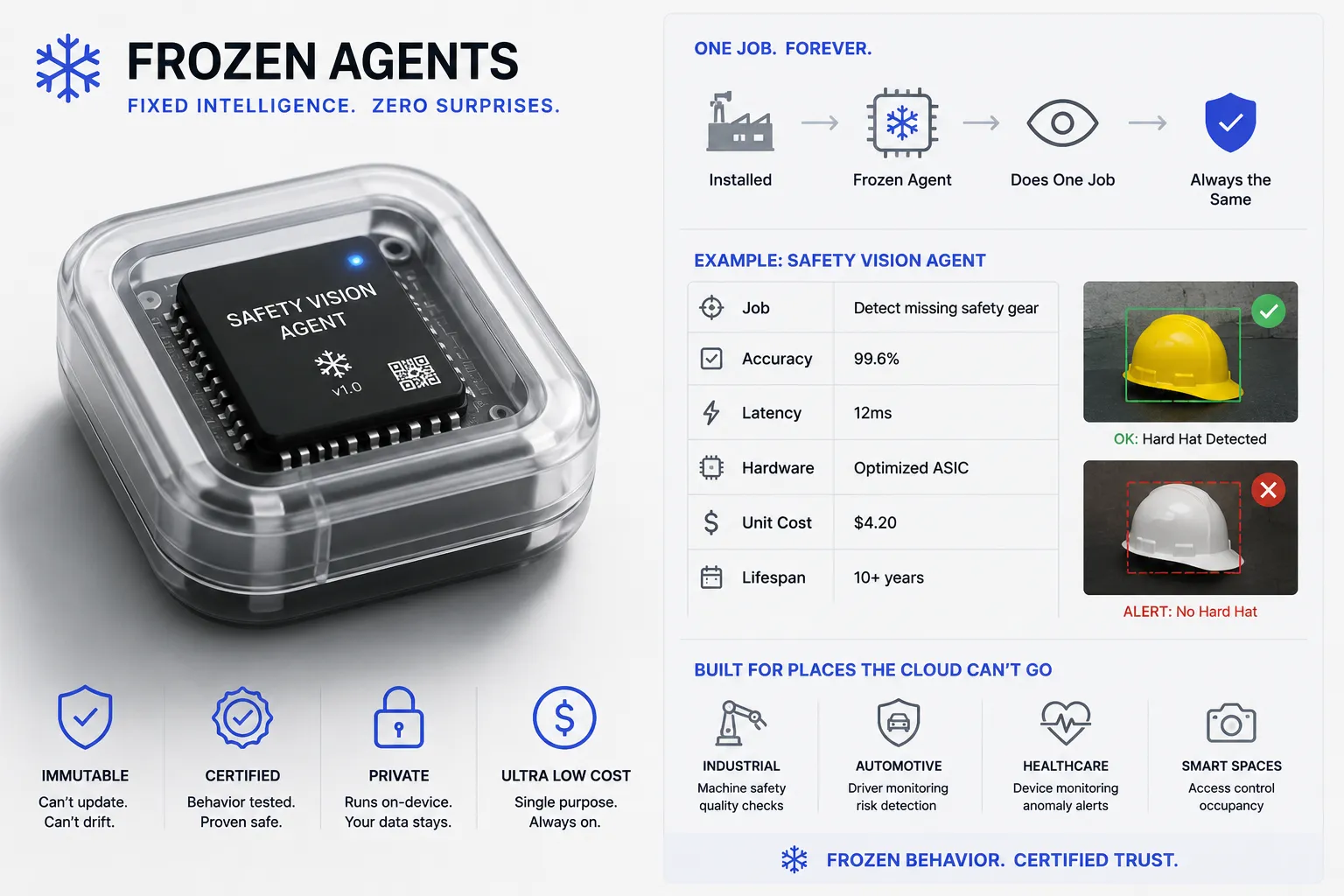
Most AI products assume models should constantly update, but some jobs may become more valuable when the intelligence can never change. Frozen Agents would be certified, single-purpose models permanently optimized into cheap hardware and sold as immutable machine workers with fixed, testable behavior. As specialized inference hardware drives the cost of narrow AI toward zero, persistent intelligence could move into devices where cloud subscriptions or continuously changing models are undesirable. A factory could install a $5 vision agent that performs one safety inspection for ten years, with regulators able to certify exactly what it will and will not do because the model cannot silently change after deployment.
Description
No additional description provided.
The Pitch
Real-world buyers do not primarily want smarter intelligence; they want dependable behavior. In factories, hospitals, infrastructure, vehicles, and regulated environments, improvement can be a liability if it arrives unpredictably. A model that changes after approval reopens testing, documentation, responsibility, and trust. A model that cannot change turns AI from a software service into something closer to a calibrated instrument: limited, inspectable, and accountable.
The deeper shift is that immutability changes who can trust the machine. Today, AI often asks users to trust a vendor’s ongoing judgment: the model, policies, training data, and behavior may evolve invisibly. Frozen intelligence would let customers trust an artifact instead. That matters in settings where the person approving a system is not the person operating it, and where the cost of a rare failure may exceed the value of marginal accuracy gains. “This will do exactly what it did during certification” is a stronger promise than “this will keep getting better.”
The economics are also unusually powerful because narrow intelligence does not need the business model of general intelligence. If a task is stable, repeated, and high-volume, the value is not in continuous novelty but in compressing expertise into a durable part. Once the model is finalized and the hardware is cheap, the product can behave more like a component than an application. That opens markets where a subscription would feel absurd: embedded sensors, tools, appliances, inspection stations, agricultural equipment, and safety systems that may sit in place for years.
The most interesting customers may be the ones that currently avoid AI altogether. Not because they doubt its potential, but because they cannot tolerate ambiguity about who is responsible when behavior changes. A frozen agent creates a clean boundary: the maker is responsible for the certified behavior, the buyer is responsible for using it within scope, and regulators can evaluate a fixed object rather than a living service. That simplicity is commercially valuable.
If most AI companies race toward ever-larger, ever-changing systems, this company would win by treating intelligence as a finished good. There is a large class of work where “obsolete but proven” beats “state of the art but shifting.” The business works if the market for boring, permanent competence turns out to be much larger than the market for magical assistants.