Career Exploration Rotational Work Program
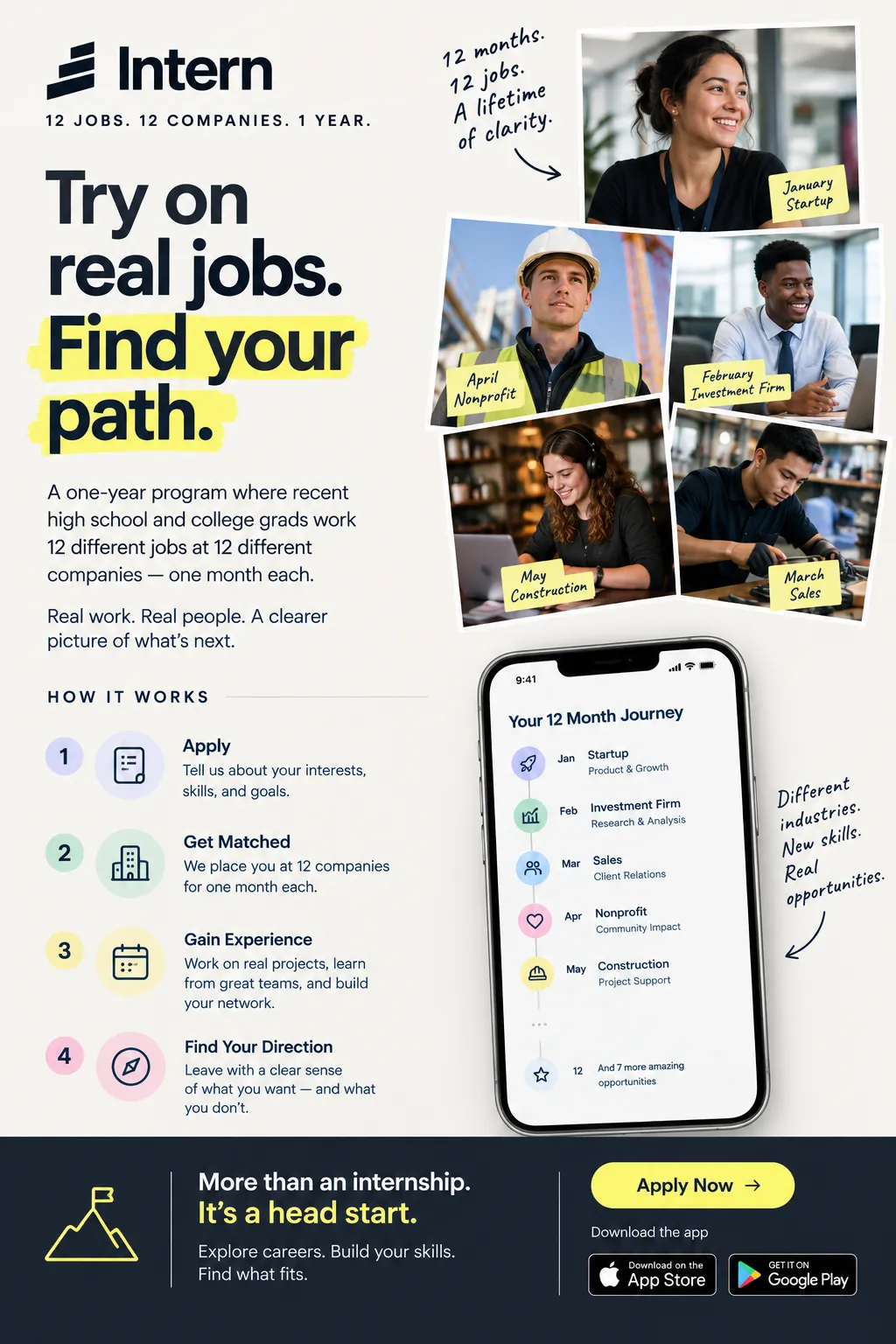
It is strange that at 21 you're supposed to pick a career after experiencing approximately three jobs. Build a highly selective program where recent high school or college graduates spend one year working 12 jobs at 12 companies, one month at each. Spend January at a startup, February at an investment firm, March in sales, April at a nonprofit, May on a construction site. Companies get ambitious young people for short, structured projects. Participants get something almost impossible to buy today: enough exposure to understand what kinds of work, people, environments, and industries they actually like. We tell young people to find their path. Maybe they should be allowed to try a few first.
Description
No additional description provided.
The Pitch
Career choice is one of the largest decisions people make with one of the worst feedback loops. College offers credentials, internships offer narrow previews, and entry-level jobs often teach you more about one manager than about a field. A year of concentrated, varied work would turn career discovery from an abstract identity question into a pattern-recognition exercise: which days give you energy, which people do you admire, which environments make you dull, which kinds of problems keep following you home.
The deeper insight is that young people do not only lack experience; they lack contrast. A single internship can feel meaningful because there is nothing to compare it with. The same person might think they hate finance when they really hate hierarchy, or think they love startups when they really love small teams, or mistake the glamour of an industry for the texture of the work. Twelve sharply different months would create a personal dataset that no aptitude test, alumni coffee chat, or campus career office can approximate.
Companies would participate because the arrangement solves a real but awkward need: many organizations have discrete, neglected projects that are too small for a full-time hire and too substantial for a casual intern. A rotating cohort also lets employers meet unusually curious, high-agency young people before they enter the conventional recruiting funnel. The short duration is not merely a compromise; it makes the work more honest. Both sides know the month is for contribution and exposure, not for pretending that a twenty-two-year-old has already made a permanent choice.
The selectivity matters because it changes the signal. If the program became known for attracting unusually capable generalists, completing it would say something different from having attended a prestigious school. It would suggest not just intelligence, but range, adaptability, and seriousness about work itself. In a labor market where resumes often blur together, a year spent inside twelve real organizations could become a more legible proof of judgment than another credential.
The business works best if it is not framed as a gap year, but as an antidote to premature specialization. Modern careers are longer, less linear, and more self-directed than the institutions that feed them. A company that helps people make better first decisions could capture value from a truth everyone privately knows: the first step matters less because it is final, and more because it shapes the questions you know how to ask next.