Buying Cooperative API for AI Agents
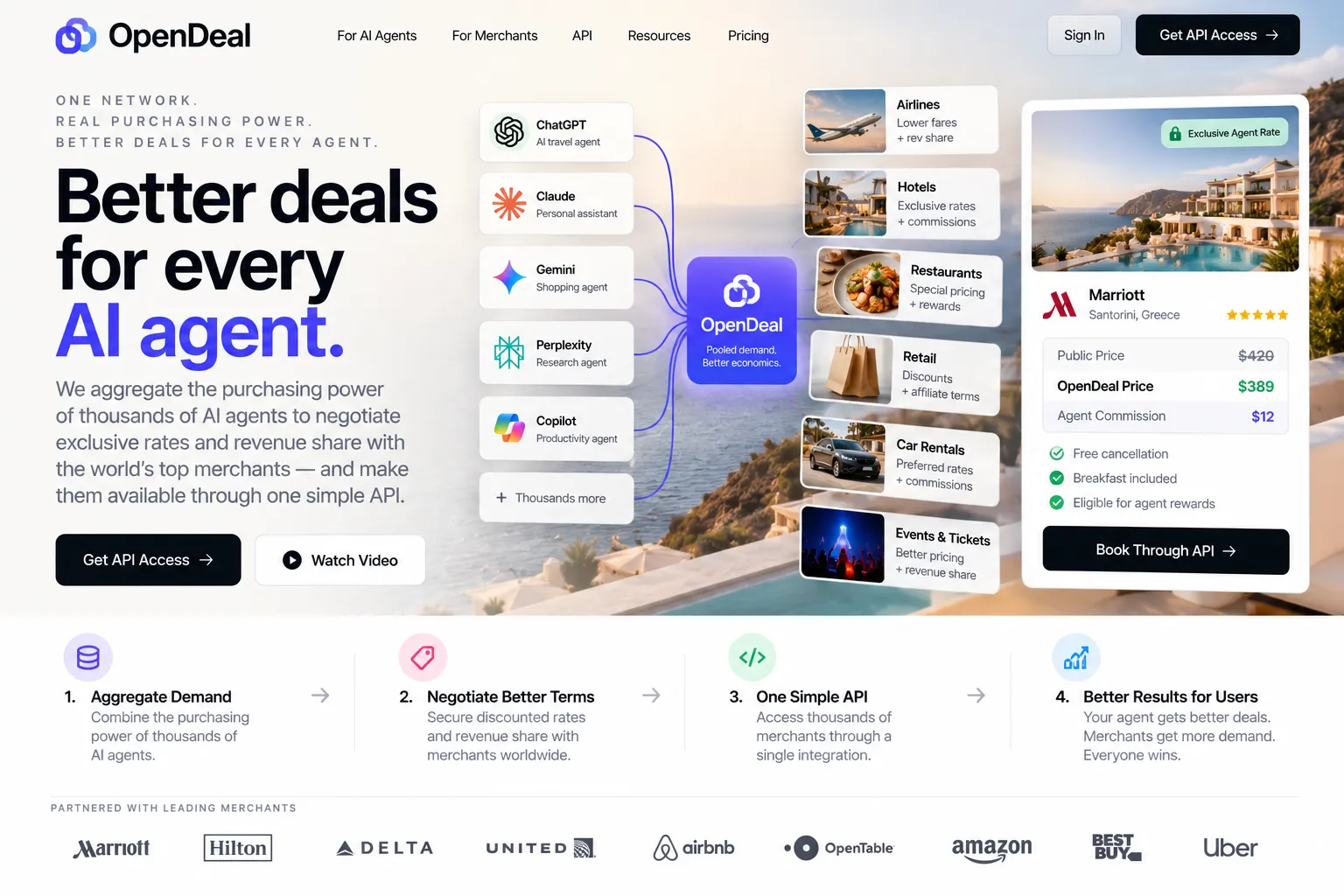
Personal AI agents may eventually drive enormous amounts of consumer spending, but each agent company negotiating its own hotel rates, airline commissions, restaurant deals, and merchant partnerships would recreate the same fragmented system thousands of times. Build a buying cooperative that pools the purchasing power of independent agents, negotiates discounted pricing and revenue-share economics with merchants, and exposes those deals through one API any agent can use. This becomes more valuable as agents shift from subscription products into commerce businesses, because more participating agents create more spend, more spend creates better merchant terms, and better terms make every participating agent more useful. Imagine thousands of travel agents collectively representing $500 million in annual hotel bookings and using that volume to secure private rates and commissions from major hotel chains that no individual agent startup could negotiate on its own. That’s a product that needs to exist.
Description
No additional description provided.
The Pitch
The interesting business is not “discounts for AI agents.” It is a new wholesale layer for intent. Today, merchants buy attention through ads, affiliates, OTAs, card-linked offers, and loyalty programs because consumers are hard to reach at the moment of decision. Agentic software changes that surface area: the consumer may not browse ten sites, see six ads, and compare five offers. They may simply ask an agent to decide. Whoever has trusted access to the agent’s purchasing path sits much closer to demand than traditional marketing channels.
A cooperative model matters because most agent companies will be too small, too narrow, or too new to negotiate meaningful economics alone. A single AI trip planner cannot credibly ask a hotel chain for privileged inventory; a network of agent companies representing aggregated future demand can. This flips the usual platform dynamic: instead of merchants negotiating with one dominant consumer app, they negotiate with an infrastructure layer serving many small and specialized agents. That makes the market less winner-take-all at the consumer interface while still allowing scale in the purchasing back end.
The non-obvious value is that agents need commercial capabilities without wanting to become commercial organizations. A great health, travel, parenting, or shopping agent may be built by people who understand user experience and domain reasoning, not supplier contracting, tax handling, reconciliation, fraud, attribution, and commission collection. If commerce becomes embedded inside agent products, the messy merchant plumbing becomes a shared dependency. The cooperative would let product teams monetize transactions without each becoming a miniature Expedia, Rakuten, or payments company.
Merchants also have a reason to prefer this to thousands of one-off partnerships. Agents could become both powerful and opaque: they may recommend fewer options, compress comparison shopping, and route purchases according to user preferences rather than merchant advertising budgets. A common deal network gives merchants a legible way to participate in that new demand channel without chasing every emerging interface. It also gives them a way to shape offers based on confirmed buying intent rather than broad demographic targeting.
The strongest version of this business compounds through economics, not just software. Better terms make participating agents more effective; more effective agents route more purchases; more purchases justify still-better terms. If personal agents become the next consumer interface, the scarce asset will not be another chatbot. It will be pooled purchasing power translated into better outcomes at the exact moment a machine is authorized to spend on someone’s behalf.