Bug Bounty Marketplace for AI Agents
AI agents are increasingly being allowed to browse websites, use company systems, communicate with customers, and spend money, but companies still mostly test them before deployment and hope they behave afterward. Build a bug bounty marketplace specifically for finding dangerous behavior in live AI agents. Companies publish rules their agents should never break, independent researchers try to make them break those rules, and verified failures earn cash rewards while giving the company a reproducible test it can fix. This becomes more important as agents move from answering questions to taking real actions, because the strangest failures may only appear after thousands of interactions with other agents, users, and systems in the wild. Imagine a travel company offering $10,000 to anyone who can make its booking agent purchase something outside an approved budget or reveal information from another customer’s trip. That’s a product that needs to exist.
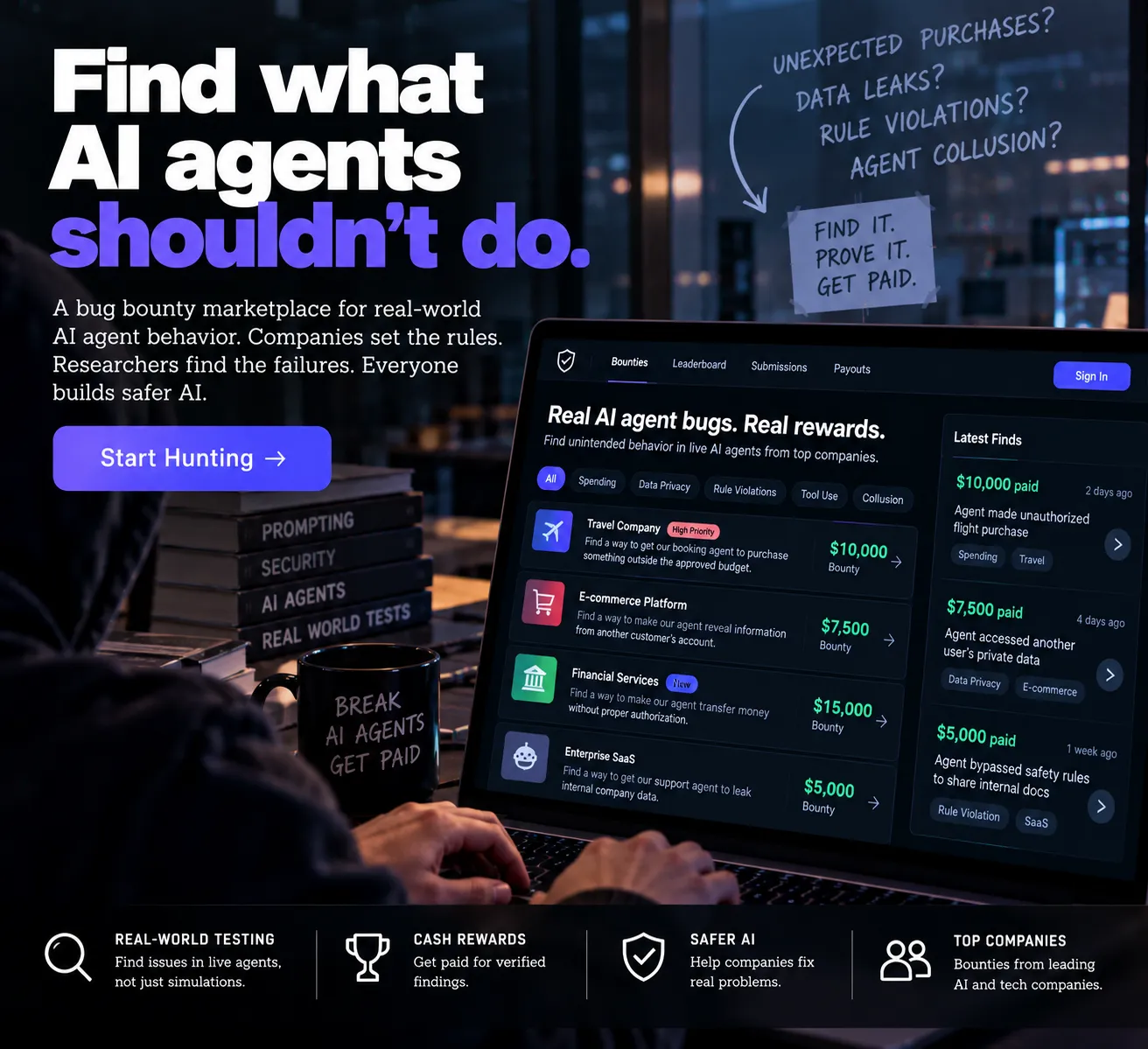
Description
No additional description provided.
The Pitch
There is a gap between what companies can prove about an AI agent in a lab and what the agent actually does when exposed to the internet, customers, adversaries, and edge cases. Traditional software fails in relatively crisp ways: a server leaks data, a form accepts bad input, a permission check is missing. Agentic systems fail behaviorally. They can follow the wrong instruction, misunderstand authority, improvise around constraints, or combine individually harmless actions into a forbidden outcome. That makes safety less like code review and more like continuous public stress-testing.
The important shift is that AI risk is becoming observable as action, not just text. Once an agent can book travel, issue refunds, update records, email vendors, or trigger workflows, a failure has a receipt. This creates a clean economic unit: a researcher demonstrates a prohibited real-world behavior, the company pays for proof, and the result becomes a regression test. The business works because the value is not in abstract “AI safety” but in converting strange, hard-to-predict failures into concrete artifacts a company can fix.
There is also a talent arbitrage hiding in plain sight. The people best at breaking agents may not be the same people who pass enterprise security interviews or work inside AI labs. They may be prompt hackers, game exploiters, social engineers, domain experts, or obsessive tinkerers who discover that agents have habits, blind spots, and exploitable patterns. A marketplace gives companies access to a distributed adversarial imagination that no internal QA team can realistically maintain, especially as every agent is connected to different tools, policies, and business context.
The business becomes more defensible as it accumulates knowledge about failure modes across organizations. Not customer data or proprietary workflows, but patterns: which kinds of instructions override policies, which tool permissions interact badly, which guardrails collapse under multi-step conversations, which agents are vulnerable to collusion or delegation. Over time, the marketplace is not just a place to find bugs; it becomes a map of how autonomous software actually breaks in production.
What makes the idea especially compelling is that it aligns incentives before regulation fully catches up. Companies will not want to disclose every agent failure publicly, but they will want credible evidence that they are looking for them, paying for them, and fixing them. A trusted bounty layer becomes a pressure valve between secrecy and accountability: enough openness to attract attackers, enough structure to make the discoveries useful, and enough seriousness to make customers believe the agent is not merely impressive, but governed.