Browser Extension Replacing Ads With Personal Reminders
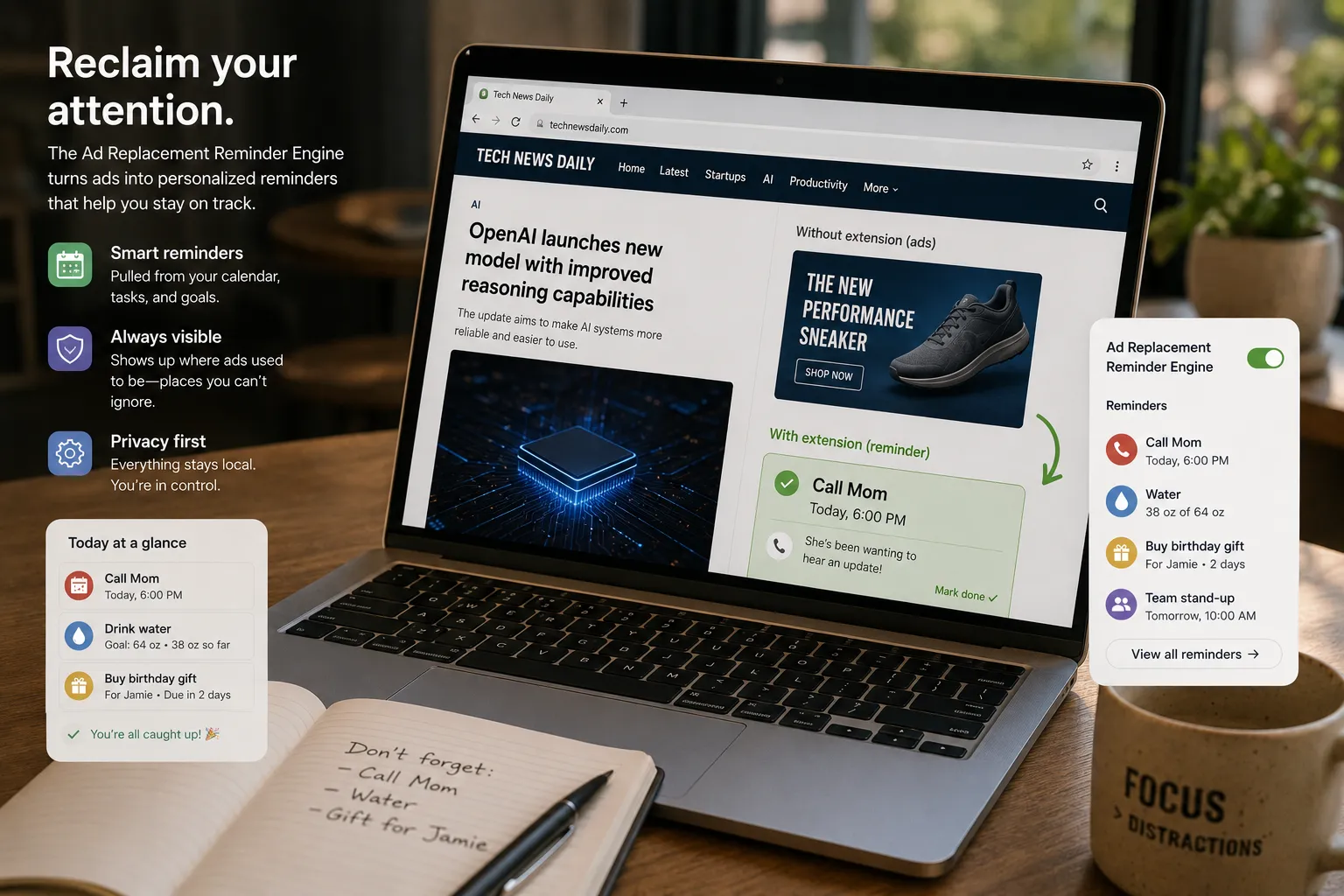
Online advertising occupies some of the most valuable attention real estate on the internet, yet almost none of it benefits the user. People constantly forget errands, appointments, birthdays, and personal goals while simultaneously seeing hundreds of irrelevant advertisements every day. An Ad Replacement Reminder Engine is a browser extension that replaces web ads with personalized reminders pulled from your calendar, to-do list, goals, and habits. Instead of seeing another insurance ad while reading an article, users might see "Call Mom today," "Take out the trash," or "Dentist appointment tomorrow." Because these reminders appear in constantly changing locations across the web, they remain far more noticeable than traditional notifications that users learn to ignore. As browser extensions, AI personalization, and productivity tools continue to mature, there is an opportunity to reclaim online attention for the user's own priorities rather than advertisers'. Imagine scrolling Instagram and, instead of a sponsored post, seeing a reminder that today is your friend's birthday before you forget to call them.
Description
No additional description provided.
The Pitch
The internet has trained people to accept that the most visible parts of their daily digital environment belong to companies trying to interrupt them. Reversing that default is powerful: the same surfaces that currently monetize distraction could become a private layer of intention. The business works if it can make people feel, in a concrete daily way, that their own life is showing up where commerce used to be.
The most interesting insight is that reminders fail less because people lack tools and more because reminders become predictable. A phone notification, a calendar alert, or a to-do app badge quickly turns into background noise. Web ads, by contrast, remain noticeable precisely because they are visually varied, contextually misplaced, and scattered across moments of attention. Repurposing that format for memory and follow-through is clever because it borrows the advertising industry’s hard-won understanding of salience without borrowing its incentives.
It also creates a rare kind of productivity product: one that does not ask for another destination. Most productivity software requires users to open an app, maintain a system, review a dashboard, or develop a habit around the tool itself. This idea meets people inside behavior they already repeat hundreds of times a week. That matters because the highest-value reminders are often mundane and time-sensitive, and mundane things are exactly what people do not want to manage in yet another interface.
The emotional appeal is larger than efficiency. A reminder to buy milk is useful, but a reminder to text a grieving friend or practice before a lesson changes the character of a day. The product’s real promise is not “getting more done”; it is reducing the gap between what people say matters to them and what survives the noise of ordinary life. That gap is one of the quiet frustrations of modern technology: people are more connected and informed than ever, yet still miss the small actions that make them feel like the person they meant to be.
If such a company existed, its defensibility would come from trust and personalization rather than ad-blocking alone. The more accurately it understands which prompts are welcome, when they should appear, and when they should disappear, the more it becomes a personal attention layer instead of a utility. In a world where every platform competes to steer behavior, a service that helps users steer themselves would occupy unusually meaningful ground.