Bankruptcy-Remote Customer Funds Management API
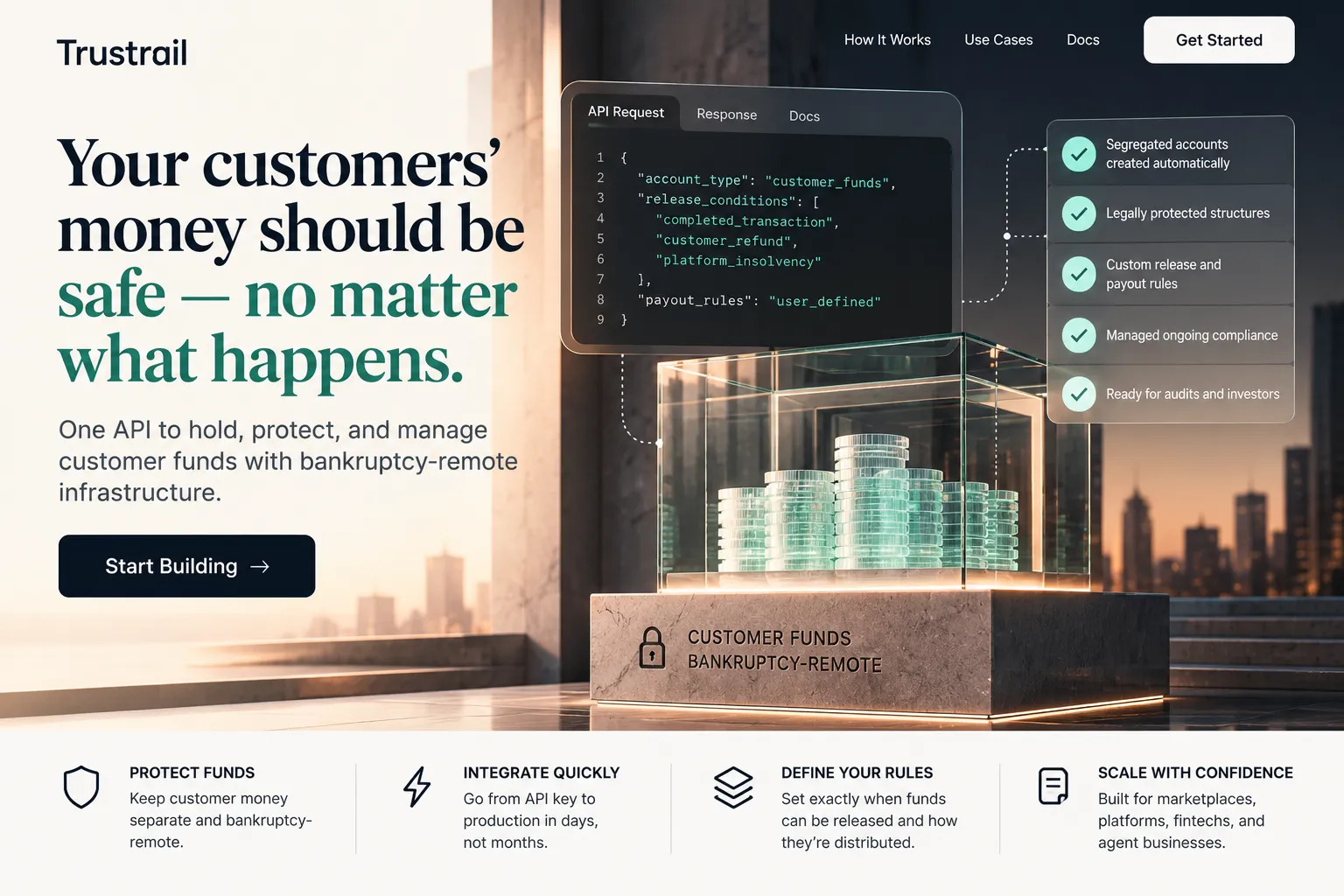
Companies increasingly hold money on behalf of customers, sellers, creators, agents, and businesses, but protecting those funds if the company fails still requires custom legal structures, segregated accounts, lawyers, and operational work. Build an API that lets any platform define how customer money should be held, when it can be released, and what happens if the company goes bankrupt, then automatically creates and manages the underlying bankruptcy-remote structure. This becomes more important now as marketplaces, stablecoin products, agent wallets, and fintech platforms hold more third-party money without wanting to become financial institutions themselves. Imagine a startup adding one integration and instantly ensuring that $20 million of customer balances legally belong to the customers, cannot be seized by company creditors, and automatically follow predefined payout rules if the business fails.
Description
No additional description provided.
The Pitch
“who owns the?” is becoming a product question, not just a legal one. More software companies now sit in the flow of funds, but most are still forced to choose between pretending the balances are operational cash or building bespoke financial infrastructure they were never meant to operate. A business that turns fund segregation, payout priority, and bankruptcy treatment into programmable infrastructure would make trust something a platform can embed directly into its product rather than describe in terms of service.
The non-obvious customer need is not only regulatory compliance; it is credibility. When a marketplace, wallet, or agent platform asks users to leave money inside its system, the user is quietly underwriting the company’s solvency. That is a strange bargain: a seller may care less about the platform’s growth than about whether yesterday’s proceeds survive a failed financing round. If bankruptcy-remote treatment became easy to adopt, “your money is not our money” could become a measurable product guarantee instead of a vague reassurance.
This could also change competitive dynamics in categories where holding balances is useful but trust is scarce. Small platforms are often disadvantaged because large incumbents can afford legal complexity, banking relationships, and internal treasury teams. An API that packages the legal and operational machinery would let newer companies offer institutional-grade protection without becoming institutions themselves. In markets where users are rationally nervous—crypto, cross-border commerce, creator payouts, autonomous agents—the ability to prove funds are insulated may matter as much as lower fees or faster payments.
The business would sit in a rare place: invisible during normal operations, indispensable during failure. Most infrastructure helps companies work when things go right; this would govern what happens when things go wrong. That is powerful because the worst day is exactly when documents, dashboards, and promises are least trusted. If the structure is already created, funded, reconciled, and rule-bound before distress begins, the product has value precisely because it cannot be improvised later.
Over time, the deeper opportunity is to create a standard layer for custodial intent. Today, every platform holding third-party money has to translate business logic into bank accounts, contracts, controls, and contingency plans. If that translation became standardized, capital held inside software could become more legible to users, partners, regulators, and courts. The company would not merely move money; it would define the legal state of money inside internet businesses.