B2B Product Usage to Budget Justification Platform
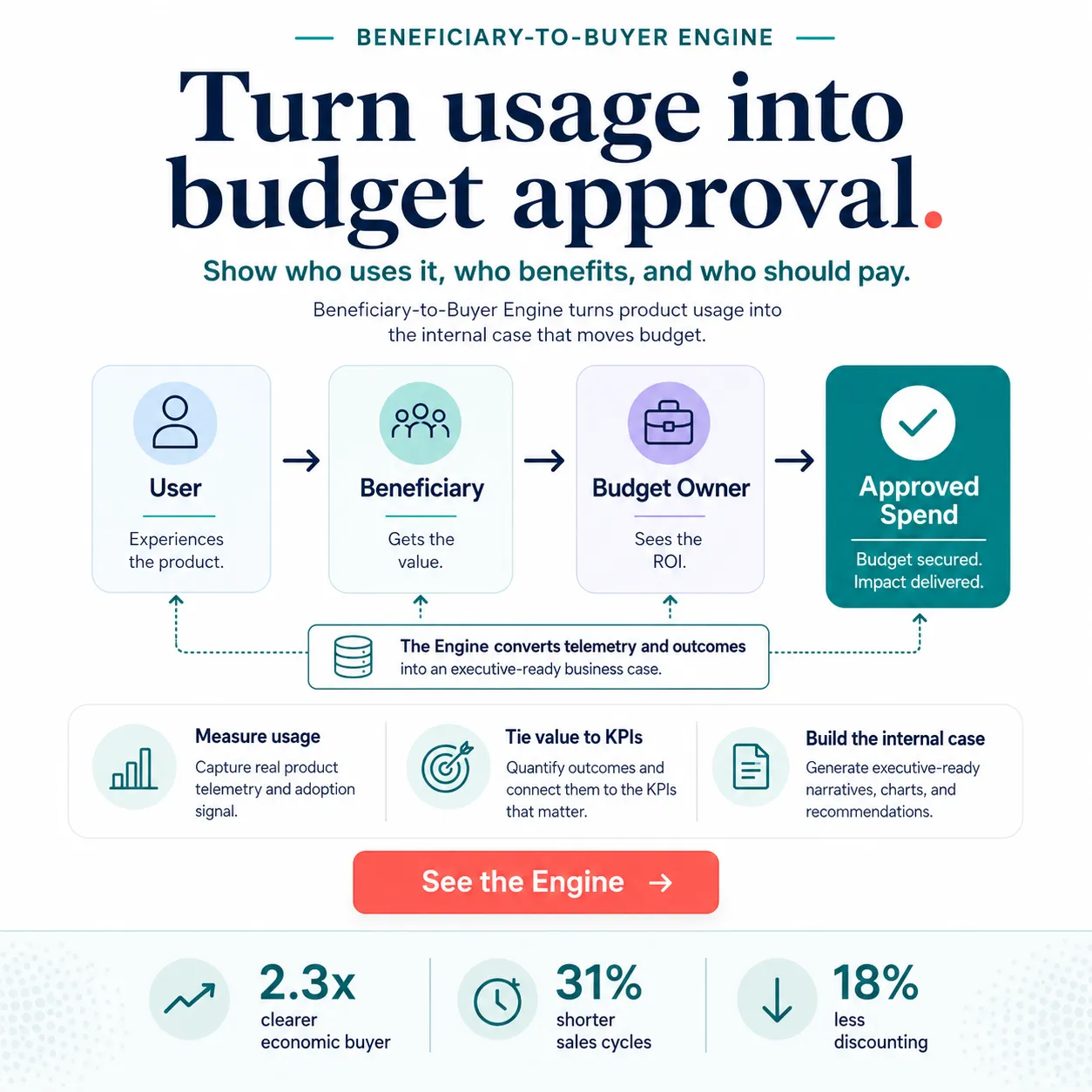
A product may have enthusiastic users who cannot buy it and economic buyers who never experience it. Beneficiary-to-Buyer Engine turns usage into the internal evidence needed to create budget pull: it measures who uses the product, what changed, which executive KPI moved and which budget owner benefits financially, then automatically builds the internal case for expansion. Why now: product telemetry and AI make it possible to translate individual-level value into executive-level financial outcomes instead of relying on champions to do the translation manually. Example: 400 employees use a financial wellness tool, but HR cannot justify the spend. The system shows reduced 401(k) leakage, lower benefits-service burden and measurable retention impact, then packages those outcomes for the benefits and finance owners who can actually approve the contract.
Description
No additional description provided.
The Pitch
Many valuable products fail not because they lack value, but because their value appears in the wrong accounting system. A tool can save employees time, reduce stress, prevent errors, or improve decisions, while the resulting financial benefit shows up months later in a different department’s metrics. That mismatch creates a strange form of enterprise waste: companies underpay for things that are working simply because the proof is trapped at the level of the user rather than the budget.
This would be especially powerful because the internal sale is often harder than the external sale. Vendors tend to imagine that once a champion loves the product, the commercial problem is mostly solved. In reality, the champion is frequently being asked to become a translator, analyst, political operator, and CFO whisperer on top of their actual job. A business that makes that translation automatic is not just helping vendors sell more; it is removing one of the hidden taxes on adoption inside large organizations.
The most interesting wedge is that usage data becomes more valuable when connected to corporate incentives. Most companies already know whether people log in, complete tasks, or return to a product. What they usually cannot say is which cost center benefited, which executive’s scorecard improved, and whether the effect is large enough to defend in a budget meeting. The business works if it can turn scattered signs of usefulness into a credible internal artifact: not a customer testimonial, but a financial argument with an owner.
There is also an asymmetry in willingness to pay. If a product helps a vendor preserve or expand a six- or seven-figure account, the evidence layer that enables that expansion can capture meaningful value without needing to own the end workflow. It sits at the moment where ambiguity becomes revenue. That is a lucrative place to be because the alternative is not another software tool; it is a stalled renewal, a smaller deployment, or a beloved product quietly dying in procurement.
The deeper thesis is that enterprise software is moving from adoption-led growth to evidence-led growth. In a world where every department is scrutinized and every tool must defend its existence, love from users is no longer enough. The companies that win will be the ones that can prove not merely that people used them, but that the right part of the organization became measurably better off because they did.