Autonomy Budgeting for AI Agents
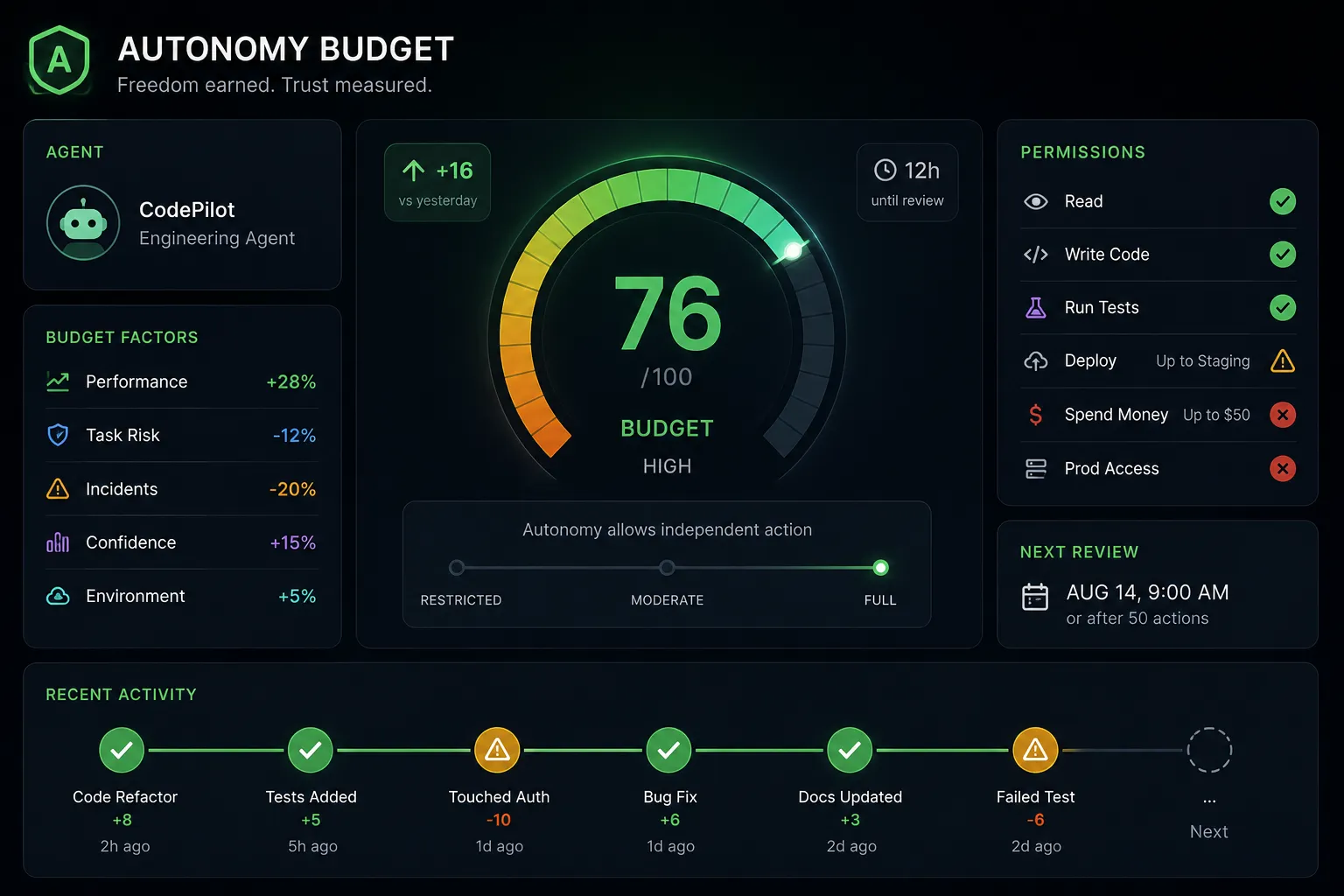
AI agents are getting permission to act without humans, but companies still manage autonomy as a binary choice: either the agent can do something or it cannot. Autonomy Budget would give every agent a dynamic allowance for independent action that expands or contracts based on task risk, recent performance, confidence, and past incidents. As agents move from answering questions to editing code, spending money, and operating systems, companies will need a way to meter machine freedom rather than granting permanent access. An engineering agent could earn the right to merge routine code after hundreds of clean changes, then automatically lose that privilege after touching authentication or causing a production incident.
Description
No additional description provided.
The Pitch
Autonomy will not be adopted at the pace agents become capable; it will be adopted at the pace organizations become comfortable with the downside. The bottleneck is not intelligence, but trust calibration. Companies already know how to grant humans judgment gradually through titles, approvals, spending limits, code ownership, and audit trails. Agents, by contrast, are often treated like software integrations: configured once, then either blocked or empowered. That mismatch becomes untenable as agents begin to occupy roles that look less like tools and more like junior employees with superhuman persistence.
The enduring insight is that permission is too crude a unit for machine labor. A human employee is not simply “allowed to spend money”; they may expense lunch freely, need approval for travel, and require legal review for vendor contracts. AI agents will need the same gradient, but updated continuously and automatically. The valuable system is not just a gatekeeper, but a credit score for autonomous behavior: contextual, history-aware, and sensitive to the cost of being wrong. That turns autonomy from a scary leap into a managed resource.
This could become a natural control layer because every company will face the same awkward middle state: agents that are useful enough to act, but not reliable enough to be trusted blindly. That middle state may last for years. Even as models improve, the world they operate in remains messy, political, regulated, and adversarial. Better models do not eliminate the need for limits; they make the limits more economically important because there are more actions worth permitting.
The business is especially interesting because it sits between productivity and governance rather than choosing one side. Security tools usually slow work down, while automation tools often create new risk. A system that lets high-performing agents earn more freedom can make caution feel like acceleration. The company that can measure when autonomy is deserved will not merely prevent bad actions; it will unlock many more good ones that would otherwise stay trapped behind human approval.
Over time, the most valuable record inside a company may be not what an agent can do, but what it has proven it can be trusted to do. That trust history becomes portable across tasks, teams, and systems. In a world with many specialized agents, the scarce asset is no longer access itself, but a defensible memory of judgment.