Autonomous SaaS Contract Negotiation Service
Most companies only negotiate the vendor contracts big enough to justify human attention. Everything else renews, increases, or gets approved with far less scrutiny than it deserves. Vendor Negotiator is an autonomous savings desk for companies without sophisticated procurement. Give it your upcoming SaaS renewals and it analyzes the contract, researches alternatives, builds the negotiation strategy, handles the back-and-forth within rules you set, and only gets paid when it creates verified savings. The interesting part is not AI writing emails. It is that agents could make professional procurement economical for thousands of contracts that were previously too small to justify it.
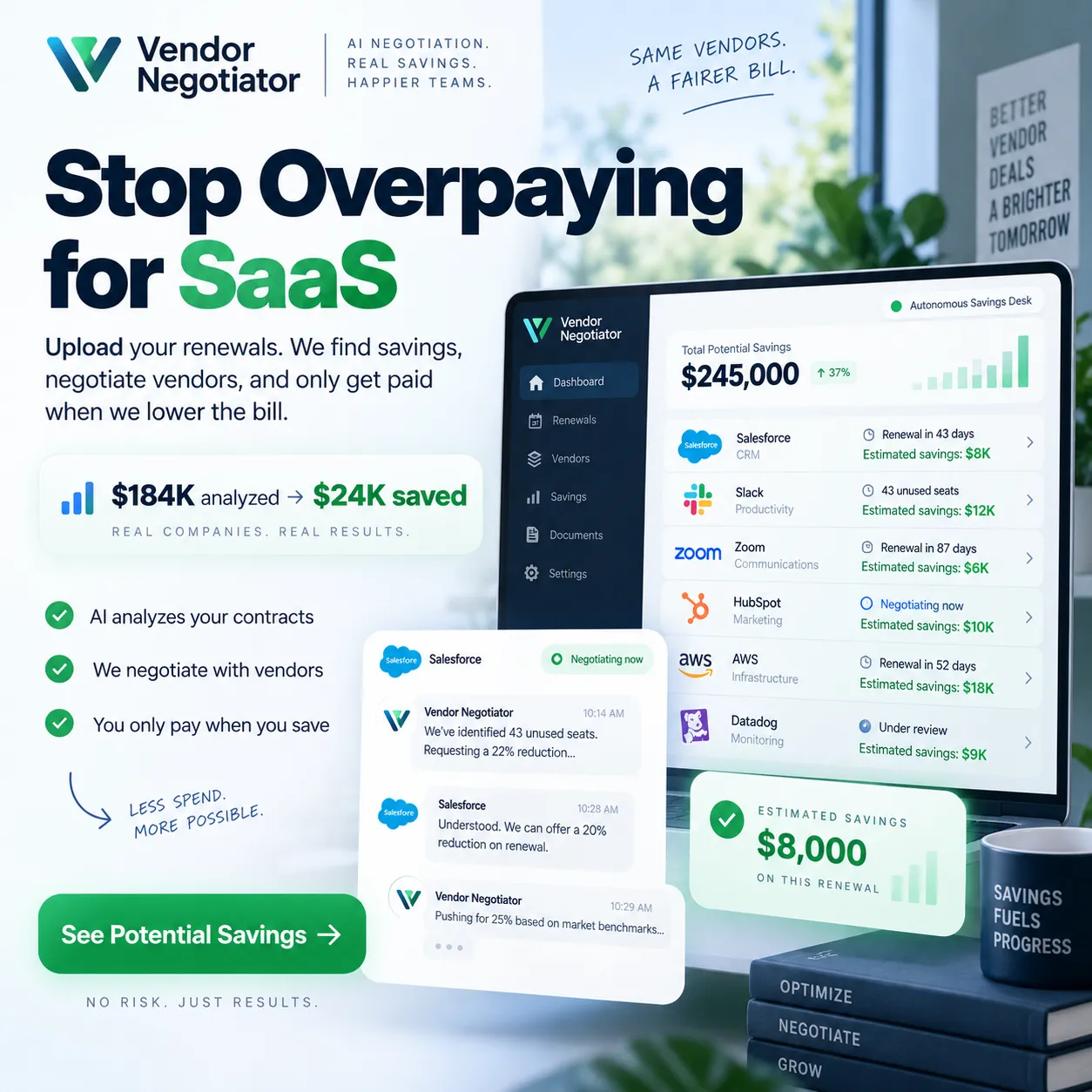
Description
No additional description provided.
The Pitch
Procurement has always had an attention problem disguised as a cost problem. A company may know, in theory, that every vendor renewal is negotiable, but the scarce resource is not information; it is someone with the time, confidence, and awkwardness tolerance to challenge the quote. That means an enormous amount of company spending is governed less by market pricing than by inertia. A business that can manufacture negotiation attention cheaply turns a neglected administrative corner into a profit center.
Small and mid-sized contracts are especially interesting because they sit in a no-man’s-land. They are large enough to matter in aggregate, but individually too small to involve legal, finance, or procurement leadership. Vendors understand this perfectly. A $12,000 renewal can rise to $15,000 because the customer’s internal cost of fighting is higher than the apparent savings. The moment that cost collapses, the psychology of the market changes. Software vendors are no longer negotiating only against the buyer’s fatigue; they are negotiating against a persistent, informed counterparty that does not get busy, embarrassed, or distracted.
This also creates a rare alignment where the customer can delegate a sensitive activity without first believing in a grand transformation. The buyer does not need to reorganize procurement or adopt a new operating philosophy. They can hand over a renewal and judge the result against a counterfactual that is easy to understand: what would we have paid otherwise? Businesses are skeptical of automation when it promises abstract productivity, but much less skeptical when it returns a signed renewal at a lower number.
The data advantage could become unusually practical. Every negotiation teaches which vendors discount, when they discount, what concessions are easy, what alternatives are credible, and which contract terms hide future price increases. Over time, the system would not merely imitate a procurement professional; it would see more mid-market vendor behavior than almost any individual buyer ever could. That matters because the best negotiation leverage is often not aggressiveness, but knowing what is normal.
If this existed, it would expose how much enterprise spending is protected by boredom. Many vendors rely on the fact that the customer’s internal process is too fragmented to resist small increases consistently. A service that quietly contests those increases at scale would not need to replace procurement departments to be valuable. It would simply bring market pressure to the long tail of spend, where today there is often no market pressure at all.