Autonomous Deal Desk for Vendor Negotiations
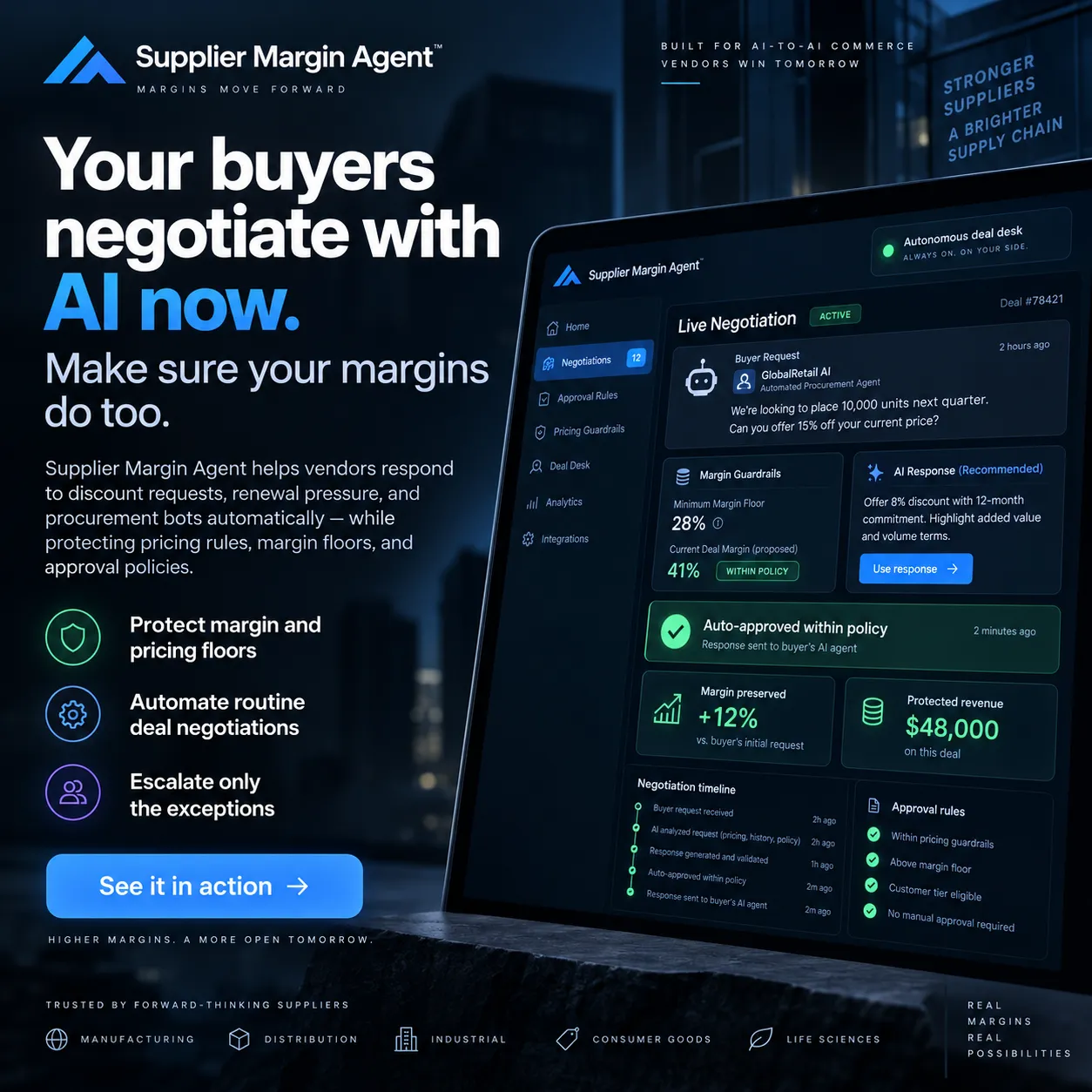
Procurement agents create a new problem for the other side of the table. If buyers can automatically negotiate every renewal, discount request, and commercial term, sales teams and deal desks cannot keep responding manually. Supplier Margin Agent is the autonomous commercial negotiator for the vendor. A company gives it pricing floors, margin targets, approval rules, preferred terms, and the concessions it is willing to trade, and the agent handles routine negotiation while escalating only the deals that actually need a human. It is essentially an autonomous deal desk built for a world where your customers increasingly negotiate with machines.
Description
No additional description provided.
The Pitch
This business is that it sits on the defensive side of automation. Most software sellers imagine agents as tools that make their own employees more productive, but the sharper pressure may come from customers using agents against them. Once buyers can ask for better terms continuously, consistently, and without social friction, every contract becomes more negotiable than vendors are staffed to handle. The supplier does not adopt this because it wants futuristic software; it adopts it because the alternative is letting an infinite buyer-side machine negotiate against a finite sales organization.
The valuable asset is not merely automation, but commercial memory. Human deal desks often know, informally and unevenly, which concessions are cheap, which terms are dangerous, which customers bluff, and which discounts were justified only by one-time circumstances. Encoded properly, that knowledge becomes a live bargaining system rather than a pile of approvals, Slack threads, and exception spreadsheets. The company that owns this layer can turn scattered judgment into repeatable margin defense.
This is also one of the rare agent products where autonomy may be more acceptable because the domain is bounded by rules. A procurement agent asking for 12% off does not require emotional creativity in response; it requires knowing whether 7% plus a longer term is better than 10% with weaker payment terms. Many commercial negotiations are not artful persuasion but controlled exchange of variables. That makes the category unusually well-suited to machine handling, as long as humans remain the backstop for strategic accounts and unusual risk.
The deeper shift is that negotiation becomes continuous rather than episodic. Vendors have historically relied on buyer inertia, sales relationships, and the hassle of renegotiation to protect price. Agents weaken all three. If customers can automatically surface cheaper benchmarks, reopen terms, and test concessions, suppliers need a system that can defend value at the same tempo. Otherwise, margin leakage will not look like one big failure; it will look like thousands of small, reasonable exceptions.
A supplier-side negotiator also becomes more useful as markets become more transparent. When everyone has better data about alternatives, the advantage moves from hiding information to executing policy with discipline. The business works if it becomes the place where a company’s commercial intent is enforced in real time: not just “what can we charge,” but “what should we trade, with whom, and under what conditions.” That is a durable position because pricing power is only valuable if a company can actually hold onto it.