Autonomous AI Research Scientist
Most research assistants stop after answering a single question. Breakthrough discoveries often require hundreds of iterative hypotheses explored over days rather than minutes. Imagine an AI researcher that continuously generates hypotheses, critiques its own work, runs new experiments, changes direction when evidence shifts, and keeps working until it finds genuinely novel insights. Instead of responding to prompts, it becomes an autonomous scientist operating around the clock. As reasoning models become more capable of self-evaluation and long-running tasks, autonomous research becomes the next leap beyond chatbots.
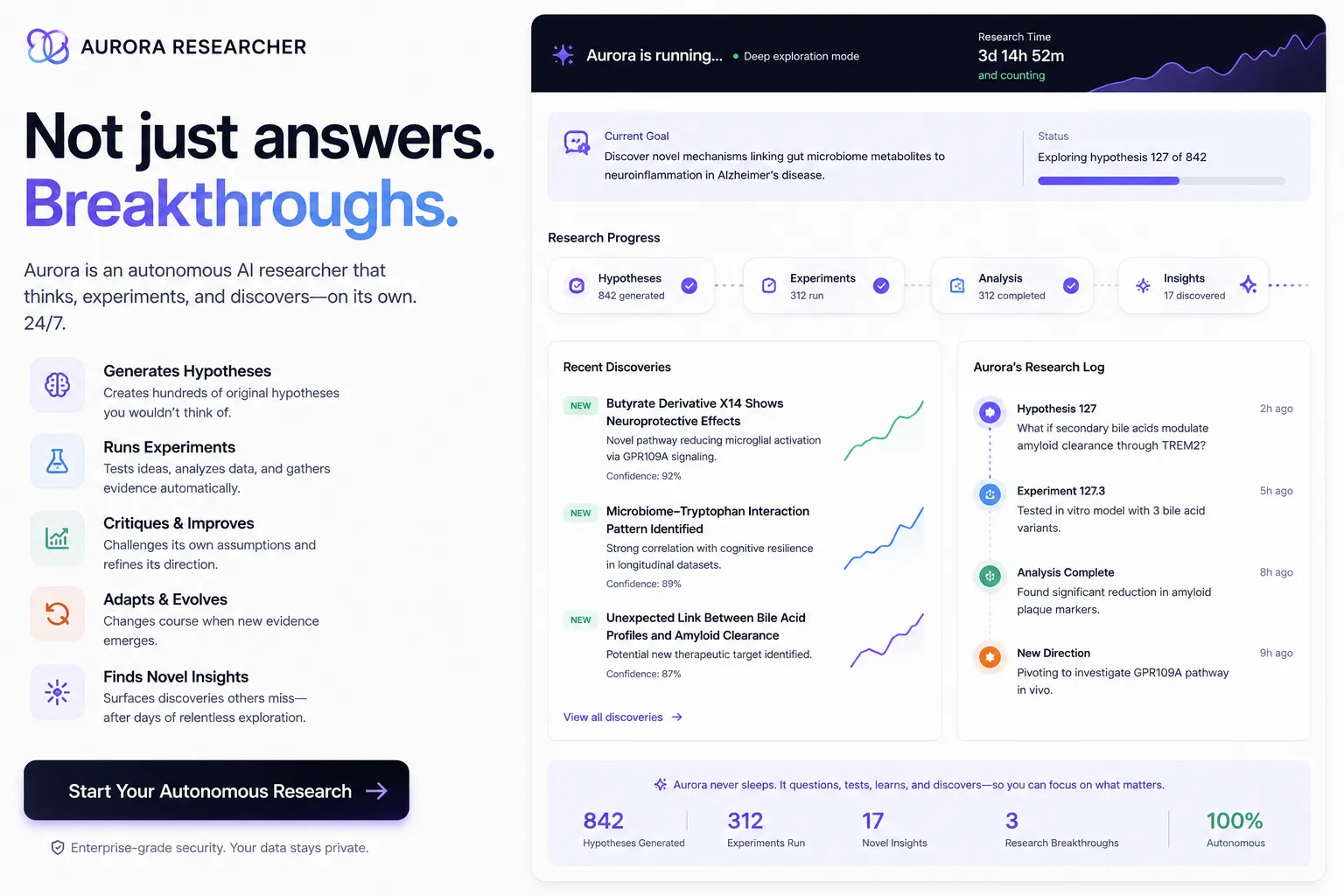
Description
No additional description provided.
The Pitch
The scarce resource in research is no longer access to information, but sustained, high-quality attention. Human researchers are excellent at judgment and taste, but they are constrained by sleep, patience, memory, and the emotional cost of dead ends. A system that can live inside the messy middle of discovery—where most paths fail, partial results contradict each other, and progress depends on trying one more angle—would not simply make researchers faster. It would expand the amount of intellectual terrain any person or organization can afford to search.
The interesting wedge is that many valuable discoveries are not blocked by genius-level insight; they are blocked by the tedium of exhaustively testing adjacent possibilities. In drug discovery, materials science, economics, biology, security, and software, there are countless hypotheses that are plausible enough to deserve investigation but not promising enough to command a person’s week. An autonomous researcher changes the economics of these “maybe” questions. It makes marginal curiosity cheap, and cheap curiosity can become a structural advantage.
The business would become more valuable as it accumulates process knowledge, not just facts. The durable asset is not a database of papers or experimental results, but a memory of which research strategies work in which domains: what kinds of hypotheses collapse quickly, what signals tend to be misleading, which tools overfit, which negative results are informative. Over time, the system could develop something akin to institutional scientific taste, a capability that is normally trapped inside senior researchers and lost when teams turn over.
This also creates a new kind of relationship between humans and machines in knowledge work. The human does not ask for an answer; the human sets a direction, applies taste at key moments, and receives a stream of sharpened possibilities. That is a higher-leverage role than prompt-writing. The product’s value would come from turning research from a sequence of isolated questions into a persistent intellectual process with continuity, memory, and momentum.
If it worked, the company would sit near the beginning of many value chains, where small improvements in discovery compound dramatically downstream. A better ad tool improves campaigns; a better researcher improves the rate at which new medicines, methods, algorithms, and materials are found. Businesses that increase the velocity of truth-seeking tend to matter because every other serious industry eventually depends on them.