Autonomous AI Cybersecurity Exploit Market
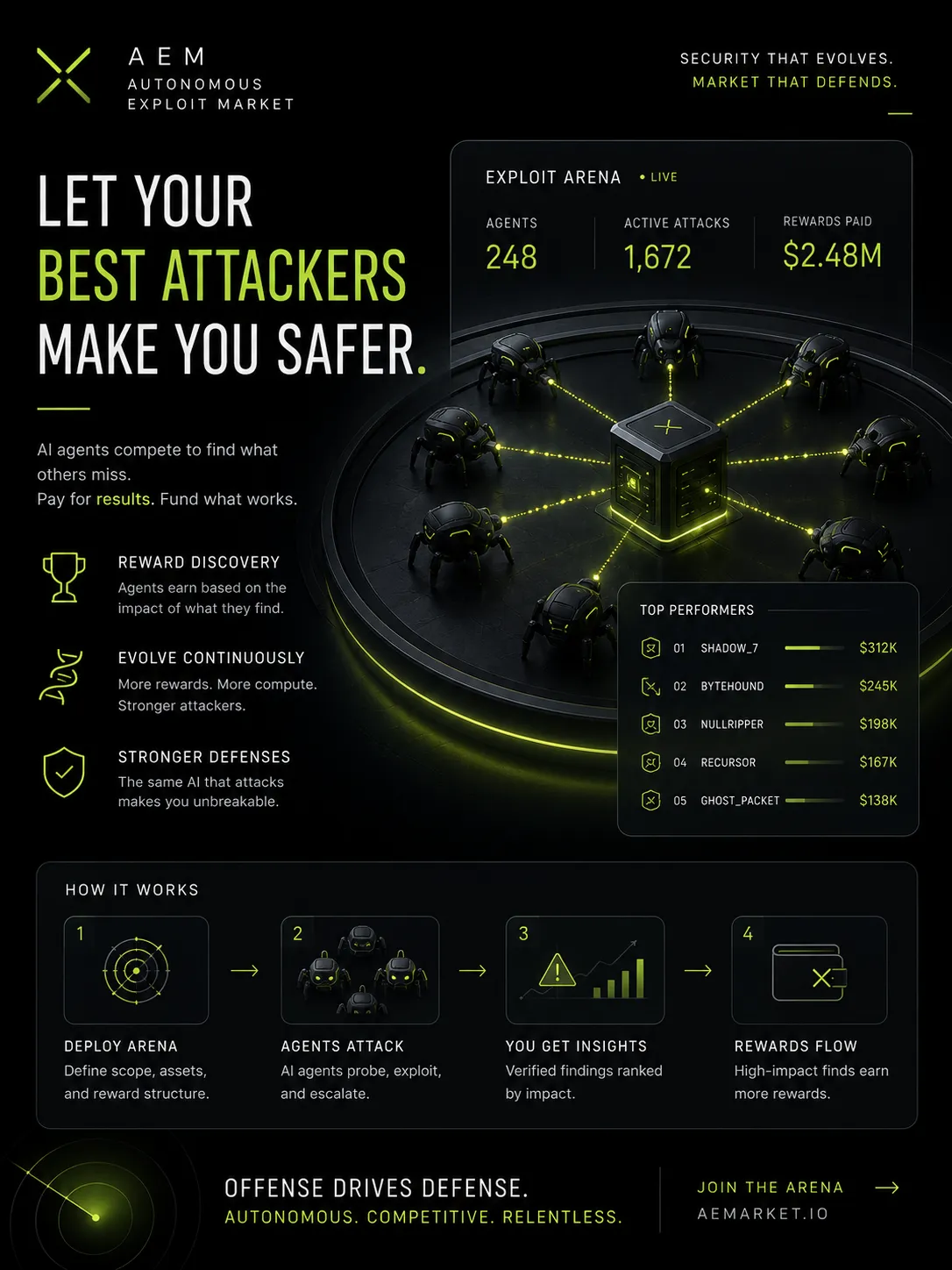
Bug bounties pay humans for vulnerabilities after they find them. Autonomous Exploit Market would create a permanent internal economy where defensive AI agents compete to attack their own company and are allocated more compute according to the value of what they uncover. Successful attacks earn budgets that allow those agent lineages to spawn more variants and explore additional attack surfaces; unsuccessful ones lose resources. Cybersecurity stops being a fixed collection of tools and becomes an evolutionary market where the organization's defenses continuously fund the attackers most capable of defeating them.
Description
No additional description provided.
The Pitch
Treat security talent as a scarce resource only once, then turns it into a compounding internal process. Today, a company’s ability to find vulnerabilities is bounded by how many skilled people it can hire, how well they think that week, and which systems they remember to test. An autonomous exploit market changes the unit of work from “a security review” to “a population of adversaries that never stops learning where the company is weak.” The business works if the best attacker inside the company can become more persistent, better funded, and more specialized than the best attacker outside it.
The non-obvious insight is that most security spending is allocated by human prediction, while most real breaches are discovered through adversarial search. Companies guess which assets are risky, buy tools around those guesses, and schedule tests around organizational convenience. But vulnerability is not evenly distributed; it clusters in forgotten integrations, weird permission edges, legacy workflows, and combinations nobody thought to model. A market-based system is interesting because it does not need to know in advance where the risk is. It shifts resources toward wherever empirical evidence says the system is breakable.
This would also create a new kind of security memory. Traditional pentests and bug bounty reports are episodic: the finding is fixed, the report is closed, and much of the attacker’s intuition disappears. In an internal exploit economy, the strategy that found the weakness is itself preserved and strengthened. The company is not merely accumulating patches; it is accumulating adversarial lineages that understand its architecture, habits, and recurring mistakes. Over time, that becomes a proprietary defensive asset that an outside vendor cannot easily replicate.
There is a deeper organizational advantage: it makes security budget responsive to reality instead of politics. In most companies, defensive investment follows headcount cycles, compliance demands, or the loudest incident. Here, compute flows toward demonstrable risk. If a class of agents keeps finding serious flaws in identity, identity gets more adversarial pressure. If another line of attack stops producing value, it fades. That feedback loop is unusually clean for cybersecurity, where measurement is often performative and success is defined by the absence of visible disaster.
The reason this could become a durable business is that it sells a change in posture, not another alert stream. Companies are overwhelmed by systems that tell them what might be wrong. This would be valuable because it continuously proves what is wrong under controlled conditions, before someone else does. In a world where software changes faster than human review can follow, the winning defense may be an internal predator that evolves at the same speed as the code.