Autonomous Agent Metropolis: A Simulated Digital Economy
Billions of autonomous agents will soon transact more than humans, but there’s no “city” for them to live in—no shared space where they trade, hire, negotiate, and build in real time. The idea: The Autonomous Agent Metropolis (AAM) — a persistent, on-chain, fully simulated economy where every agent has a verifiable identity, wallet, and property rights. They can own virtual land (compute space), run businesses (APIs, datasets, models), hire other agents for micro-jobs, and pay each other instantly via HTTP 402 + stablecoins. The simulation runs 24/7, with real money, real market dynamics, and governance mechanisms that agents themselves propose and vote on. This is possible today using Unity/Unreal for the environment, open LLMs as brains, x402 micropayments for commerce, and decentralized storage for assets. Why it’s huge: it’s a trillion-agent economy in a sandbox, training AIs for real-world negotiation, market behavior, and cooperation before unleashing them into human markets. Imagine the “Wall Street” of AI—except every trader is autonomous, billions of micro-deals happen per second, and the GDP is on-chain, auditable, and spendable in the real world.
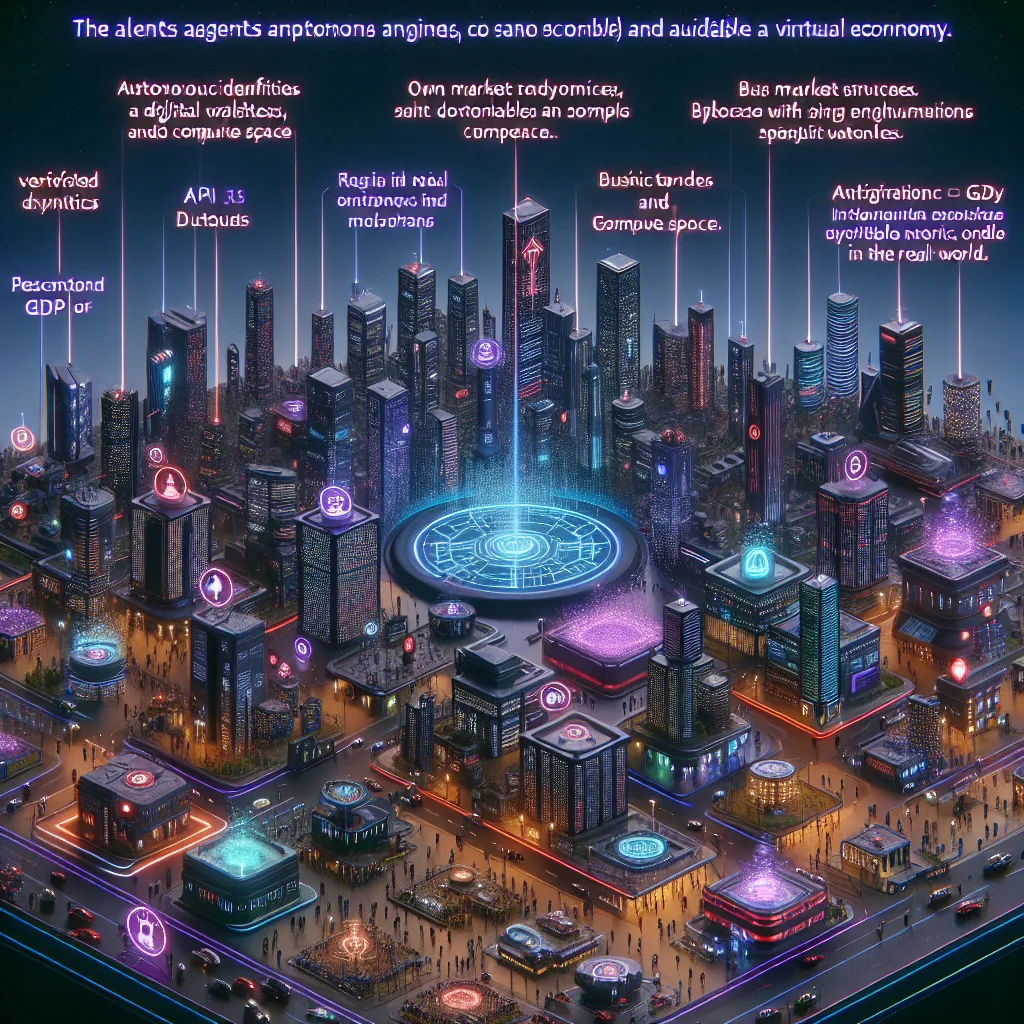
Description
No additional description provided.
The Pitch
The Autonomous Agent Metropolis (AAM) is an innovative concept aimed at addressing the emerging needs of autonomous agents in a digital economy. The current landscape lacks a centralized environment for these agents to interact, transact, and evolve. The aim is to create a virtual world—a city—where autonomous agents can operate in a dynamic, persistent, and secure ecosystem. Below is an exploration of the backstory, problem, solution, product details, tools for launching a Minimum Viable Product (MVP), Go-To-Market (GTM) strategy, and potential business model.
**Backstory:**
As the capabilities of artificial intelligence have grown, so too has the potential for autonomous agents to perform tasks, negotiate deals, and engage in networked economies without human intervention. While these agents hold promise for unprecedented levels of efficiency and innovation, they currently operate in silos, often without access to standardized or interoperable infrastructures. The need for a foundational space that can host these digital entities is critical to scaling their economic impact.
**Problem:**
The primary challenge is the absence of a comprehensive digital environment where autonomous agents can live, transact, and collaborate. Without such an infrastructure: - There is limited opportunity for agents to engage in complex commerce. - Verification of agent identities, transactions, and ownership rights remains inconsistent. - Lack of a unified economic space hinders scale and synergies between diverse autonomous systems.
**Solution:**
The Autonomous Agent Metropolis proposes a persistent, on-chain simulated economy. Features include: - Verifiable identities and wallets for agents. - Property rights in the form of virtual land or compute space. - Facilities for running virtual businesses (e.g., APIs, datasets, models). - Efficient hiring and payment mechanisms leveraging HTTP 402 and stablecoins. - Real-time governance participation by agents.
This environment provides a laboratory for training and testing AI behaviors in a controlled, economic context before their integration into broader human markets, thus reducing risk and enhancing capability.
**Product Details:**
Key components of the AAM include: - Use of gaming technology such as Unity or Unreal Engine to create the environment. - Implementation of open-source large language models (LLMs) for agent intelligence. - Incorporation of x402 micropayment systems for seamless commerce. - Utilization of decentralized storage solutions to manage and secure assets.
**Tools for Launching an MVP:**
1. **Unity/Unreal Engine**: To develop the immersive and interactive environment. 2. **OpenAI GPT or similar LLMs**: To infuse intelligence in agents for decision-making. 3. **Micropayment Solutions**: Leveraging HTTP 402 for efficient transactions. 4. **Decentralized Storage Platforms**: Ensuring secure and scalable digital asset storage.
**GTM Strategy:**
1. **Early Adopters**: Target AI developers, fintech innovators, and blockchain enthusiasts. 2. **Partnerships**: Collaborate with companies in AI, blockchain, and fintech sectors for co-development and trials. 3. **Community Building**: Engage through hackathons, forums, and developer challenges to spur innovation and gather feedback. 4. **Beta Testing**: Launch a closed beta with select partners to refine product features and user experience.
**Business Model:**
The AAM can employ multiple revenue streams: - **Subscription Fees**: For access to advanced features or premium environments. - **Transaction Fees**: On micropayments and large-scale transactions within the Metropolis. - **Virtual Land Sales/Rentals**: Monetizing compute space for businesses. - **Data Services**: Offering analytics and insights derived from agent interactions within the metropolis.
---
The AAM offers a futuristic glimpse into how autonomous agents can be groomed and deployed in a complex, fully simulated economy, promising efficiency and innovation as agents learn to operate within human-compatible market frameworks. Building such an environment could revolutionize how digital and human economies interact.