Automotive Repair Capacity Exchange for Dealerships
Dealership service departments can be booked for weeks while nearby shops have unused technicians, empty bays, or specialized equipment sitting idle. A Technician Capacity Exchange would let dealers route overflow repairs to vetted local partners while keeping the customer relationship and earning a share of the revenue. As technician shortages grow and service becomes more important to dealership profits, flexible capacity could matter more than adding another permanent location. A Honda dealer that cannot handle a transmission repair for ten days could send it to a certified partner that afternoon and still manage the customer experience.
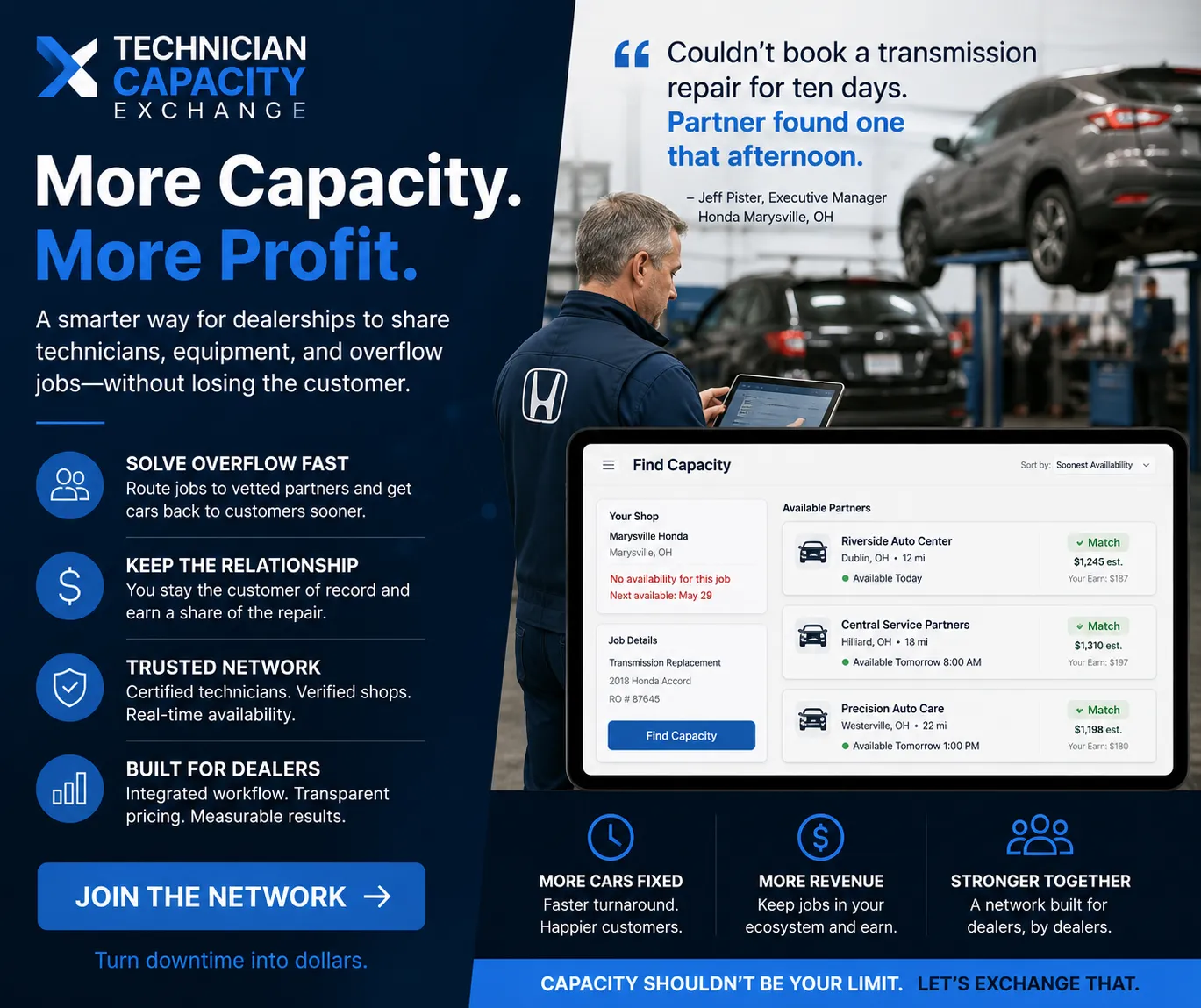
Description
No additional description provided.
The Pitch
The most interesting thing about this business is that it treats auto repair capacity as a perishable asset. An empty bay at 2 p.m. is not just underutilized space; it is inventory that disappears by the end of the day. Meanwhile, a dealer with a two-week backlog is effectively turning away high-margin work while annoying the customer at the exact moment trust matters most. A market that can translate one shop’s delay into another shop’s yield captures value that currently evaporates.
The dealer’s customer relationship is the key constraint and the key opportunity. Most repair marketplaces ask the customer to leave the dealer’s orbit; this idea lets the dealer remain the front door. That matters because service is one of the few recurring relationships a dealer has after the vehicle sale, and giving that relationship away is more expensive than outsourcing the labor behind it. The elegant version of this business is almost invisible to the car owner: the dealer appears faster and more capable, while the actual work is fulfilled by a trusted back-end network.
The timing is compelling because technician scarcity changes the economics of fixed infrastructure. In a looser labor market, a dealer could respond to demand by hiring more people or expanding its own shop. When qualified labor is the bottleneck, owning more bays does not solve much. The better answer is coordination: matching the right job to the right available capability across a local repair ecosystem. That makes service capacity feel less like a set of isolated buildings and more like a distributed network.
Trust and standardization are what would make the exchange defensible. Repair work is not interchangeable in the way a ride or delivery is; quality failures are expensive, emotional, and reputational. A useful exchange would not simply find “someone nearby.” It would know which partner is reliable for which job, what certifications and tools they actually have, how quickly they complete work, and whether their outcomes protect the dealer’s brand. Over time, that operational memory becomes more valuable than the transaction itself.
The deeper business is not overflow handling; it is becoming the coordination layer for a fragmented local service economy. Independent shops have capacity but lack predictable demand. Dealers have demand but not always the capacity to serve it. The company that safely connects those two sides could make the entire market more productive without asking anyone to build a new facility, hire scarce labor they cannot find, or surrender the customer relationships they depend on.