Automated Deadline Tracking and Renewal Agents
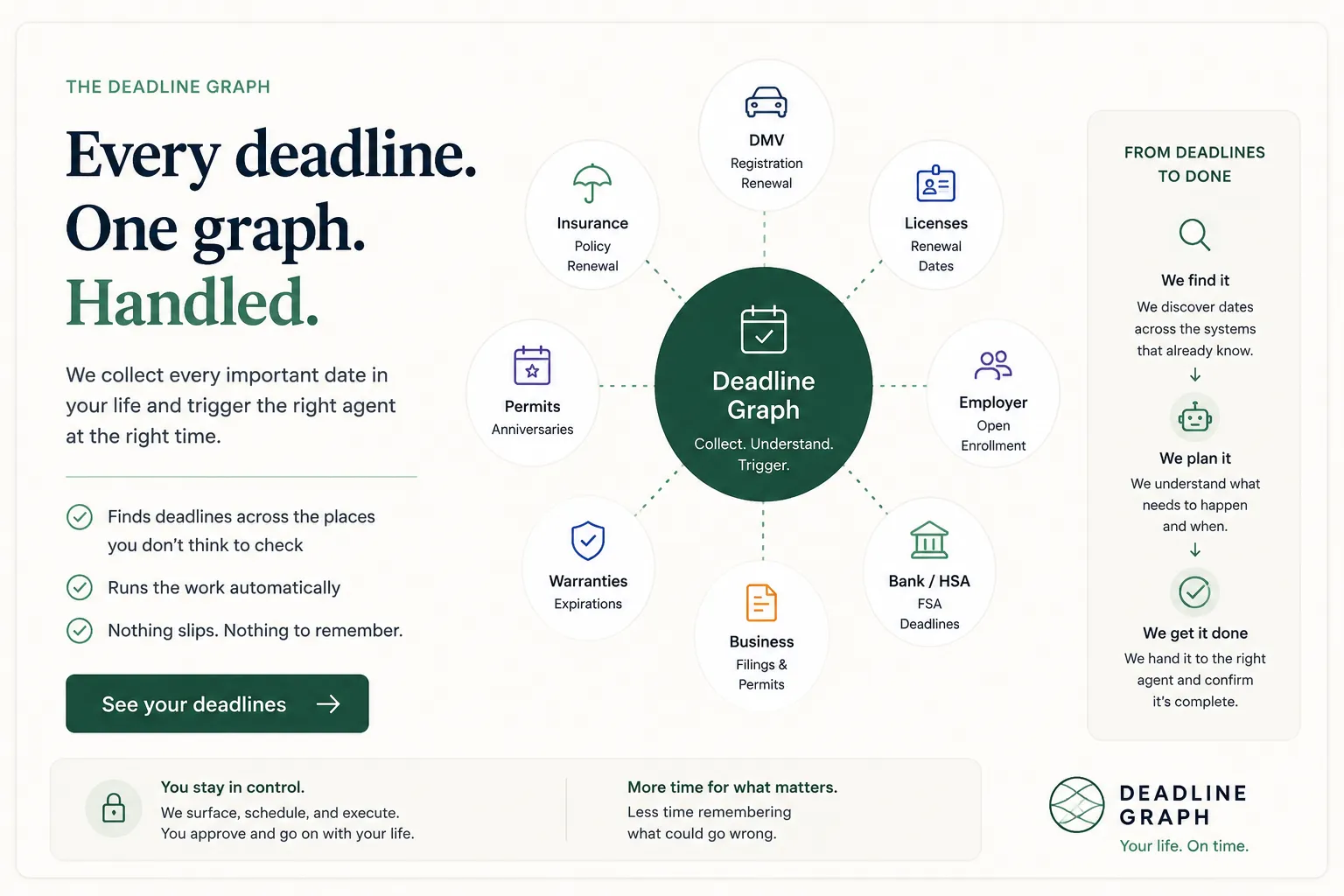
Agents can already do a surprising amount of work once they are told what to do. What they do not have is a reliable way to know when something needs to happen. Registration renewals, professional licenses, HSA and FSA deadlines, warranty expirations, open enrollment, permit anniversaries, insurance policy dates, entity filings. All of these clocks already exist, but they live across the DMV, insurers, employers, states, banks, and software systems, with the person still responsible for remembering them. A deadline graph would pull those dates into one place, understand what each one requires, and trigger the right agent at the right time. That matters more now because agents are getting good enough to actually complete the task, which makes the missing trigger layer much more valuable. Instead of remembering that your car registration expires next month and asking an agent to renew it, the graph sees the date, hands the job to the agent, and gets it done before you ever think about it. Whoever owns that trigger gets to route the task, and routing the task is where the money is.
Description
No additional description provided.
The Pitch
A deadline graph would be compelling because it sits at the point where obligation becomes action. Most software helps people store information or execute tasks, but the valuable moment is often earlier: recognizing that a latent requirement has become urgent. The world is full of quiet, high-consequence timers, and the penalty for missing them is usually not inconvenience but money, lost coverage, compliance risk, or bureaucratic friction. A company that reliably knows when life’s administrative clocks are about to ring would own a strangely intimate and economically meaningful layer of attention.
The non-obvious insight is that reminders are not the product; certainty is. A calendar reminder says “something may be due.” A deadline graph says “this exact thing must happen, under these rules, using these documents, before this date.” That distinction matters because the difficulty is not merely remembering the date, but interpreting the obligation. Two people may both have a renewal date, but one needs an inspection, another needs an employer form, another needs proof of insurance, another needs a state-specific filing sequence. The business becomes defensible if it turns scattered institutional dates into structured, actionable obligations.
It also benefits from a rare alignment of user value and distribution power. People do not want another dashboard for chores they resent; they want the chore to disappear. But the same system that removes the chore also becomes the natural place to choose who performs it. If a deadline requires an insurer, tax preparer, government filing service, bank, repair shop, benefits administrator, or legal provider, the deadline owner has context before anyone else. That context is more valuable than generic lead generation because the need is verified, time-bound, and often mandatory.
The most interesting version of this company would become more useful as life gets more complex. Every additional account, asset, license, dependent, job change, state move, or small business entity creates more clocks and more ways to fail. Complexity usually creates demand for experts, but here it creates demand for memory infrastructure. The business works because modern life keeps creating obligations faster than people can build habits around them.
If agents become abundant, the scarce asset is not the ability to click through forms; it is knowing which forms matter right now. The trigger layer becomes the practical operating system for delegated work: not a place where people ask for help, but the system that knows help is needed before the person does.