Audience-Based Lending Underwriting Standard
Companies routinely describe their audiences as assets, but lenders rarely treat the audience itself as one. Audience Collateral would create an underwriting standard for permissioned audiences based on verified reachability, engagement persistence, acquisition cost, historical monetization, churn and replacement cost. A business with 800,000 highly engaged subscribers could establish an independently verified audience value and borrow against a portion of its expected future economics. Revenue tells you what an audience produced yesterday. Audience collateral attempts to finance what the relationship itself is worth tomorrow.
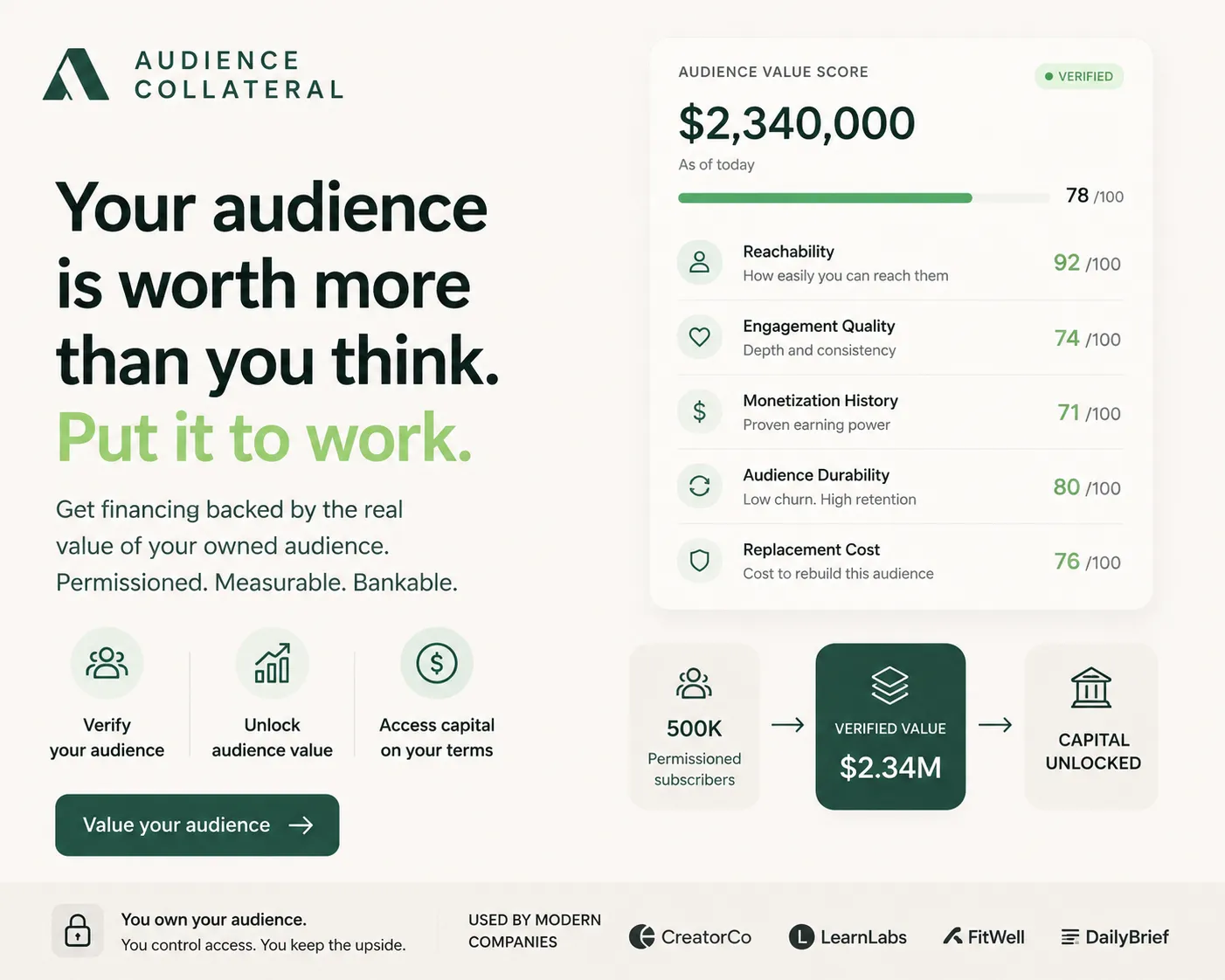
Description
No additional description provided.
The Pitch
A large permissioned audience is one of the few business assets that can be both liquid and invisible. It can move revenue quickly, lower customer acquisition costs, and give a company strategic resilience, yet it rarely appears on a balance sheet in a form a lender can use. That mismatch creates an opening: many media companies, creators, marketplaces, newsletters, consumer brands, and communities are richer in trusted attention than they are in hard assets, but the credit system still behaves as if inventory, equipment, or receivables are more real than a reachable customer relationship.
The strongest version of this business would not be lending against “followers” in the vague social-media sense. It would be creating a new measurement category around durable, permissioned demand. The valuable audience is not the largest one; it is the one that can be repeatedly reached, measured, reactivated, and monetized without starting from zero each time. That distinction matters because modern companies often spend years and millions of dollars assembling audiences that are expensive to rebuild, but then finance themselves as if those audiences have no salvage value.
The compelling insight is that attention has become more expensive at the exact moment distribution has become less dependable. Algorithmic platforms made rented audiences feel abundant, then reminded businesses that access can disappear overnight. A verified owned audience becomes a hedge against that instability. If a lender can distinguish between rented reach and durable permission, the audience begins to look less like marketing fluff and more like infrastructure: a private distribution channel with measurable replacement cost.
This would also change behavior. Once audiences can be valued by persistence, reachability, and monetization history, companies have a financial reason to maintain the health of the relationship rather than merely exploit it. Spammy growth, low-quality acquisition, and vanity metrics become liabilities because they weaken the collateral. In that sense, the underwriting standard could quietly reward better audience stewardship: cleaner consent, stronger engagement, lower churn, more resilient trust.
The business is interesting because it would sit between two worlds that currently misunderstand each other. Lenders understand predictable cash flows but often ignore the asset that produces them; audience-led businesses understand the power of trust but struggle to translate it into financeable terms. A credible standard would not just unlock loans. It would give the market a language for one of the defining assets of the digital economy: the right to be heard by people who still want to listen.