API for Verified Earth Observation Data
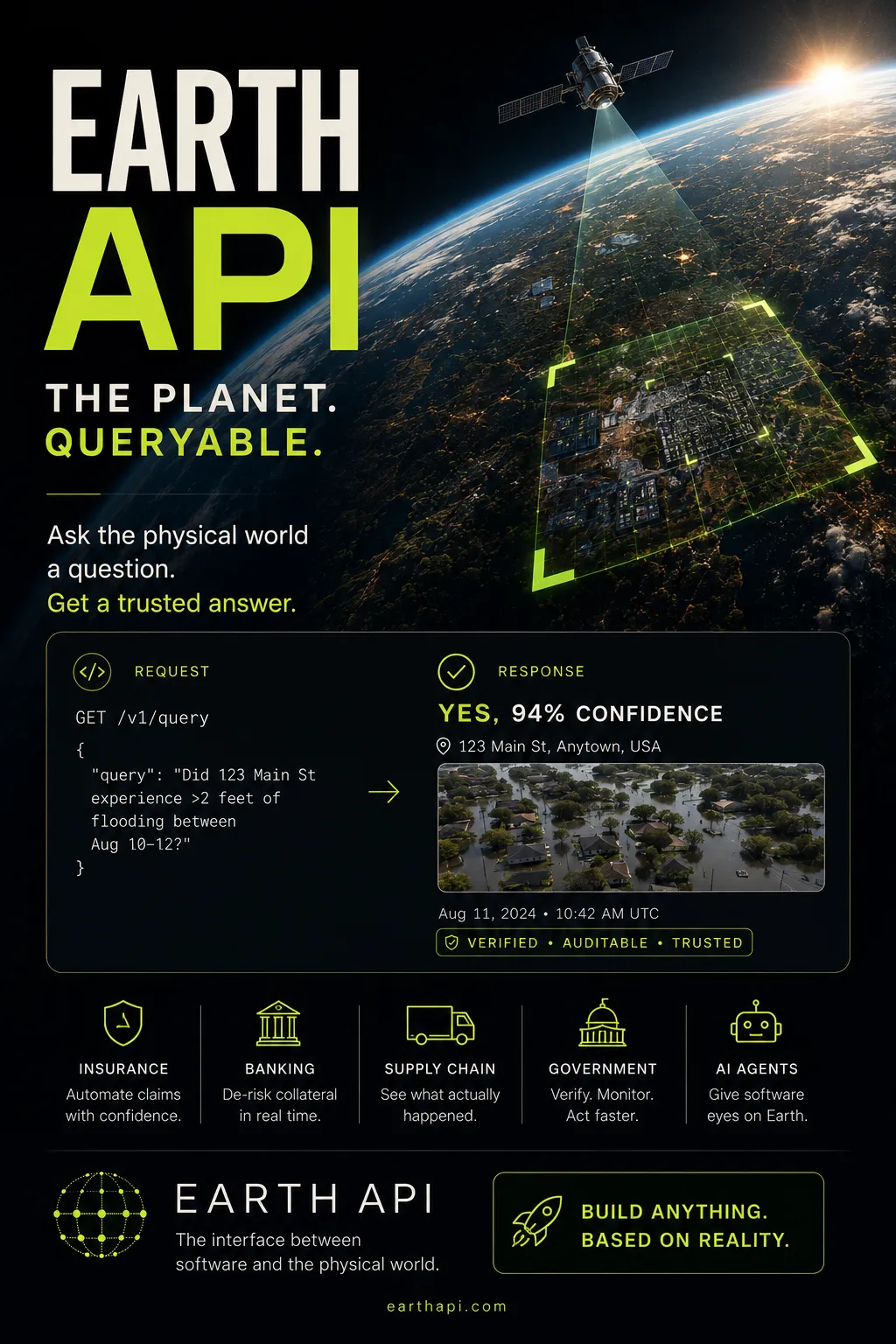
The internet has APIs for payments, identity, maps and communication, but there is no API for asking the physical world a question and getting a trusted answer. Earth API would make the planet queryable. A developer could ask whether a building has a new roof, whether a field flooded, whether trees are approaching a power line, whether construction actually started, whether a ship unloaded, or whether a factory appears operational, and receive a timestamped answer generated from satellites, drones, weather sensors, public cameras and other observation networks. This becomes possible because observation is getting dramatically cheaper while multimodal AI can turn raw imagery into answers instead of requiring analysts to inspect it. An insurer could write Did 123 Main Street experience >2 feet of flooding between August 10–12? and Earth API would return YES, 94% confidence, supporting evidence and a verification record that could automatically release a claim. If this works, the company isn’t selling satellite imagery. It becomes the machine-readable interface between software and the physical world, allowing insurers, banks, governments, logistics companies and eventually AI agents to ask Earth questions and take actions based on the answers.
Description
No additional description provided.
The Pitch
Most institutions already make expensive decisions based on beliefs about the physical world, but those beliefs are still gathered like bespoke detective work. An insurer, lender, trader, city agency, or logistics operator does not really want imagery; it wants permission to act. Today the gap between “something happened out there” and “our system can safely do something about it” is filled by adjusters, inspectors, field reports, PDFs, phone calls, and delayed human judgment. A trusted answer layer compresses that gap into software.
The non-obvious opportunity is that the value is not in seeing more of the planet, but in making observations admissible inside workflows. Raw pixels are abundant and becoming cheaper; defensible conclusions are scarce. If an answer can be timestamped, sourced, confidence-scored, and audited, it becomes closer to a record than a recommendation. That matters because large organizations do not merely need to know what is true; they need a version of truth that can survive disputes, compliance reviews, counterparties, and automated execution.
This would also create a new kind of data network effect. Each question teaches the system what the world’s institutions care about, which sensors are reliable for which conditions, and where ambiguity tends to arise. Over time, the company accumulates not just imagery or sensor feeds, but a map of verifiable change: which roofs were replaced, which roads washed out, which assets moved, which fields recovered, which buildings became active. That history is far more valuable than any single observation because it becomes a continuously updated memory of the physical economy.
The business works because the same primitive repeats across many high-value domains: resolve uncertainty about a place, object, or event, then trigger a financial, legal, operational, or safety decision. The questions vary, but the underlying need is consistent. In a world where software increasingly acts on behalf of companies, the bottleneck becomes trust in offscreen reality. The company that provides that trust could become as fundamental as payment rails or identity verification, except its domain is everything that happens outside the database.