API for Automated Transaction Failure Recovery
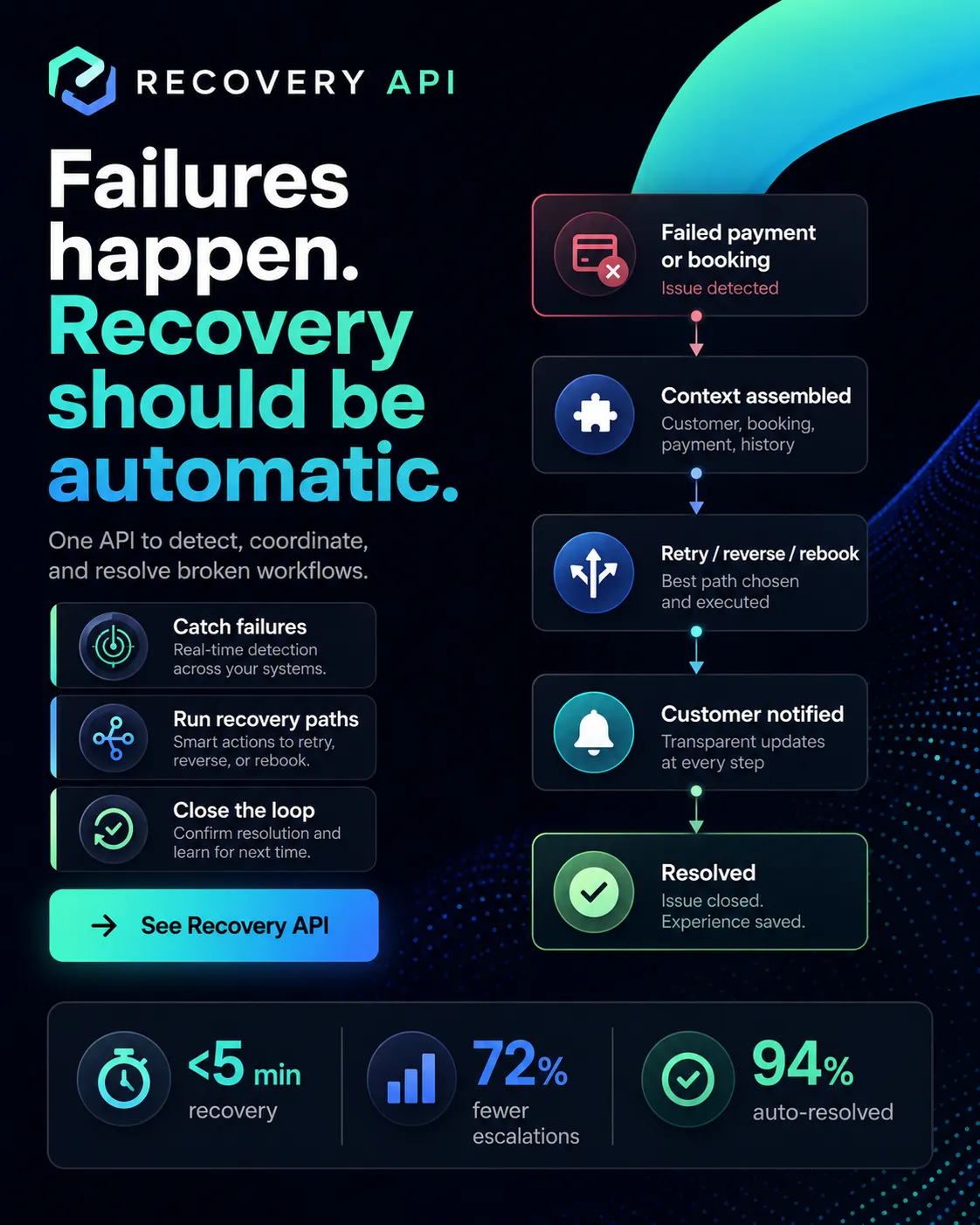
Companies build APIs for creating accounts, sending payments and booking reservations, but almost never expose a standardized way to recover when those actions fail. Recovery API would give product teams a single endpoint for resolving operational failures: send the failed transaction plus context, and the system determines and executes the safest available recovery path. Why now: more business processes are automated end to end, which means exceptions increasingly cross multiple vendors and internal systems that no single application knows how to repair. Example: a travel booking fails after payment authorization. The API coordinates inventory, payment reversal, rebooking and customer notification rather than sending the customer into a support queue.
Description
No additional description provided.
The Pitch
The interesting thing about operational failure is that it is usually treated as an edge case, even when it is where much of the cost and customer damage actually lives. Most software is designed around the happy path: create the booking, issue the refund, submit the order, provision the account. But the business does not experience failures as isolated technical errors. It experiences them as incomplete promises. A company that owns the recovery layer would sit at the exact point where a broken workflow becomes either an expensive human task or a preserved customer relationship.
The reason this could become a valuable business is that recovery logic is both highly repetitive and strangely bespoke. Every company has some version of “payment succeeded but fulfillment failed,” “identity check passed but account creation stalled,” or “vendor A accepted while vendor B rejected.” Today these cases are often handled by tribal knowledge buried in support playbooks, Slack escalations, and one-off scripts. That makes them invisible to the systems that caused them. Standardizing recovery would turn a messy operational habit into programmable infrastructure.
A recovery system would also become more useful as it sees more failure patterns. The same surface error can require very different responses depending on timing, vendor state, customer status, regulatory constraints, and whether money or scarce inventory is involved. This is not just automation; it is judgment under constraint. If the system can learn which remedies are safe, reversible, and preferred across many environments, it becomes a kind of institutional memory for failures that individual companies rarely encounter often enough to handle well.
The business is compelling because companies already pay for failure, just indirectly. They pay through support teams, refunds, chargebacks, manual operations, customer churn, and engineering time spent debugging one-off incidents after the damage is done. A recovery layer would not need to convince companies that the problem matters; it would reveal that a surprising share of operational expense is simply unstructured exception handling.
The most durable position would come from being neutral between systems. Individual vendors can fix failures inside their own walls, but modern failures often span payment processors, logistics providers, identity tools, CRMs, and internal databases. The company that understands the whole failed transaction, rather than one component’s error code, becomes the natural place to decide what should happen next. That is a rare and valuable vantage point: not the system of record, but the system of repair.