API Cost Routing Layer for AI Agents
AI agents can make tens of thousands of calls a day into Salesforce, HubSpot, Atlassian, and other enterprise systems, turning what used to be a software subscription into a massive new API bill. Build a routing layer that decides the cheapest legitimate way to answer every agent request before it hits the source system. If the agent needs a live account status, call Salesforce; if it needs last quarter’s data, use the warehouse; if the same information was just requested, serve it from cache; if the data rarely changes, use a local replica. This matters now because agents are dramatically increasing machine-to-machine traffic just as software companies are beginning to charge separately for that access. Imagine a revenue agent making 40,000 CRM requests a day and automatically reducing 90% of them to cached or replicated data while preserving live calls for the few requests that actually need fresh information. That's a product that needs to exist.
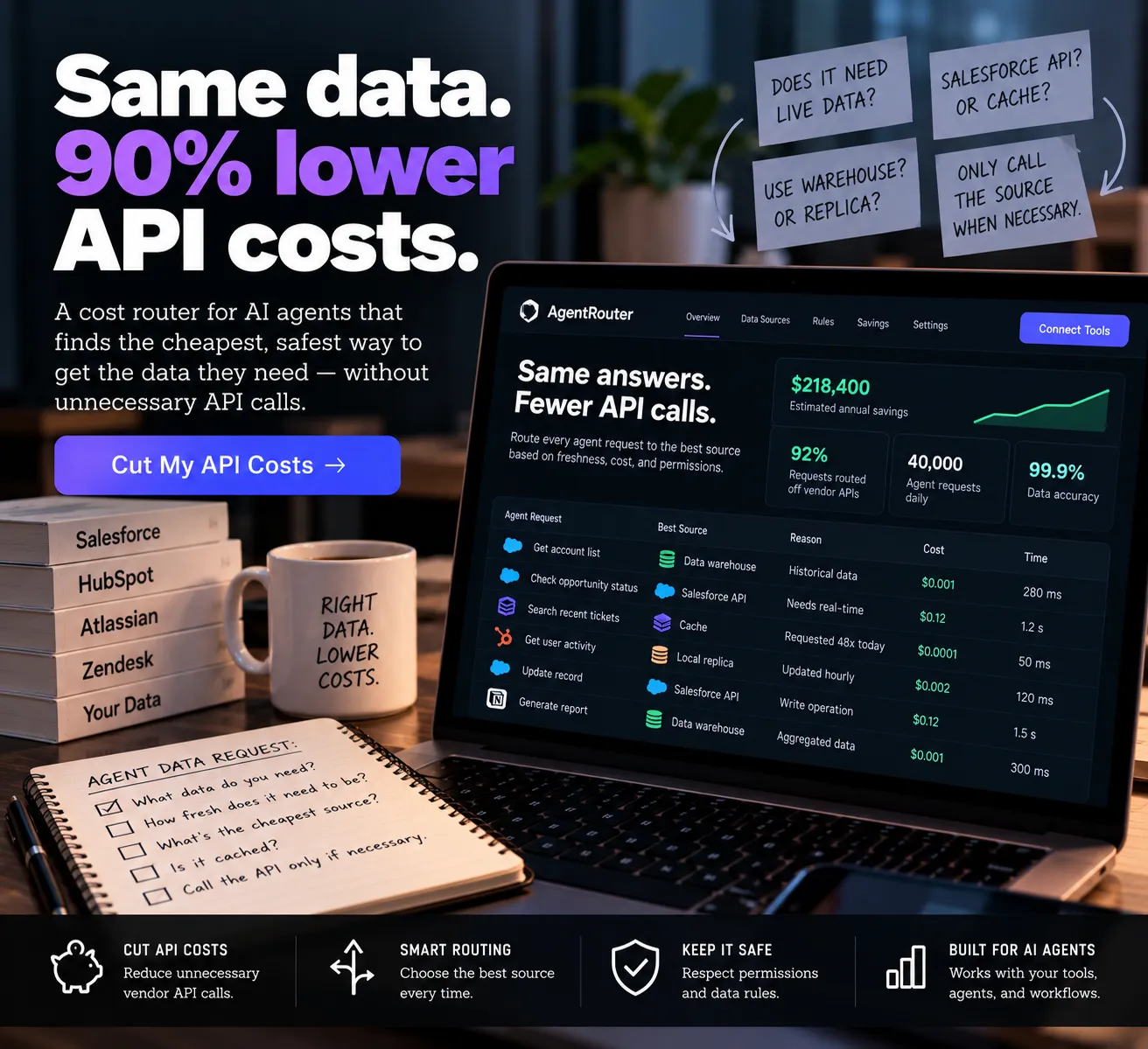
Description
No additional description provided.
The Pitch
Enterprise software was priced for humans, but AI agents behave like extremely fast, extremely literal employees who never stop clicking. A CRM seat made sense when one salesperson looked up an account a few dozen times a day. It breaks when an agent decomposes one business question into hundreds of tiny reads across contacts, opportunities, notes, tickets, and activity history. The cost problem is not “APIs are expensive” in the abstract; it is that the unit economics of SaaS access were designed around human friction, and agents remove that friction.
The most interesting wedge is that freshness is not binary. Companies often treat source systems as sacred because they confuse “authoritative” with “always necessary.” In reality, most enterprise questions have a hidden tolerance for staleness. A commission calculation may need yesterday’s bookings, not this second’s pipeline movement. A support summary may need the latest open ticket, but not the latest spelling change in an account description. A business that understands the difference between authoritative, recent, good-enough, and live data can turn access into an optimization problem rather than a default tax.
This also creates a new control point inside the enterprise stack. Today, systems of record sit behind user interfaces, workflows, and reporting tools. Agents invert that architecture: they ask for raw context directly and constantly. Whoever governs those requests sits between intelligence and memory. That layer can enforce not only cost discipline, but also data minimization, permission boundaries, auditability, and source preference. The economic buyer may start with API spend, but the enduring value is that the company becomes the traffic controller for machine consumption of enterprise knowledge.
The business would likely be durable because every major application vendor has an incentive to meter access more aggressively as agent traffic grows. At the same time, every enterprise will want agents to use more context, not less. That tension creates a persistent market: software vendors monetize access, agents hunger for access, and customers need an intermediary that makes access sane. The more agents a company deploys, the more valuable the routing layer becomes, because waste compounds faster than headcount ever did.
The deeper insight is that AI does not just create new applications; it changes the cost structure of old ones. A company that prevents intelligent systems from bankrupting themselves on unnecessary retrieval could become as essential as observability became for cloud infrastructure. It would exist because automation makes invisible software consumption visible, measurable, and worth managing.