Anonymous Organizational Benchmarking Intelligence Platform
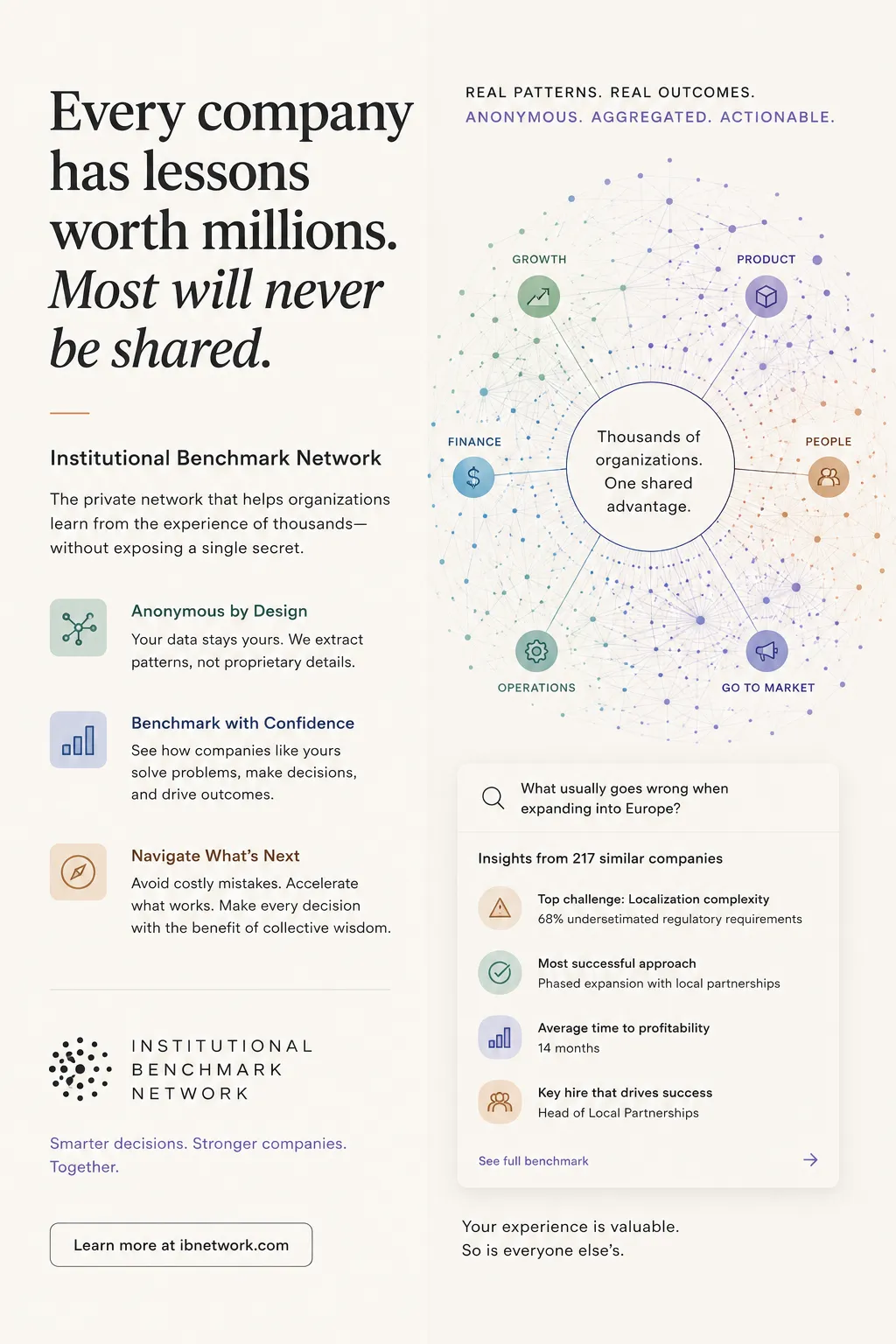
Every company is building its own private memory system, but those systems are completely isolated. Thousands of organizations are independently solving the same operational problems without learning from one another. This startup anonymously aggregates organizational patterns across customers without exposing proprietary information. Instead of asking, “How did our company handle this?” leaders can ask, “How do companies at our stage typically solve this problem?” The product surfaces common failure modes, implementation patterns, organizational benchmarks, and emerging best practices from across the network. The timing works because AI-generated organizational memory is exploding, creating structured data about how companies actually operate for the first time. The long-term moat isn’t better search. It’s the network of organizational intelligence that no single company could build alone.
Description
No additional description provided.
The Pitch
Most management knowledge is trapped in two bad formats: polished case studies that omit the messy parts, and private internal documents that no one outside the company can see. The most valuable lessons inside organizations are rarely strategic secrets; they are mundane truths about rollout failures, approval bottlenecks, hiring ratios, tooling decisions, escalation paths, and what broke at 200 employees but not at 50. These are exactly the things companies most need to know, and exactly the things the market has no efficient way to share.
The interesting shift is that companies do not actually want another source of advice. They want a comparison set. Leaders are surrounded by opinions from executives, consultants, peers, and software vendors, but almost none of it answers the quiet question behind operational decisions: “Are we unusually broken, or is this normal?” A product that can distinguish idiosyncratic dysfunction from predictable growing pains would become a kind of organizational weather map. It would not need to tell every company what to do; it would make the terrain visible.
The defensibility comes from the fact that the underlying data has increasing returns to trust. No individual customer has enough examples to know which patterns generalize, and no public corpus contains the sensitive operational residue required to answer well. But if the system can protect anonymity while preserving context, every participant improves the map for everyone else. The unusual asset is not documentation itself, but normalized evidence of how work changes across size, industry, maturity, and structure.
This also reframes benchmarking from a static report into a living diagnostic. Traditional benchmarks flatten companies into numbers: revenue per employee, attrition, sales cycle length. The deeper questions are comparative and procedural: when do companies add a RevOps layer, what breaks when product managers report into business units, how often does a new planning process survive its second cycle? Those answers have economic value because they compress years of painful trial and error into a narrower set of plausible moves.
The strongest version of this company would become the missing institutional layer between private experience and public management theory. It would let organizations learn from one another without becoming exposed to one another. If it worked, the surprising consequence is that operational excellence would stop being quite so dependent on having already worked at the right company before.