Anonymous Consumer Demand Auction Marketplace
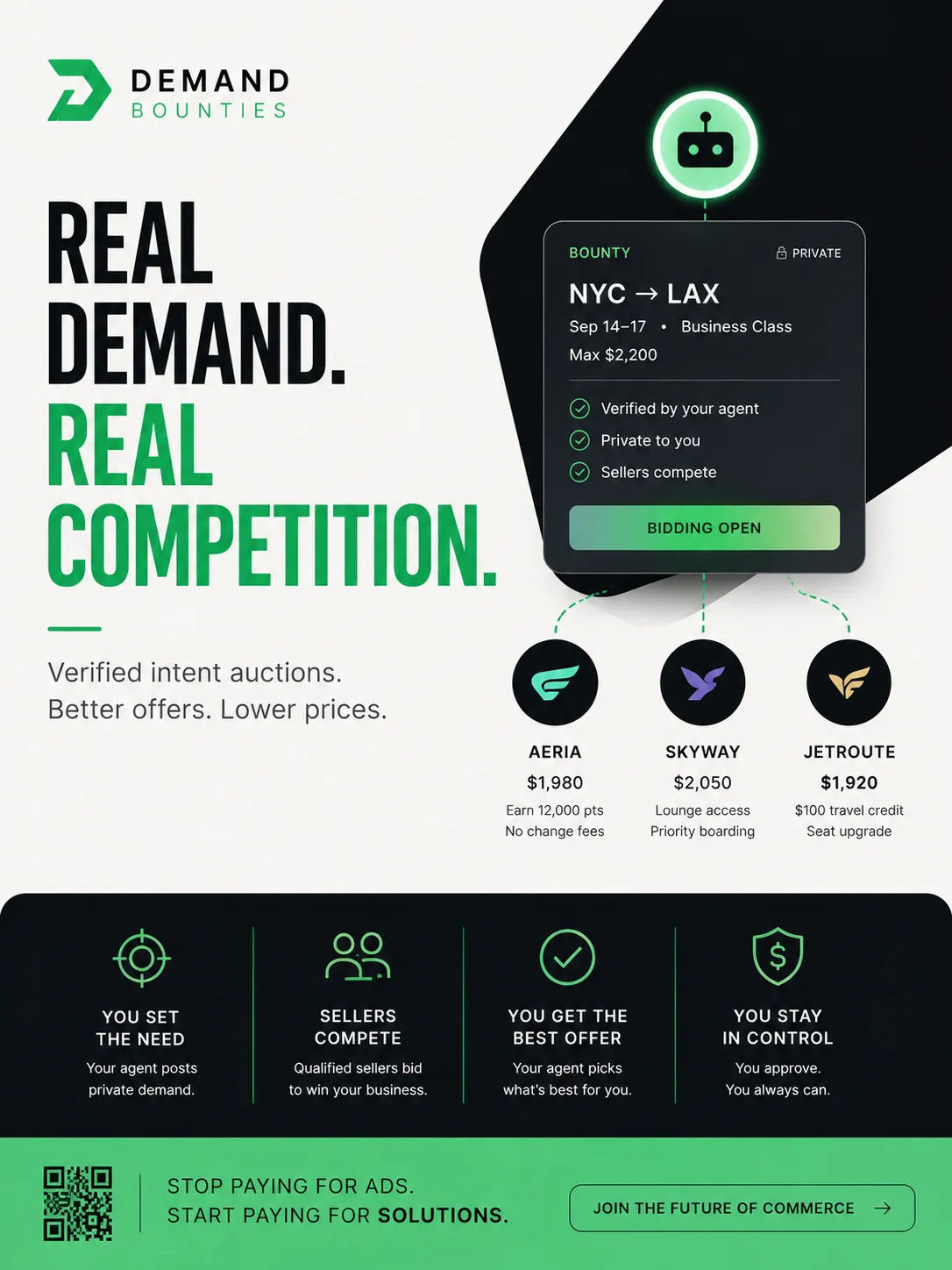
Companies are already making products machine-readable and publishing agent-readable incentives. Flip the market around. Demand Bounties would allow consumer agents to auction unfulfilled intent without revealing the consumer's identity. Instead of Delta advertising flights hoping someone wants one, an agent could broadcast: "Verified buyer wants EWR→LAX, business class, September 14–17, <$2,200." Qualified sellers then compete by creating offers specifically for that demand, while the agent evaluates them against private preferences. Businesses stop purchasing probabilistic attention and start purchasing the opportunity to satisfy verified demand that already exists. Google built an auction for people's attention; Demand Bounties would build an auction for the right to solve people's intentions.
Description
No additional description provided.
The Pitch
A market for verified intent would be compelling because it changes the most expensive part of commerce: uncertainty. Most selling today begins with a guess that the right person might be persuaded at the right moment. That guess is embedded in ad budgets, retargeting systems, sales teams, abandoned cart emails, and loyalty gimmicks. If a buyer’s agent can credibly say “this purchase is real, funded, and imminent,” the seller is no longer buying influence over a stranger. It is buying access to a transaction that is already trying to happen.
The strange power of this idea is that anonymity could make demand more valuable, not less. In today’s market, personalization usually means surveillance: the seller learns who you are, then uses that knowledge to shape the offer. But many preferences are valuable precisely because they do not require identity. An airline does not need to know your name to know that a real traveler wants a specific route, cabin, date range, refund rule, and price ceiling. Stripping identity out of the transaction could reduce manipulation while preserving the commercial signal that matters most.
It would also create a new kind of price discovery. Prices today are often posted by sellers and searched by buyers, with the buyer doing the labor of comparison. Demand bounties invert that labor: the buyer defines the job, and sellers reveal how badly they want to fulfill it. This is especially powerful in categories with perishable inventory, opaque pricing, or high customer acquisition costs. A hotel room, mortgage quote, insurance policy, medical appointment, or software contract is often worth more or less depending on the exact buyer and moment. A live demand signal lets sellers discriminate around fit rather than around attention.
The deepest shift is that agents could become trusted market participants rather than just shopping assistants. A consumer’s agent would know the preferences the consumer should not have to restate: tolerance for layovers, brand exclusions, refund anxiety, delivery urgency, ethical constraints, hidden budget flexibility. Sellers would compete in public on the parts of the offer that matter, while the agent keeps the buyer’s private utility function private. That makes the agent less like a search box and more like a personal procurement department.
If this existed at scale, advertising would not disappear; it would be demoted. Discovery still matters when people do not know what they want. But once intent is formed, the rational market is not one where sellers shout louder. It is one where they bid to be chosen.