Algorithm-Free Chronological Social Network
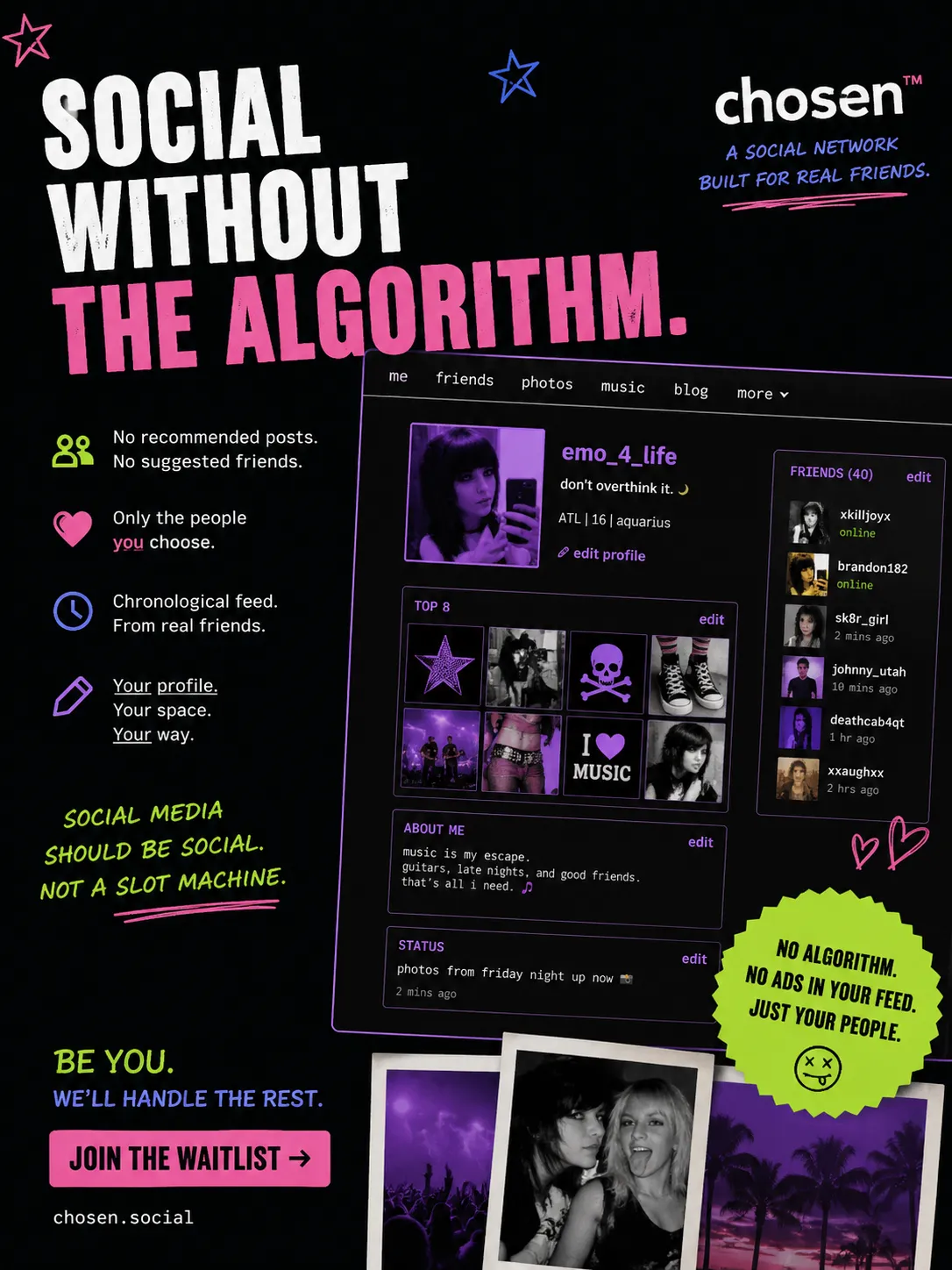
The Algorithm-Free Social Network — Social media used to be a place you made your own. Now most platforms decide what you see, who you discover, and what deserves your attention, while AI-generated content is making those feeds even less personal. Build a social network with no recommendation algorithm, suggested posts, influencers, or viral feed. You choose your friends, customize your profile, pin music and photos, and see posts from those people chronologically. The timing makes sense as Myspace considers a comeback and younger consumers increasingly romanticize the pre-algorithm internet. A teenager could build a ridiculous purple profile, add 40 actual friends, post photos from Friday night, and know that everyone seeing them intentionally chose to be there. The next social network might grow by giving people less to see.
Description
No additional description provided.
The Pitch
Built on the idea that scarcity can be a feature in a market addicted to abundance. Most social products compete by increasing surface area: more videos, more strangers, more prompts, more reasons not to leave. But that has made them feel less like places and more like weather systems. A network that deliberately limits what can enter the room could become valuable precisely because it restores a sense of edges. If only chosen people appear, every post carries a different social weight.
The deeper opportunity is that algorithmic feeds have quietly weakened the meaning of “friend.” On most platforms, friendship is now just one weak signal among many, easily outranked by entertainment, outrage, or professional content optimized for strangers. A smaller chronological network would make the social graph feel consequential again. Adding someone would matter because it changes the entire experience, not because it feeds another ranking model. That shift turns the product from a broadcast channel into a shared container for actual relationships.
There is also a generational irony here: young users who grew up inside perfectly optimized apps may be unusually receptive to clumsy self-expression. Custom profiles, bad layouts, favorite songs, inside jokes, and visual chaos are not just nostalgia; they are proof that a human made the space. As AI makes content cheaper and smoother, evidence of personal taste becomes more precious. The imperfection is not a bug but the trust signal.
The business would work if it understood that “less addictive” does not mean “less loved.” People may spend fewer minutes in a place that shows only real friends, but those minutes could be more emotionally durable. A product that becomes the private record of a friend group, a school year, a scene, or a phase of life does not need to win every idle moment. It needs to become the place people are sad to lose.
The most interesting bet is that social media’s next premium quality may be absence: no strangers, no ranking, no ambient competition with the entire internet. In a world where every feed is trying to become television, there is room for a product that behaves more like a bedroom wall.