AI Tool for Discovering Proprietary Data Assets
Every company is unknowingly sitting on proprietary data that could become dramatically more valuable because of AI. Most organizations never realize they own unique datasets until someone else builds a business around them. Imagine an AI that scans a company's products, users, operations, and historical data to identify hidden data assets that could become licensing businesses, AI training datasets, or entirely new product lines. As AI creates enormous demand for unique proprietary data, companies need a way to discover the assets they already own.
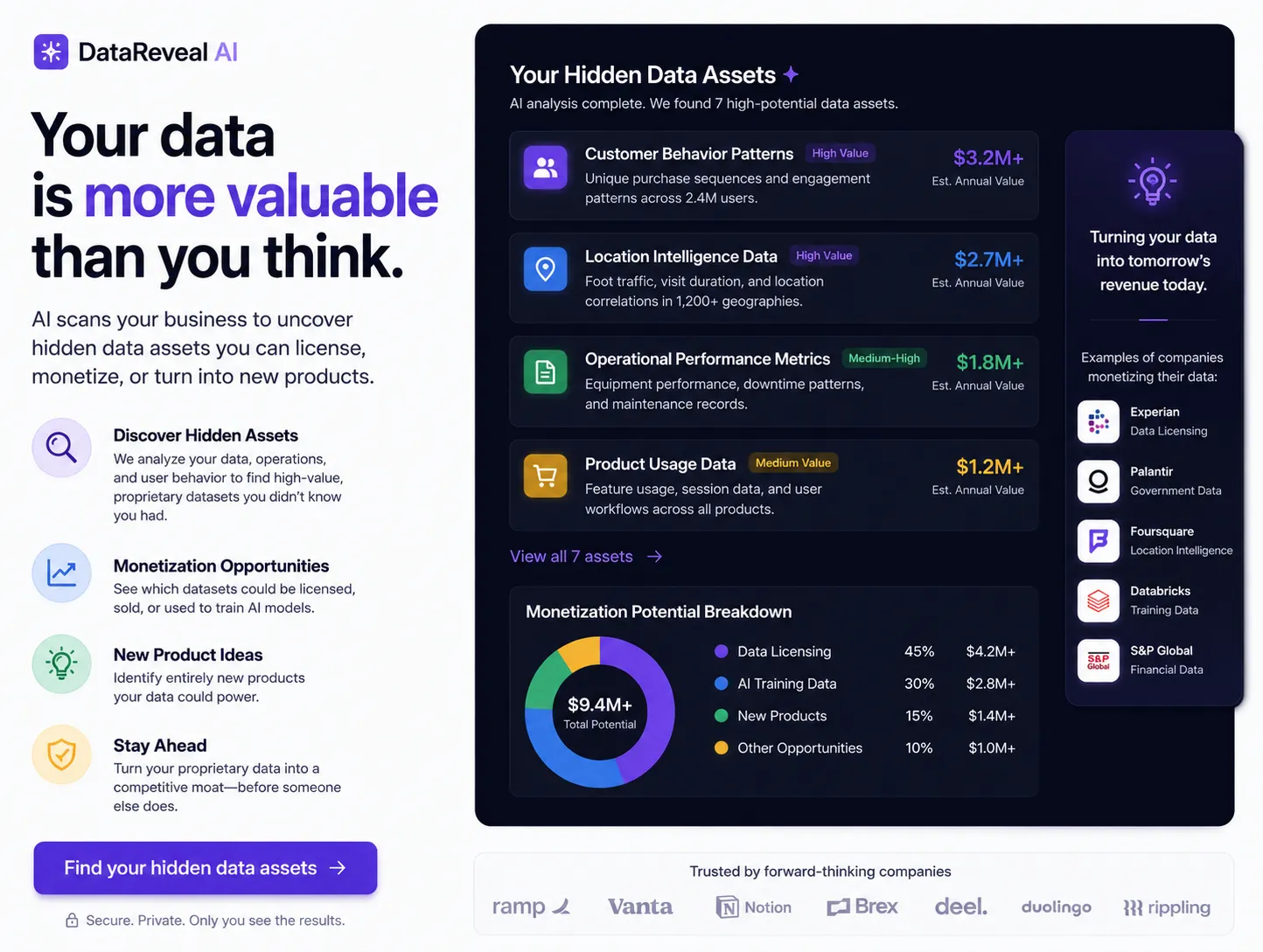
Description
No additional description provided.
The Pitch
Treats data not as exhaust, but as inventory. Most companies know how to value software, customers, brand, and distribution; they are much worse at valuing the strange byproducts of operating their business. A logistics company may have years of exception-handling data that reveals where supply chains actually break. A healthcare workflow tool may have de-identified patterns about administrative bottlenecks. A vertical SaaS company may have the cleanest map of how an industry behaves day to day. These assets often sit below the threshold of executive attention because they were never labeled as products.
AI changes the accounting. Data that was once too narrow, messy, or obscure to monetize can become valuable when models need domain-specific examples, edge cases, workflows, annotations, and behavioral traces. The paradox is that the most useful datasets for AI are often not the obvious ones. They are buried in operational systems, support logs, transaction histories, compliance archives, usage patterns, and human corrections. The business works if it can see commercial meaning in what looks like residue.
There is also a timing advantage: companies are increasingly afraid of giving away their data too cheaply, but they do not yet know what “cheaply” means. Legal teams can block data sharing; executives can demand AI strategies; product teams can imagine new features. But very few organizations can look across the whole company and say, “This specific dataset is rare, defensible, permissible to use, and valuable to someone else.” That translation layer becomes important because the bottleneck is not storage or modeling. It is recognition.
The most interesting wedge is that the buyer may not be trying to become a data company. They may simply want to know what should not be leaked, what could be licensed, what could improve their own products, and what deserves governance. Discovery precedes strategy. A company that can produce a credible map of hidden data assets becomes useful even before any monetization happens, because it changes how management sees the firm.
If this existed, it could create a new category of corporate self-knowledge. Balance sheets record assets that accountants know how to name. AI is making unnamed informational assets economically legible. The durable business is not merely finding datasets; it is teaching organizations to see themselves as owners of scarce machine-readable experience.