AI Tool for Capturing Manual Workflow Knowledge
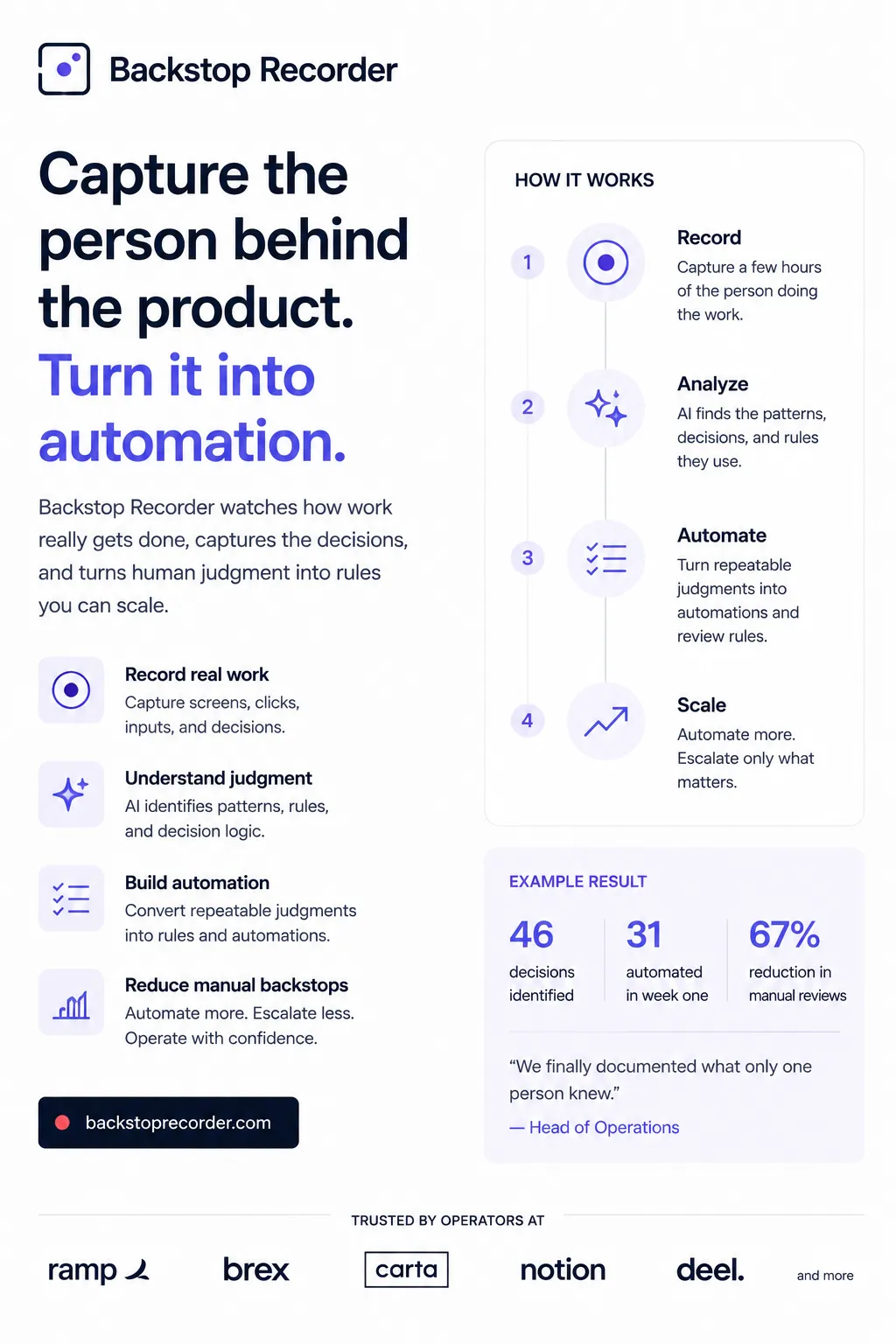
Companies often have one founder, analyst or contractor quietly doing the work that keeps an automated product accurate, but nobody has documented exactly what that person knows. Backstop Recorder watches the human perform the work, captures the inputs, decisions and corrections, then turns repeated judgment into explicit rules and automation candidates. Why now: multimodal AI can understand screens, actions and explanations well enough to extract operating knowledge that previously required weeks of process mapping. Example: a founder manually reviews every marketplace listing; after a week, the product identifies 46 recurring decisions, automates 31 and creates clear review rules for the rest.
Description
No additional description provided.
The Pitch
Many “automated” companies are secretly held together by undocumented human judgment. The software looks scalable from the outside, but inside there is often a person who knows which edge cases matter, which exceptions can be ignored, and which customer requests are symptoms of a deeper rule. That knowledge is not in the codebase, the wiki, or the dashboard. It lives in muscle memory. A company that can extract it turns an invisible operational liability into an asset.
The strongest market is not businesses that know they need process documentation. It is businesses that believe they already built automation, but still depend on one unusually competent person to keep it true. These companies have a painful asymmetry: they can measure output, but they cannot see the judgment producing it. When that person is unavailable, quality drops in ways that are hard to diagnose. Capturing the work while it is being done is far more valuable than asking someone to explain it afterward, because experts usually cannot fully articulate their own shortcuts until those shortcuts are observed.
This also changes the economics of internal automation. Traditional automation starts with an analyst interviewing people, drawing workflows, and translating them into rules. That is slow, political, and often wrong because people describe the official process instead of the real one. Watching actual work creates a different source of truth: not what the company thinks happens, but what repeatedly happens when accuracy is on the line. The business works if it becomes the audit trail between human discretion and machine execution.
The result is not just labor savings. The more durable value is that a company can preserve its operating taste. In many products, quality depends on hundreds of tiny calls: what counts as spam, which listing feels suspicious, when a customer complaint deserves escalation, which vendor output is “good enough.” Those judgments define the product as much as the interface does. A system that captures them gives companies a way to scale taste without flattening it into generic rules.
This is especially interesting because the first customer may be the person whose work is being recorded, not their replacement. The person doing the backstopping is usually trapped: too important to stop, too busy to document, and too close to the work to train others well. A tool that turns their repetitive judgment into shared operating memory gives them leverage. The business becomes compelling because it sells something companies rarely know how to buy directly: the conversion of tacit competence into institutional capability.