AI Rollup for Service Business Automation
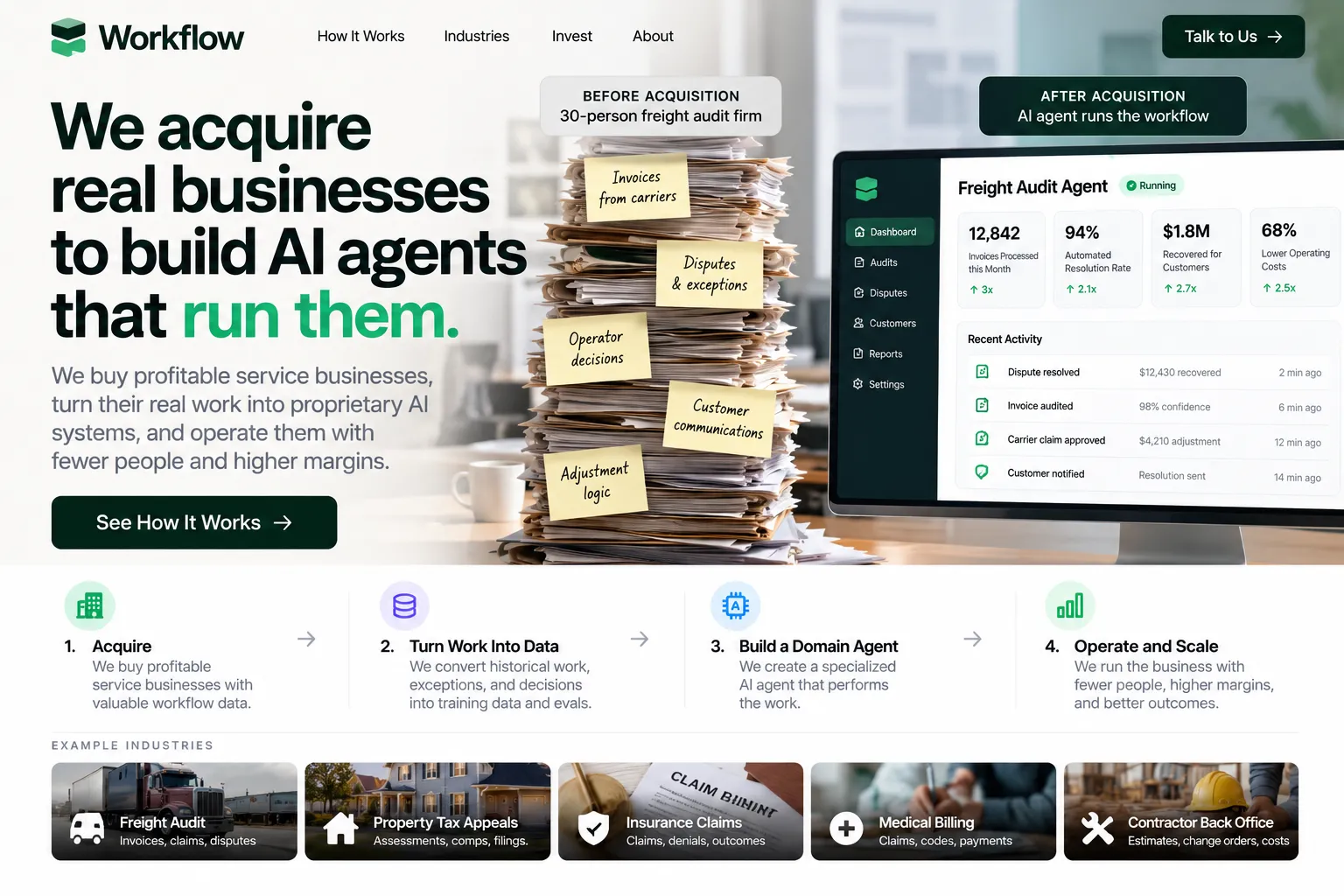
Small service businesses often look valuable because of their customers and cash flow, but many are sitting on something even more valuable: years of proprietary examples showing exactly how a specialized job gets done. Build an acquisition company that buys boring service businesses specifically to turn their historical work, exceptions, decisions, and outcomes into the dataset and evals needed to build a domain-specific AI agent, then uses that agent to operate the business with dramatically lower costs. This becomes possible now because AI can finally learn complex professional workflows from messy real-world records while thousands of profitable service companies already possess the data needed to train those systems. Imagine buying a 30-person freight-audit firm not just for its revenue, but because ten years of invoices, disputes, adjustments, and operator decisions contain the knowledge required to build the agent that eventually performs most of the work. That’s a product that needs to exist.
Description
No additional description provided.
The Pitch
The interesting asset is not the service business itself, but the accumulated residue of judgment inside it. In many narrow industries, the valuable know-how was never written as software because it lived in email threads, spreadsheets, annotated PDFs, exception logs, and the instincts of long-tenured employees. These records are usually treated as operational clutter. In an AI-native acquisition model, they become training material with context, edge cases, and ground truth outcomes attached.
This flips the usual logic of small business acquisition. Traditional buyers want stable cash flow and try not to disturb the machinery. Here, the messiness is the reason to buy. A clean, well-documented business may be easier to operate, but a messy one with thousands of resolved exceptions may be more valuable, because it contains the long tail that generic AI tools cannot infer. The obscure cases are the moat; they show not only what the work is, but what happens when the rules conflict.
The model is compelling because the first customer is already owned. Most AI companies have to persuade a cautious industry to trust automation in high-stakes workflows. This company would inherit revenue, workflows, customers, and a live environment in which mistakes can be compared against human performance. That shortens the distance between “model works in a demo” and “system improves margin in production,” which is where many vertical AI efforts break down.
There is also an unusual compounding effect. Each acquired business can produce both cash flow and a reusable operating brain for a niche workflow. If the agent meaningfully lowers labor intensity, the acquisition target becomes more profitable; if the agent generalizes across similar firms, the next acquisition can be underwritten differently. The company is not merely buying earnings. It is buying examples that can make future earnings cheaper to operate.
The deepest insight is that many service markets are not too small for AI; they are too small for standalone software companies to reach one by one. Ownership solves that distribution problem. Instead of selling transformation to fragmented operators, the company becomes the operator, absorbs the tacit knowledge, and turns yesterday’s manual work into tomorrow’s proprietary system.