AI Research Serendipity Detection Network
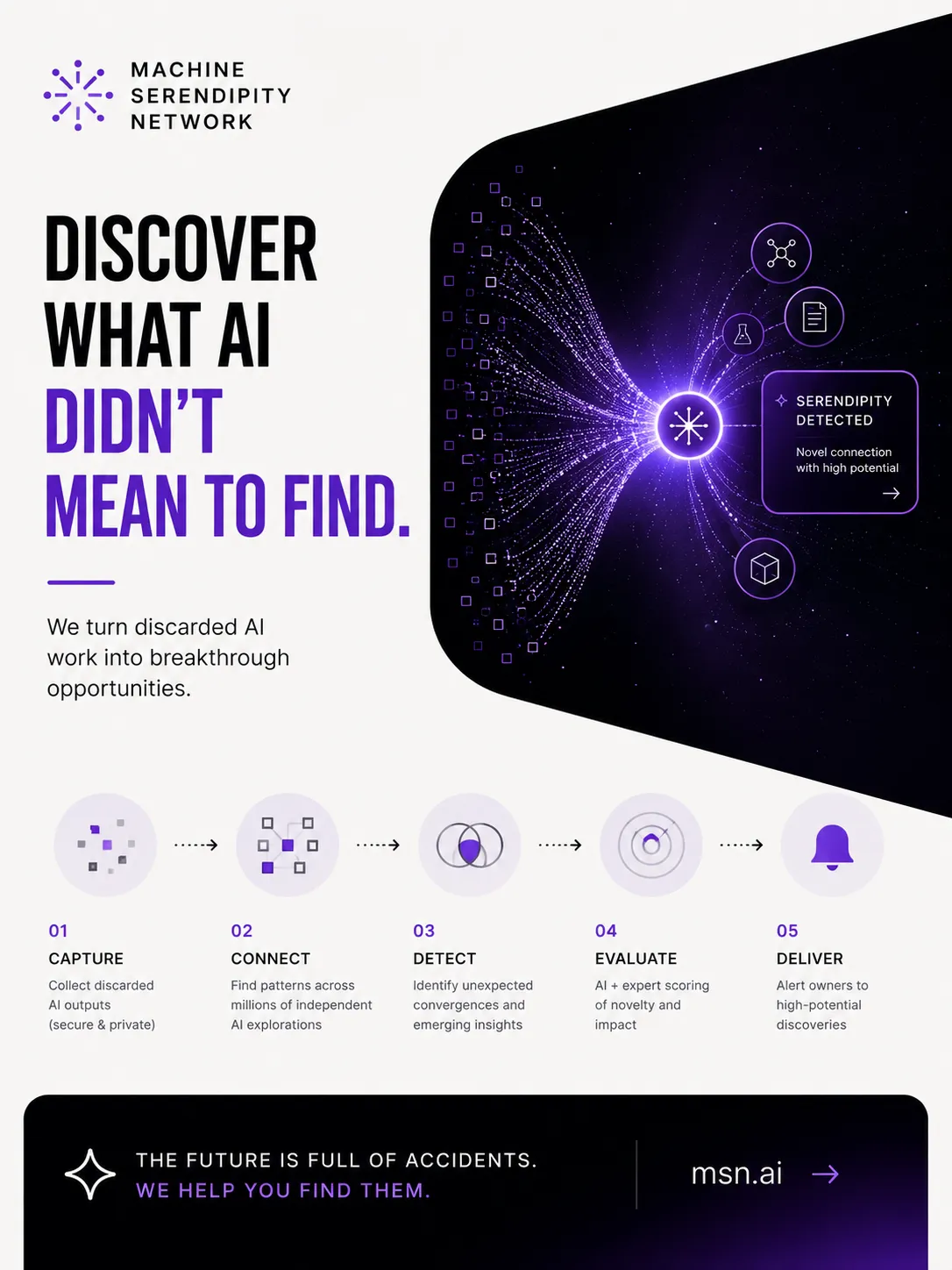
AI agents will increasingly perform millions of experiments, analyses and research tasks, but their most valuable output may occasionally be something they weren't looking for. Machine Serendipity Network would watch the discarded branches of authorized AI work—not merely final answers—and search across organizations for independently generated fragments that become significant when combined. One chemistry agent might discard an unusual molecular interaction, another materials agent might encounter the same mechanism, and a third patent agent might reveal that nobody has commercialized it. Individually they're failures; together they may constitute a discovery. The system would privately fingerprint these fragments, detect unexpected convergence and alert their owners without exposing underlying proprietary work. AI dramatically increases deliberate discovery; Machine Serendipity would create infrastructure for industrialized accidental discovery.
Description
No additional description provided.
The Pitch
The amount of “almost useful” knowledge created by AI systems may soon exceed the amount of useful knowledge humans can review. Today, failed experiments, abandoned hypotheses, low-confidence outputs, and strange intermediate results mostly disappear because they are not worth curating one by one. But at machine scale, waste changes character. A discarded branch is not just an error; it is a weak signal whose value may only appear when another system, somewhere else, fails in a similar way.
The most interesting business insight is that serendipity is usually trapped inside institutional boundaries. Companies already own fragments of discoveries, but they cannot safely expose them, and they often lack the context to know which fragments matter. A network that can compare fingerprints without revealing substance turns private dead ends into shared optionality. It creates a new category between secrecy and publication: a way to learn that something you possess may be important without giving away what it is.
The value would compound because coincidence becomes more meaningful as participation grows. One discarded observation is noise; the same pattern appearing in unrelated domains, generated by different models and workflows, is evidence. The network is not simply searching a database. It is detecting independent convergence, which is one of the strongest clues that an overlooked phenomenon is real. That makes the business less like a research tool and more like a market for hidden adjacency.
There is also a structural reason this belongs outside any single company. The best matches will often be between organizations that would never know to talk to each other: pharmaceuticals and battery materials, aerospace and protein design, chip manufacturing and climate modeling. Each participant has local expertise but incomplete vision. The intermediary’s defensibility comes from seeing across these blind spots while preserving enough privacy that serious institutions can participate.
If AI makes intentional research cheaper, then the scarce thing becomes not computation but attention to anomalies. The companies that benefit most from AI may not be the ones that run the most agents, but the ones that best capture what their agents accidentally notice. A business that turns machine exhaust into a discovery layer would sit on top of an expanding universe of automated work, harvesting value from what everyone else is trained to ignore.