AI Product Ownership Lifecycle Manager
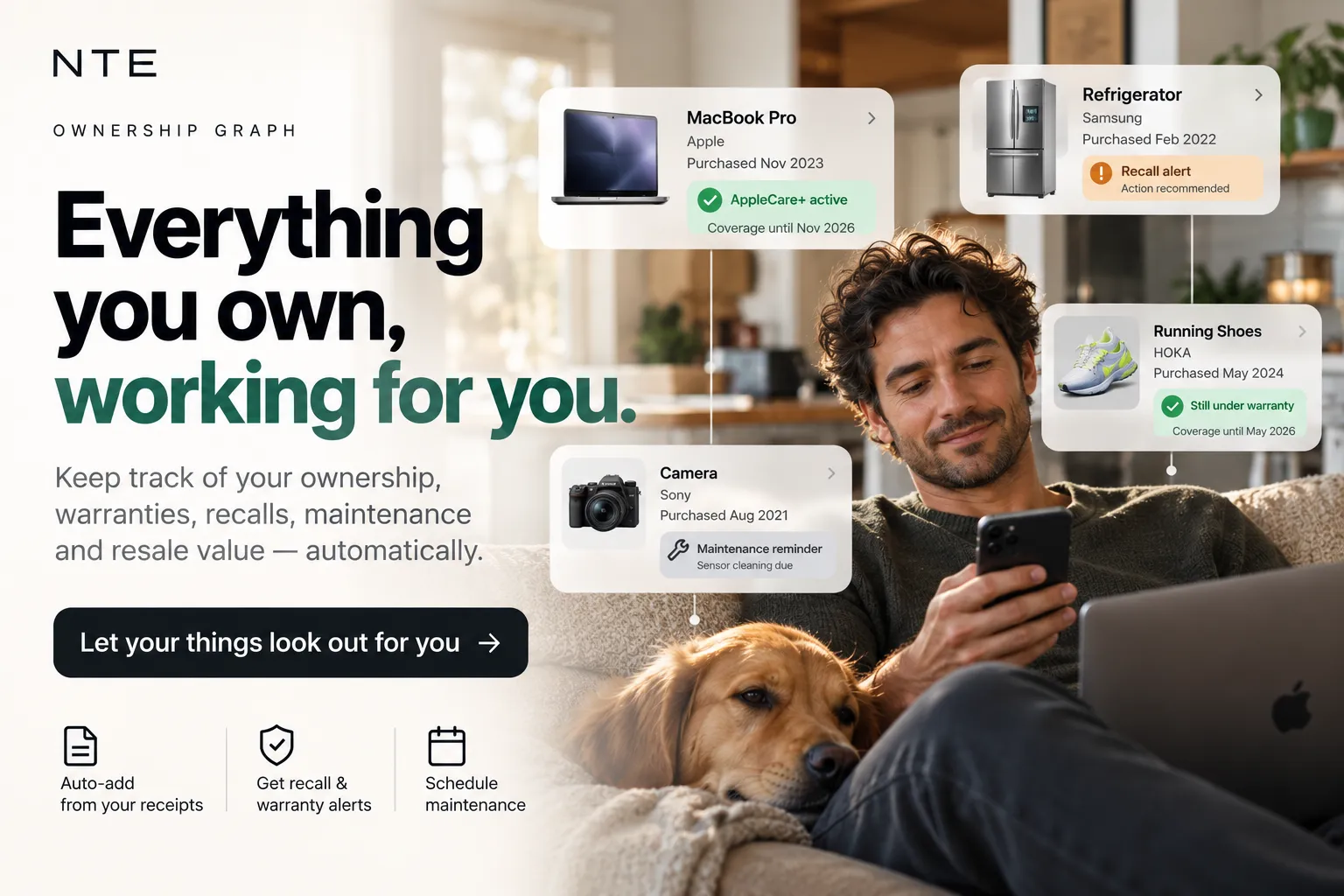
People own thousands of dollars of products, but the record of what they own is scattered across email receipts, retailer accounts, credit cards, warranty registrations, manuals, and old boxes. As a result, warranties expire unused, recalls get missed, maintenance does not happen, resale value disappears, and replacing or repairing something means reconstructing its history from scratch. Someone should build a user-owned graph of everything a person owns and give an AI agent permission to manage the lifecycle of those things automatically: register warranties, monitor recalls, schedule maintenance, file claims, find replacement parts, price resale, and know when replacement makes more sense than repair. Receipt extraction and agents make this possible without forcing people to manually catalog their homes. A dishwasher purchase could automatically create an ownership record, retain the receipt and model number, detect a recall three years later, and arrange covered service before the warranty expires.
Description
No additional description provided.
The Pitch
Ownership is one of the largest unmanaged categories in consumer life. People have become disciplined about tracking money, health, travel, and work, but the physical objects they depend on remain mostly invisible after purchase. The strange thing is that these objects are not trivial: appliances, electronics, furniture, tools, bicycles, cars, medical devices, and home systems often represent tens or hundreds of thousands of dollars of household capital. Yet once bought, they fall out of the software layer almost completely. A company that turns possessions into a living record would make ownership legible for the first time.
The business works because the pain is episodic but the value is cumulative. Nobody wakes up wanting to “manage their belongings,” but everyone eventually faces the moment when a serial number, receipt, warranty term, filter size, recall notice, or proof of purchase suddenly matters. The product becomes more valuable precisely because it was quietly accumulating context before the user needed it. That is a rare consumer pattern: low daily attention, high trust, and sharp moments of gratitude.
There is also an unusual alignment between consumers, manufacturers, insurers, repair networks, and resale marketplaces. Most consumer data businesses depend on attention or advertising; this one could be built around making the object’s lifecycle more efficient. A verified ownership record reduces fraud in claims, improves recall completion, makes repairs easier, and increases resale confidence. The same data that helps a person avoid losing value also helps counterparties transact with less uncertainty. The asset graph becomes more useful as proof, not just as memory.
The deeper insight is that ownership is becoming too complex for humans to administer manually. Products are more connected, warranties are more conditional, repair is more specialized, and resale markets care more about provenance. Meanwhile, households are aging into stacks of devices with different apps, accounts, parts, batteries, subscriptions, and service intervals. The burden is not knowing what to do once; it is remembering at the right time, with the right evidence, across years.
If this company existed at scale, it would occupy a quiet but durable position: the trusted system of record between purchase and disposal. Retailers know what was bought, manufacturers know what they made, and marketplaces know what something might be worth. But the person is the only party whose interest spans the full life of the object. Software built around that perspective would not merely organize possessions; it would make ownership itself work better.