AI Platform for Preserving Institutional Knowledge
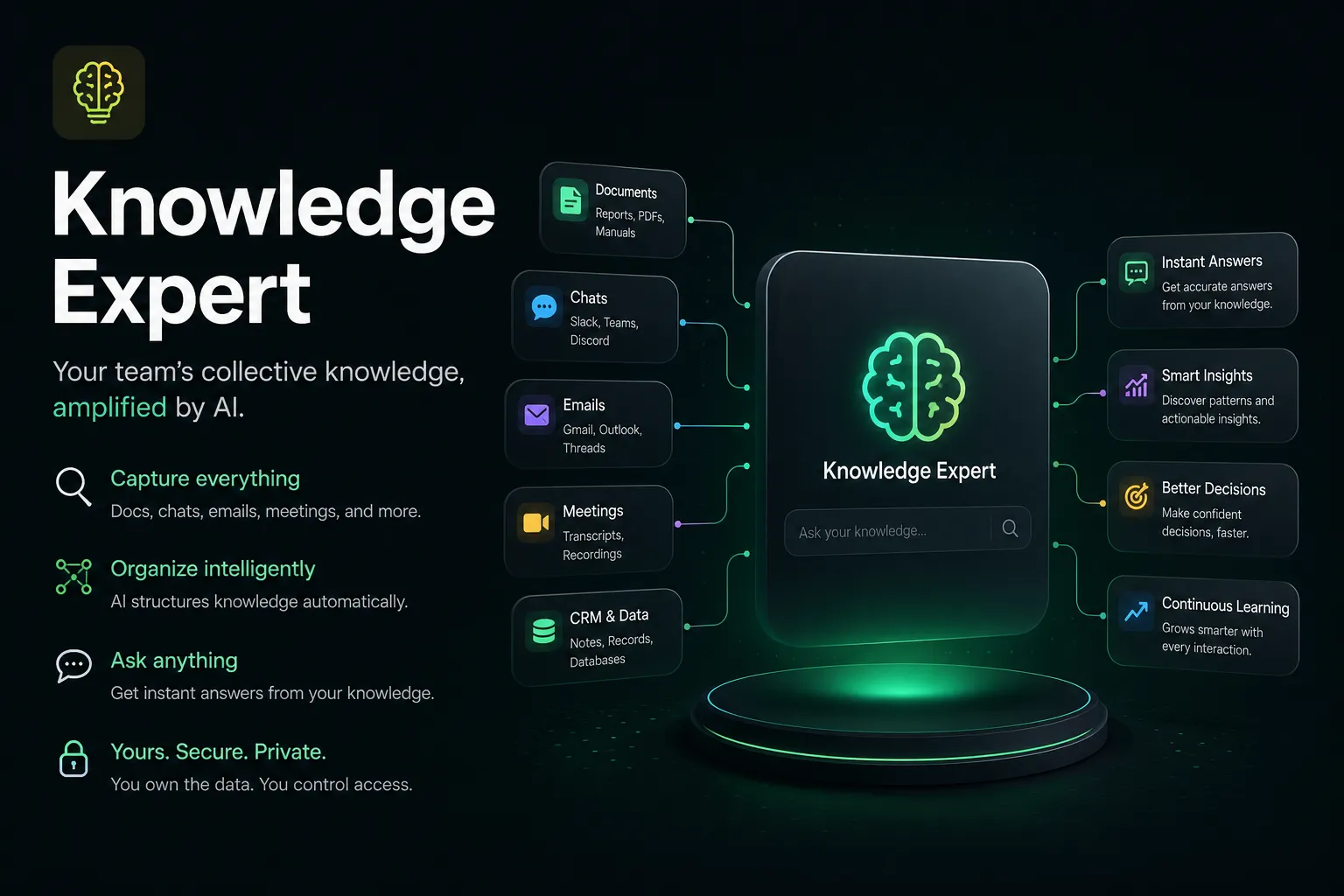
Every time an experienced employee leaves a company, years of institutional knowledge disappear with them. Businesses spend millions documenting processes, yet the most valuable information lives inside conversations, habits, and experience that rarely make it into manuals. This platform continuously learns from meetings, documents, workflows, emails, and employee interactions to build a living AI that captures organizational intelligence before it’s lost. Instead of replacing employees, it preserves what they know forever. With AI now capable of understanding context across thousands of information sources and organizations increasingly concerned about retiring workforces and turnover, the timing is ideal. Imagine a manufacturing company losing its operations director after 25 years, but instead of losing decades of expertise, every future employee can simply ask the company’s AI exactly how that person would have solved the problem.
Description
No additional description provided.
The Pitch
Most firms are not actually short on information; they are short on memory. The strange thing about modern organizations is that they record more than ever while remembering less than ever. Files multiply, chats scroll away, meetings vanish into transcripts, and the practical judgment that makes work succeed remains trapped in the people who have repeated a task hundreds of times. The opportunity is not to create another repository, but to turn the residue of daily work into something closer to organizational recall.
The most valuable knowledge inside a company is often not the official answer, but the exception to the official answer. Manuals describe the process when everything goes right; experienced employees know what to do when a supplier misses a shipment, a key customer threatens to churn, a machine sounds slightly wrong, or a regulator asks the question in an unusual way. That edge-case knowledge is hard to document because it does not feel like knowledge to the person who has it. It feels like common sense. A system that can notice those patterns while work is happening would capture the part of expertise companies usually discover only after it is gone.
This would also change the economics of tenure. Today, long-serving employees create enormous hidden value, but much of it is rented rather than owned by the organization. When they leave, the company often pays twice: once in disruption, and again in the time required for successors to relearn the same lessons. If institutional intelligence became durable, every senior employee would leave behind an appreciating asset rather than a vacuum. The business would make retention and succession less binary: even when people move on, their accumulated judgment remains part of the operating fabric.
The deeper insight is that organizational knowledge has been treated as static content, when it is really a living pattern of decisions. Companies do not need better binders; they need a way to ask, “How do we handle this here?” and receive an answer grounded in how the organization has actually behaved. That makes the product valuable not just during departures, but in everyday ambiguity, where the cost of not knowing is slow decisions, repeated mistakes, and unnecessary dependence on a few overloaded experts.
The companies that would care most are likely the ones where mistakes are expensive and expertise compounds slowly. In those environments, the difference between a novice and a veteran is not raw intelligence but thousands of remembered situations. Capturing that difference could make an organization less fragile, less forgetful, and less dependent on heroic individuals to keep the place running.