AI Platform for Company Naming Decisions
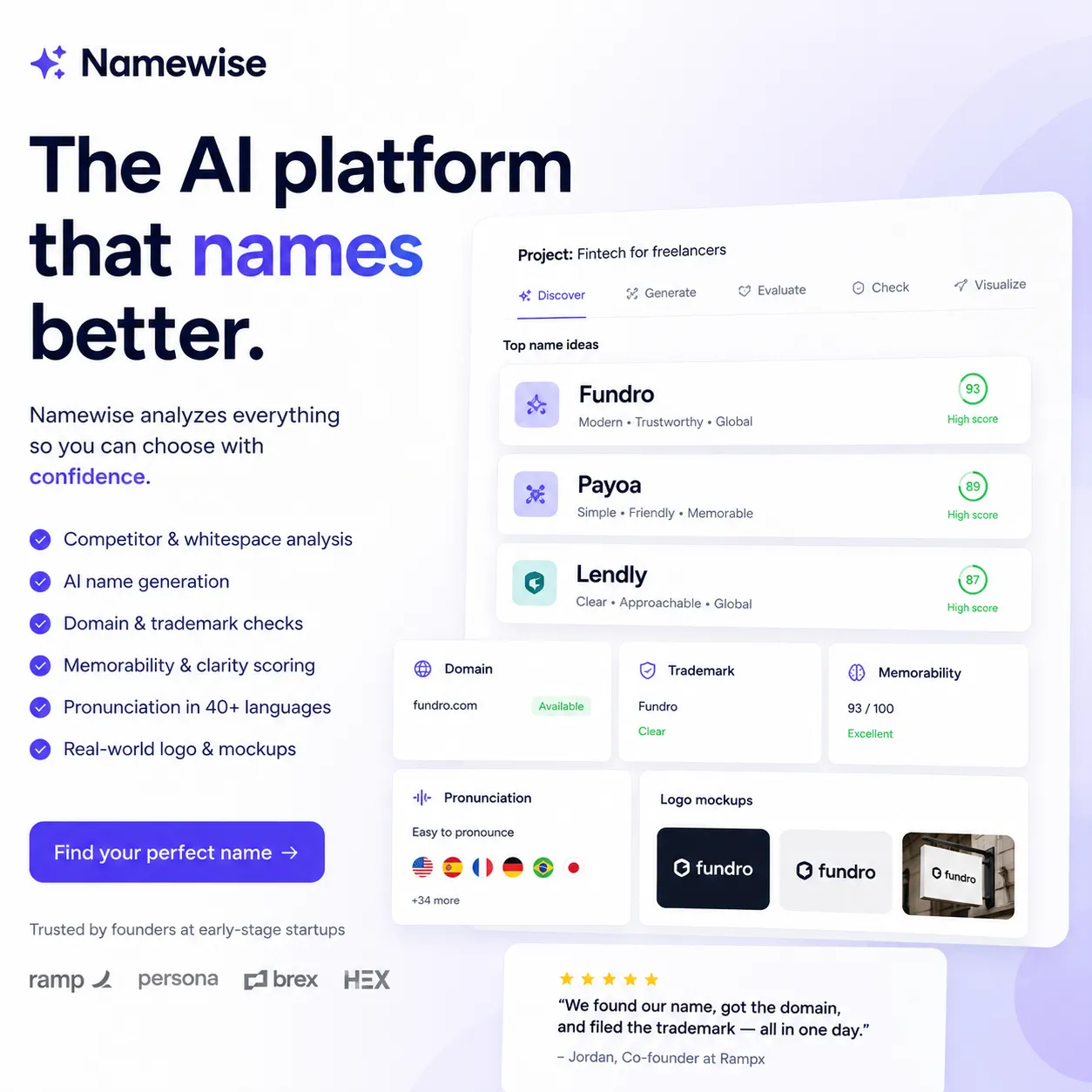
Naming a company is still surprisingly manual. Founders bounce ideas around in Slack, ask ChatGPT for lists of names, search domain registrars, check trademarks, and rely on gut instinct to make one of the most important branding decisions they'll ever make. Imagine an AI platform that manages the entire process: analyzing competitors, identifying whitespace, generating names, checking trademarks and domains, predicting memorability, testing pronunciation across languages, and even creating mockups so founders can see each name in the real world before deciding. As AI becomes better at understanding language, branding, and consumer psychology, naming should become a structured design process instead of an expensive guessing game.
Description
No additional description provided.
The Pitch
A company name is one of the few business decisions that is both emotionally charged and mechanically checkable. People treat it like poetry, but much of the risk is administrative, linguistic, and competitive: is it already taken, does it sound like something else, does it travel poorly, does it create the right category expectation, does it look serious on a product page or ridiculous in an email subject line. The compelling business is not “AI generates clever words.” It is that naming sits at the intersection of taste and verification, where software can remove a surprising amount of anxiety without pretending to replace judgment.
The hidden pain is that naming becomes expensive precisely when founders are least equipped to evaluate it. Early teams have no brand memory, no customer research base, and no tolerance for a mistake that later requires legal cleanup, domain negotiation, or a painful rebrand. The current process rewards confidence over evidence: the loudest opinion in the room often wins because there is no shared system for comparing options. A structured tool could become valuable by making names discussable rather than mystical, turning “I don’t like it” into sharper questions about distinctiveness, recall, legal risk, tone, and future category fit.
There is also an unusual data advantage here because naming quality is easier to observe after the fact than most creative work. Some names survive, spread, and acquire meaning; others remain hard to spell, hard to remember, or constantly confused with competitors. Over time, a system that studies real naming outcomes could learn patterns that human brainstorms miss: when invented words feel premium versus empty, when literal names help distribution, when brevity hurts clarity, and when a name’s apparent weirdness is actually an asset. That makes the product less like a thesaurus and more like a decision engine for a narrow but consequential creative act.
The best version would sell confidence, not names. Founders are rarely short on possible names; they are short on conviction that they are not walking into an avoidable trap. The business works if it becomes the place where a name stops being a vibe and becomes a tested object. That is a small surface area, but an important one: every new company, product, fund, app, newsletter, studio, and AI agent needs a name, and the cost of choosing badly compounds for years.