AI Personal Life Timeline and Insights App
Your digital life is scattered across emails, photos, calendars, browser tabs, messages, documents, and thousands of moments you'll never remember again. Imagine an AI that quietly builds a searchable timeline of your entire life, helping you answer questions like "When was I happiest?", "How has my thinking changed?", or "What patterns led to my biggest successes?" Instead of storing your memories across dozens of disconnected apps, it continuously learns from them, revealing trends and insights you'd never notice yourself. As AI becomes capable of understanding years of personal data, your digital history can become a source of wisdom instead of forgotten storage.
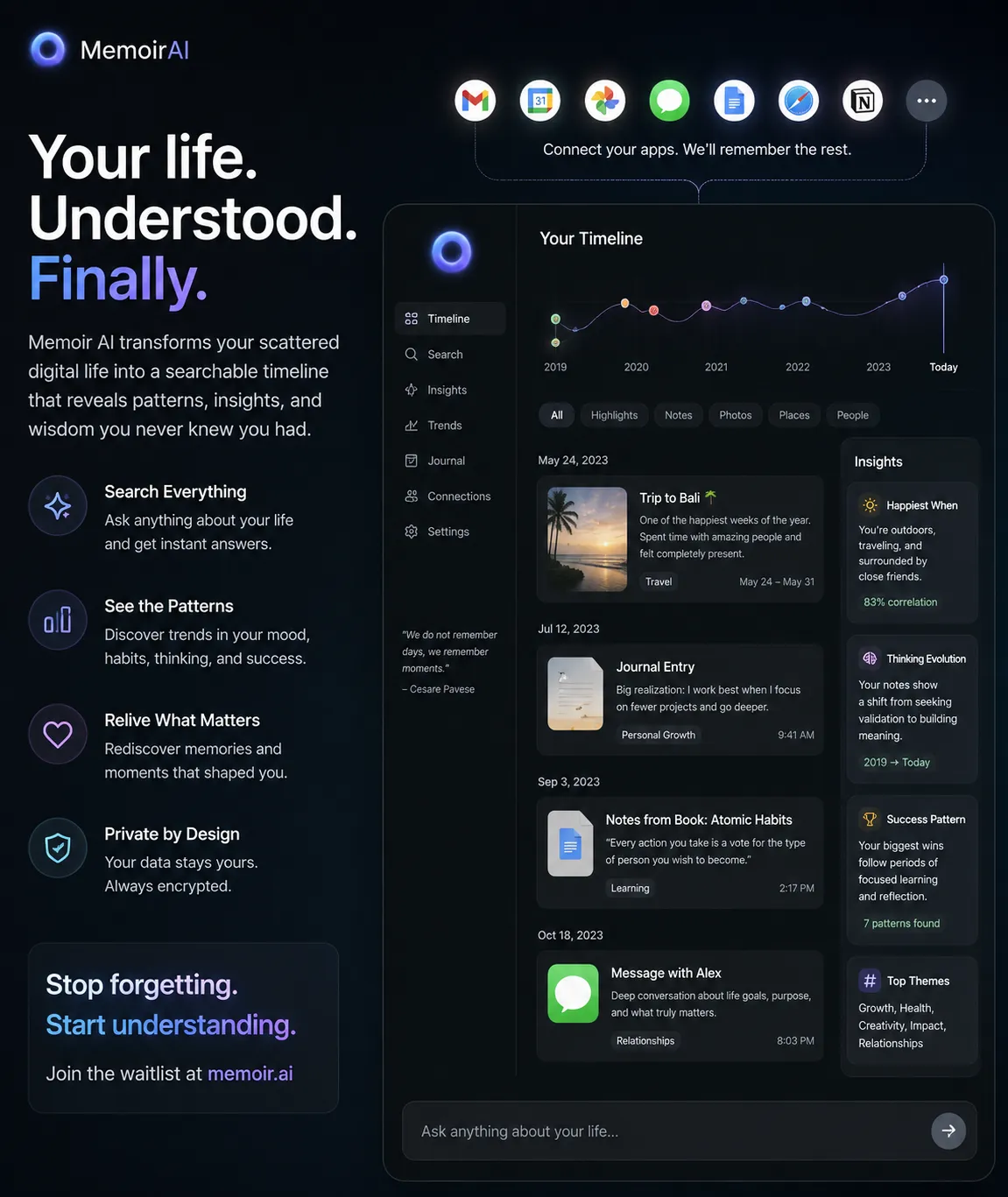
Description
No additional description provided.
The Pitch
People already produce the raw material every day, but almost none of it compounds. A photo from 2017, a note from a difficult week, a calendar packed with meetings, and an old conversation with a friend each contain signal, but they are trapped in formats designed for retrieval, not reflection. Search can find an artifact you remember exists. The deeper opportunity is in surfacing the meaning of artifacts you forgot you created.
The product would sit in an unusual emotional category: part archive, part mirror. Most software helps users do something faster; this would help them understand what their life has been becoming. That is a much rarer and stickier relationship. A person may switch task managers, photo apps, or note tools, but they are less likely to abandon the one place that has learned the shape of their relationships, seasons, ambitions, regrets, and recurring patterns over many years. The value increases precisely because time passes.
There is also a quiet asymmetry between how much people care about their lives in retrospect and how poorly existing tools serve that desire. We make albums after trips, journals during crises, and annual recaps when platforms generate them for us, but these are crude summaries of a much richer dataset. The popularity of “year in review” products hints at something larger: people are hungry for narrative coherence. They want evidence that their days add up to something legible.
If it worked, the business would benefit from becoming a personal data layer that is emotionally difficult to replace. The defensibility would not come merely from storing information, but from accumulating context: knowing that a certain city mattered because of who was there, that a job looked successful but coincided with exhaustion, that a friendship faded gradually before the user noticed. Those interpretations are not easily portable, because they depend on long-term memory and intimate calibration.
The most interesting version is not a productivity assistant but a wisdom interface. The market is crowded with tools that optimize the present tense. Far fewer help people learn from the long arc of their own behavior. In a culture that records everything but remembers surprisingly little, a company that turns private digital exhaust into self-knowledge could become one of the few technologies that feels more valuable with age.