AI Peer Accountability Groups for Career Growth
The biggest predictor of your career often isn't your mentor—it's the five people growing alongside you. Yet most peer groups start as group chats and slowly die. Imagine an AI operating system that forms small cohorts around a shared goal, schedules weekly discussions, summarizes lessons, identifies who can help whom, surfaces introductions, and keeps everyone accountable for years. Rather than another community with thousands of passive members, it becomes an AI-powered board of directors for your career that grows smarter as every member progresses. That's a product that needs to exist.
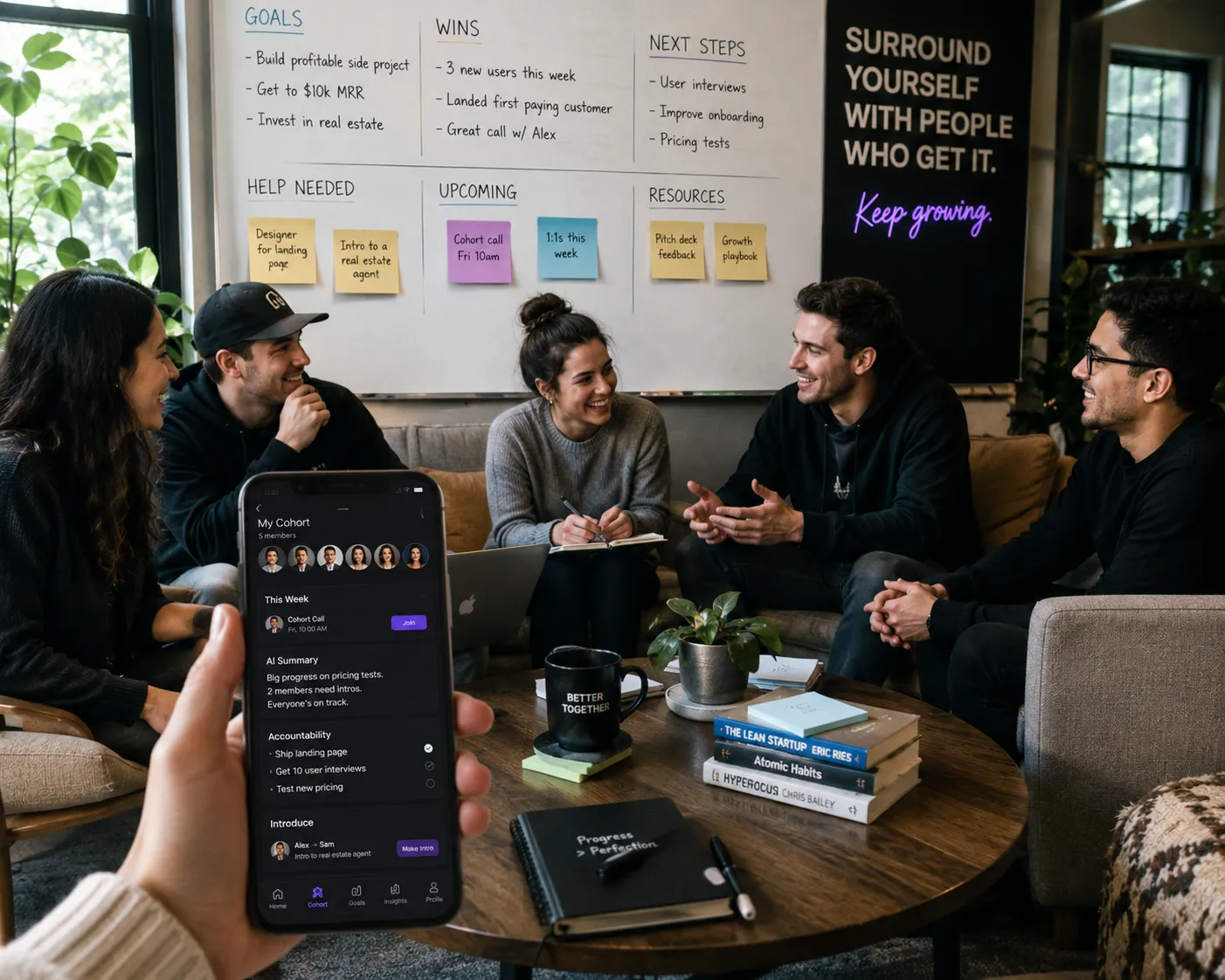
Description
No additional description provided.
The Pitch
Peer groups value is usually highest when the structure is least visible. A great cohort does not feel like a product; it feels like a small circle of people who somehow keep showing up at the right moments. The business opportunity is in turning that hidden coordination into infrastructure: remembering what each person is trying to do, noticing when someone’s experience becomes useful to another member, and making the group feel naturally helpful without relying on one heroic organizer.
Most professional networks are optimized for reach, but career progress is often driven by repeated context. A stranger can make an introduction; a peer who has watched your thinking evolve can challenge your assumptions, call out patterns, and notice opportunities you are too close to see. That kind of compounding relationship is difficult to manufacture at scale, which is exactly why it is valuable. A product that preserves shared memory across years could make a small group more useful over time rather than more stale.
The best business version would not compete with large communities; it would be the antidote to them. Online communities tend to decay because attention fragments, status games take over, and most members never become legible to one another. Small cohorts solve the intimacy problem but usually fail from administrative neglect. If software can absorb the boring work of facilitation while leaving the human trust intact, it creates a format that feels both personal and durable.
There is also a strong timing advantage: careers have become less institutionally managed. Companies no longer provide a reliable path, professional associations feel dated, and public social networks reward performance more than reflection. Ambitious people still need a place to process decisions, compare notes, and borrow judgment from near-peers. The absence of a modern “career institution” creates room for something smaller, more adaptive, and more private to become the default.
The deepest defensibility would come from longitudinal context. A résumé shows outcomes, but a peer operating system would know the decisions, doubts, tradeoffs, and inflection points behind them. Over time, that memory becomes a map of how people actually grow. The company would not just host conversations; it would accumulate a rare dataset about professional development as it happens, making every cohort better at helping its members navigate the next turn.