AI-Native Services for Professional Firms
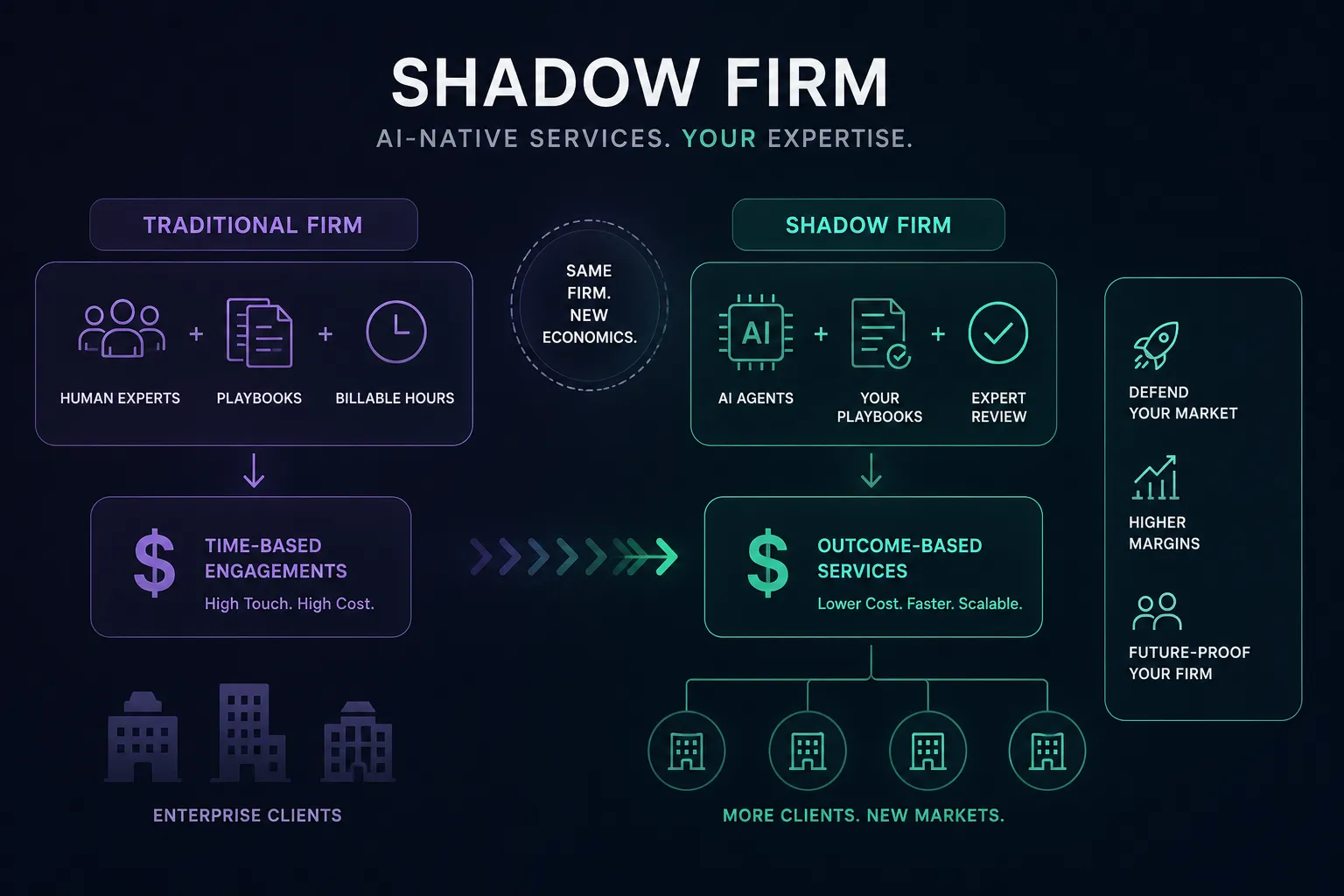
Professional-services firms know AI can automate much of the work they currently bill humans by the hour to perform, but adopting it aggressively risks destroying their own economics. Shadow Firm would let an accounting, legal, consulting, or agency business spin up an AI-native version of itself using its existing playbooks, templates, historical work, and expert review rules, then sell that service on fixed-price or outcome-based economics. As startups use AI to undercut incumbents, established firms need a way to cannibalize themselves before someone else does. A $200 million accounting firm could launch a $5,000 automated diligence product next to its $75,000 traditional engagement and serve customers it would otherwise lose.
Description
No additional description provided.
The Pitch
Shadow Firm treats self-disruption as an organizational design problem, not a technology adoption problem. Professional-services firms do not mainly lack access to AI tools; they lack a safe container for a different business model. Their existing partnership structures, utilization metrics, staffing ladders, and client expectations are built around expensive human time. An AI-native service cannot simply be inserted into that machine without making everyone fear it is dissolving the machine. A separate shadow version gives the firm a place where the new economics are not seen as a bug.
The hidden asset inside these firms is not just expertise, but repeatability disguised as bespoke work. Every serious services business has accumulated patterns: clauses it reuses, diligence checklists it trusts, memos that follow an implicit structure, judgment calls that partners make over and over. Much of this is too contextual to become generic software, but too systematic to remain purely artisanal. Shadow Firm would turn institutional habit into a product without requiring the firm to pretend that its work was simple all along.
This becomes especially interesting because the strongest incumbents are also the most vulnerable to focused AI entrants. Their brands signal trust, but their cost structures make them slow to offer cheaper, narrower, faster versions of their own services. A new AI-first competitor can win by selling a limited answer with confidence, while the incumbent is still defending the comprehensiveness of the traditional engagement. Shadow Firm would let the incumbent use its reputation at the exact moment when the market begins separating “I need the full white-glove process” from “I need a good-enough professional answer by Friday.”
The business also changes the psychology of cannibalization. Firms are often willing to lose low-end or smaller clients in theory, but in practice those clients are training grounds, relationship seeds, and future revenue. If the firm does not create the cheaper version, the client relationship migrates elsewhere, and the incumbent loses not only the initial work but the data, context, and habit loop around that customer. A shadow service preserves the relationship while allowing the delivery model to shrink.
The deeper thesis is that AI will not eliminate professional services evenly; it will split them into judgment, trust, and production. Firms that own the first two should not be structurally trapped in charging for the third. A company that helps them separate those layers could become the migration path from hours sold to expertise scaled.