AI Model Specialization Portability Platform
Companies can now customize open-weight AI models with proprietary data and specialized behavior, but that intelligence is often stuck to the specific base model it was trained on. Build a portability layer that preserves the training data, adapters, evals, behavioral rules, and tuning setup behind a specialized model, then automatically recreates and validates that specialization on newer models as they appear. This matters now because open-weight competition is accelerating, making it increasingly likely that a better or cheaper base model will arrive long before an enterprise wants to rebuild its AI stack from scratch. Imagine a company moving from a two-year-old Mistral model to a newer open model and keeping the same compliance behavior, domain expertise, and task performance without starting the fine-tuning process over. That's a product that needs to exist.
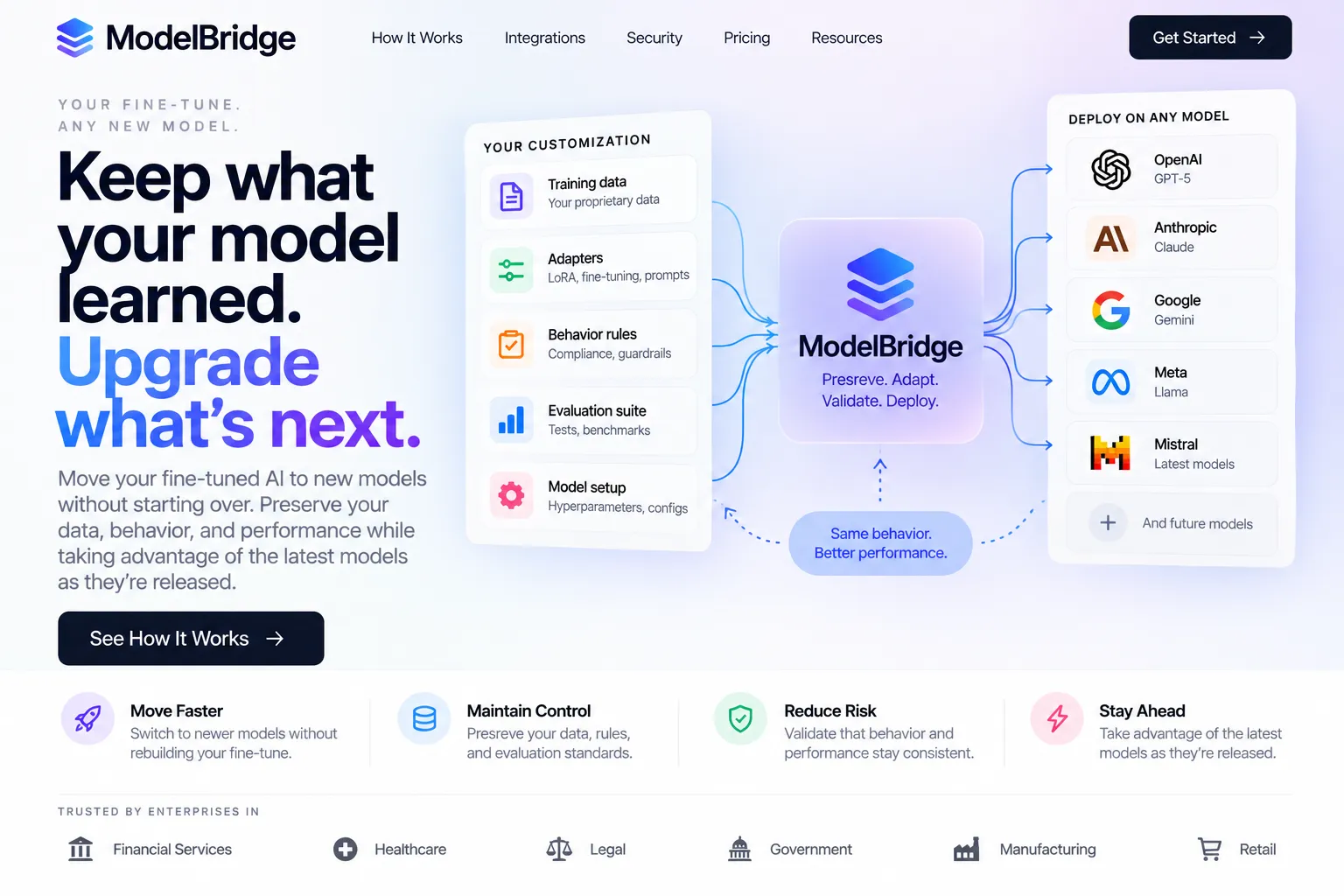
Description
No additional description provided.
The Pitch
The interesting business here is not really model migration; it is institutional memory for machine intelligence. As companies teach models their terminology, policies, edge cases, tone, workflows, and taboos, they are creating a new kind of operational asset. Today that asset is oddly fragile: part dataset, part prompt stack, part adapter, part eval suite, part tribal knowledge held by the team that tuned it. A portability layer turns that scattered knowledge into something durable, inspectable, and re-instantiable.
The strongest pull is that enterprises do not want to bet their proprietary intelligence on the half-life of any single model family. In normal software, infrastructure choices can be abstracted over time; in AI, the “application” and the “runtime” are often fused together. That creates a quiet form of lock-in even when the model weights are open. The company that breaks this fusion gives buyers something more valuable than flexibility: it lets them treat base models as replaceable compute substrates while their real differentiation stays theirs.
There is also a measurement wedge that could make the product unusually sticky. The hard part of moving between models is not copying behavior, but knowing whether the copied behavior is still correct. If the portability layer owns the evals, regression tests, failure cases, and acceptance thresholds, it becomes the system of record for what “good” means inside that company. Over time, that definition is more defensible than any single tuning technique, because it accumulates every painful lesson from production.
This could become more important as models improve, not less. Better base models will create pressure to upgrade constantly, but each upgrade will threaten existing compliance guarantees and business-specific behavior. The faster the model market moves, the more valuable it becomes to have a stable layer above it. Volatility underneath creates demand for continuity above.
The non-obvious prize is that this business would sit at the boundary between AI vendor management and knowledge management. It would help companies avoid relearning themselves every time the model landscape changes. In a world where intelligence becomes cheaper and more abundant, the scarce thing may be the carefully encoded understanding of how a particular organization wants intelligence to behave.