AI Model Risk Assessment for Startups
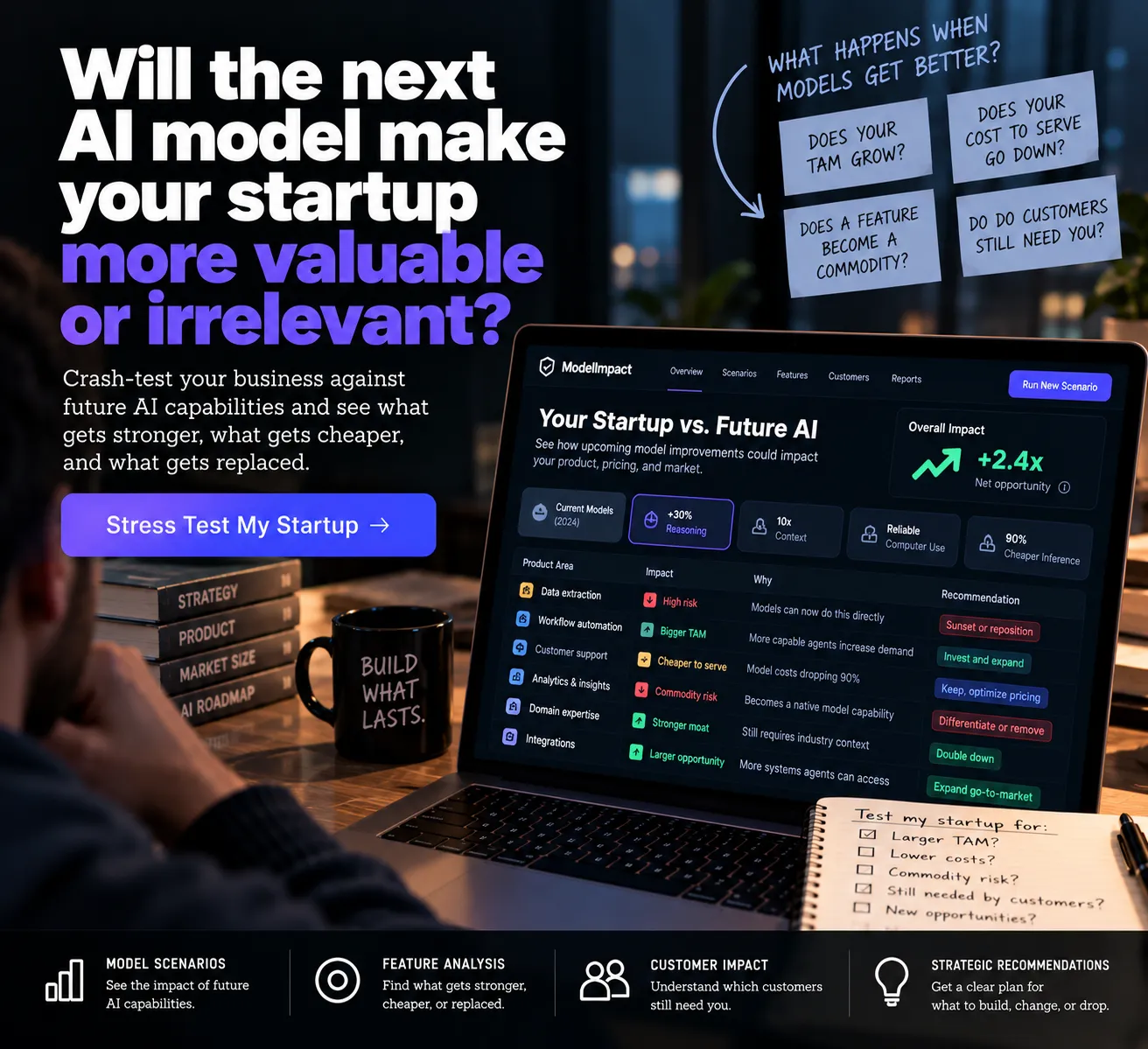
A lot of AI startups exist because today's models cannot quite do what customers need, which means every major model release could either expand the company’s opportunity or quietly erase it. Build software that continuously tests a startup against improving AI capabilities and shows which parts of the business become more valuable, cheaper to deliver, or completely unnecessary as models improve. Founders could connect their workflows, customer jobs, and product features, then simulate changes like better reasoning, unlimited context, reliable computer use, or dramatically cheaper inference. This becomes useful now because model capability is improving fast enough that a startup's competitive position can change between fundraising rounds, while founders still mostly evaluate that risk with intuition. Imagine a founder discovering that the next model release will commoditize three paid features but make a fourth workflow ten times more powerful and open a market five times larger.
Description
No additional description provided.
The Pitch
Most companies can measure churn, usage, revenue, and cost, but they cannot measure their dependency on model weakness. That is a strange blind spot: for an AI company, the most important external force is not merely customer demand or competition, but the slope of capability improvement underneath the product.
The interesting insight is that “AI risk” is not one thing. A better model can destroy a feature, strengthen a workflow, reduce delivery cost, collapse a services layer, or make a previously impossible customer promise viable. Two startups using the same underlying model can be affected in opposite ways by the same release. The company that understands this could turn model progress from a vague existential anxiety into a map of where value is migrating.
This would be especially useful because AI startups often mistake temporary scaffolding for durable advantage. Human review, prompt chains, narrow evaluations, custom routing, and workflow constraints can look like product depth when models are weak. But some of that complexity is really a debt that disappears when the base model improves. A business that helps founders distinguish “we built something customers love” from “we built around a temporary model defect” would provide a form of clarity that is hard to get from normal analytics.
The enduring value may come from accumulating a comparative dataset of how real workflows respond to model changes. Public benchmarks are too abstract; they rarely answer whether a specific sales assistant, legal drafting flow, clinical intake process, or engineering agent becomes more defensible or less necessary. If the software could observe the relationship between capabilities and business functions across many companies, it could develop a practical sense of which kinds of product surfaces survive model progress and which are living on borrowed time.
The most compelling part is that this would reward a different kind of founder behavior. Instead of treating each model release as an unpredictable shock, companies could design around capability gradients: pushing harder where improvements expand the job to be done, and avoiding elaborate moats built on today’s limitations. In a market where the ground is moving, the advantage belongs not just to those who move fast, but to those who know which direction the ground itself is moving.