AI Model Provider Migration Continuity Platform
Businesses are switching AI model providers more often, but every switch risks breaking prompts, tool calls, structured outputs, evaluations, and production workflows that were tuned around the old provider. Build a continuity layer that keeps every important AI workflow continuously portable across multiple model vendors by maintaining equivalent prompts, adapters, evals, fallback configurations, and tested cutover paths, so a company can change providers without rebuilding its stack under pressure. This matters now because models are becoming more interchangeable while pricing, performance, policies, and availability can change quickly, making vendor lock-in increasingly dangerous. Imagine an enterprise running primarily on Anthropic while knowing its OpenAI fallback is already tested, 97% migration-ready, and capable of taking over immediately if costs spike or service changes.
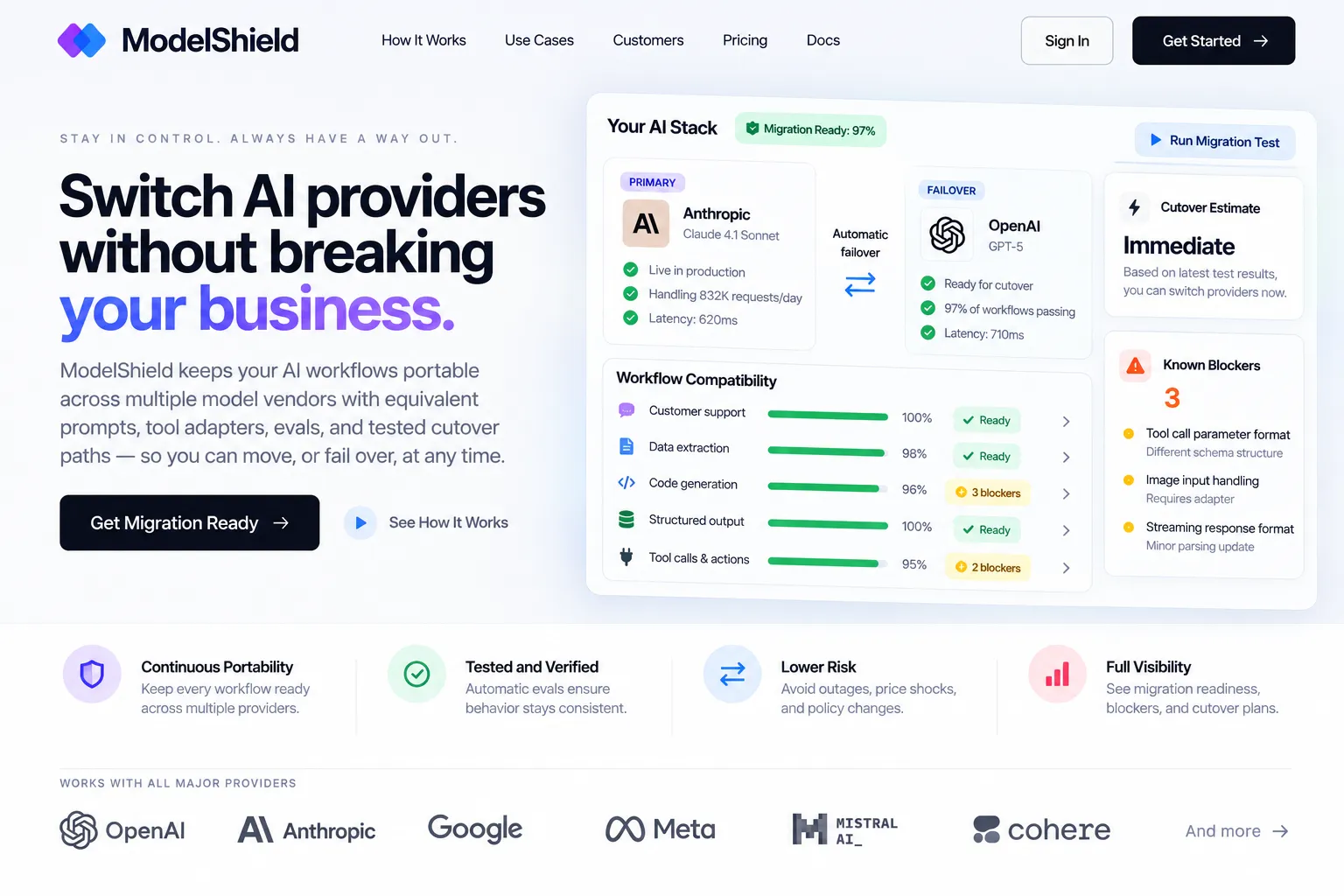
Description
No additional description provided.
The Pitch
Insurance against semantic dependency. Once a company puts a model into production, the dependency is rarely just an API call. It is a bundle of undocumented assumptions: how verbose the model is, how it interprets ambiguous instructions, how faithfully it emits JSON, when it refuses, how it chooses tools, and which mistakes humans have quietly learned to tolerate. That hidden coupling becomes part of the company’s operating system. A continuity layer would make that coupling visible, measured, and portable.
The most interesting truth is that AI lock-in will not look like cloud lock-in. In cloud, the pain is migrating databases, storage, and infrastructure. In AI, the pain is that two models can accept the same prompt and both be “working” while producing subtly different business outcomes. The danger is not downtime; it is silent behavioral drift. A business that can prove equivalence across models would sell something more valuable than uptime: confidence that the same workflow still means the same thing after the underlying intelligence changes.
This also becomes more valuable as models improve, not less. If model quality converges, buyers will want the freedom to treat providers as interchangeable commodities. But the last mile of production behavior will remain stubbornly specific. The companies that win from model commoditization may not be the model vendors, but the firms that make switching safe enough for customers to actually exercise their leverage.
There is also a strong asymmetry in willingness to pay. Most of the time, portability feels like hygiene. But when a provider changes pricing, deprecates a model, suffers an outage, weakens performance, alters policy behavior, or loses internal approval, the ability to move quickly becomes extremely valuable. The buyer is not paying for a theoretical migration tool; they are paying to avoid negotiating, rebuilding, and revalidating while a critical workflow is exposed.
The enduring company would sit in the uncomfortable gap between benchmark scores and real-world reliability. Public evals say which model is generally better; enterprises need to know whether their invoice dispute agent, claims triage workflow, contract redliner, or support escalation system will behave acceptably on another model tomorrow morning. Owning that operational memory across vendors could become a durable control point, because the more workflows it observes and tests, the better it understands what “equivalent” really means in practice.