AI Model Provenance Registry
Companies increasingly deploy models that have been fine-tuned, distilled, merged, copied, and rebuilt from other models, making it difficult to know where the intelligence actually came from. Intelligence Title Registry would create a verifiable chain of custody for every deployed model, recording its base models, fine-tunes, training licenses, inherited restrictions, safety evaluations, and known vulnerabilities. As models become valuable corporate assets, buyers and regulators will need provenance in the same way property owners need clean title. A company acquiring an AI startup could instantly see that its flagship model was derived from restricted weights or inherited a known security flaw before the deal closes.
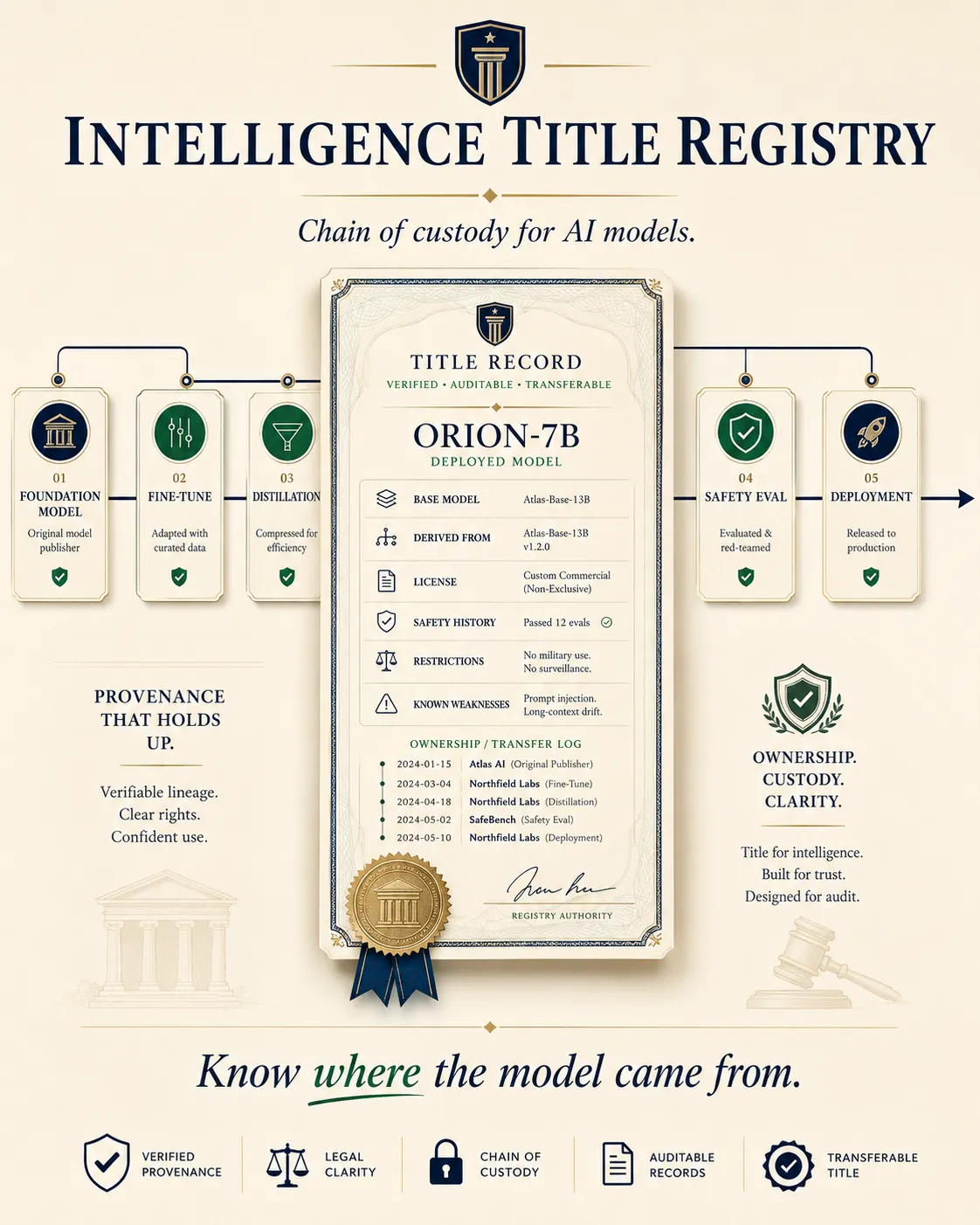
Description
No additional description provided.
The Pitch
A registry for model provenance becomes compelling because AI models are starting to behave less like software and more like financial instruments: they are composed, reworked, repackaged, and transferred many times before anyone relies on them. Traditional software due diligence asks whether the company owns its code; model due diligence has to ask a stranger question, which is whether the company truly owns the statistical behavior embedded inside the artifact. That is a harder thing to inspect after the fact, and the cost of being wrong can sit dormant until an acquisition, lawsuit, audit, or breach exposes it.
The non-obvious value is that provenance is not mainly about compliance paperwork. It is about making model quality legible in markets where the artifact itself is opaque. Two models may perform similarly on benchmarks, but one may carry inherited restrictions, contaminated training data, unpatched vulnerabilities, or obligations from an upstream license. Without title, those differences are invisible at the moment decisions are made. A registry turns hidden encumbrances into knowable attributes, which makes safer models more valuable and risky models harder to pass along unnoticed.
This also creates a rare kind of infrastructure business: one that becomes more useful as the ecosystem becomes more fragmented. The more models are fine-tuned internally, shared through open-weight communities, embedded in vendor products, and acquired through corporate transactions, the less any single party can reconstruct lineage from memory or documentation. A neutral system of record becomes attractive precisely because no participant can fully trust another participant’s spreadsheet. Once provenance is used in a few high-stakes transactions, the absence of it starts to look like a defect.
The business would also benefit from liability moving downstream. Today, many companies consume models as if upstream risk will remain upstream. But when AI systems make regulated decisions, leak data, or reproduce prohibited behavior, the deployer will be asked what it knew and what it should have known. A chain of custody gives companies a way to prove diligence, not just claim it. In industries where blame is expensive, evidence has its own market.
The deeper reason this company should exist is that intelligence is becoming transferable property before society has built the institutions that make property transferable safely. Land needed title systems because possession alone was not enough. Models may need the same because performance alone will not be enough.